


 Lions Logo PNG
The Lions’ logo symbolizes strength, resilience, and the Johannesburg rugby team’s determined style. Its simple, clear design emphasizes the club’s sporting identity and competitive spirit.
The Lions trace their history to 1889, when several Johannesburg clubs united under the Transvaal Rugby Union as the sport gained an organized structure in South Africa. That year, the team played its first official match against Griqualand West. Initially dressed in blue and white, it later adopted white jerseys with a red band, inspiring the Afrikaans nickname “Rooibontes,” or “Red Stripes.”
The club first played at Wanderers Stadium before moving to the newly built Ellis Park in 1928, where it remained through reconstructions. During the 1950s and 1960s, Transvaal regularly challenged for the Currie Cup, facing strong opposition from Western Province and Northern Transvaal, but major titles remained difficult to secure.
In 1993, captain Francois Pienaar led the side to its first Currie Cup in two decades. He later captained South Africa to victory over New Zealand in the 1995 World Cup final. Around the same period, Transvaal became the first South African team to win the international Super 10 tournament. Administrative changes in the late 1990s brought several renamings, eventually producing Golden Lions, while Lions remained the familiar professional identity.
Under coach Johan Ackermann, the club reached three consecutive Super Rugby finals in 2016, 2017 and 2018, losing each decider, with Crusaders among its main rivals. In 2021, the Lions entered the United Rugby Championship, joining a competition with teams from Ireland, Scotland, Wales, Italy and Argentina.
Meaning and History
What is Lions?
It is a professional rugby club based in Johannesburg, South Africa, competing in international championships that involve teams from South Africa and Europe. The club has won the prestigious Currie Cup on numerous occasions. In recent history, the team has reached the Super Rugby finals several times. Known for aggressive, high-speed play, the team regularly fields players who represent the national team.
1996 – 1998

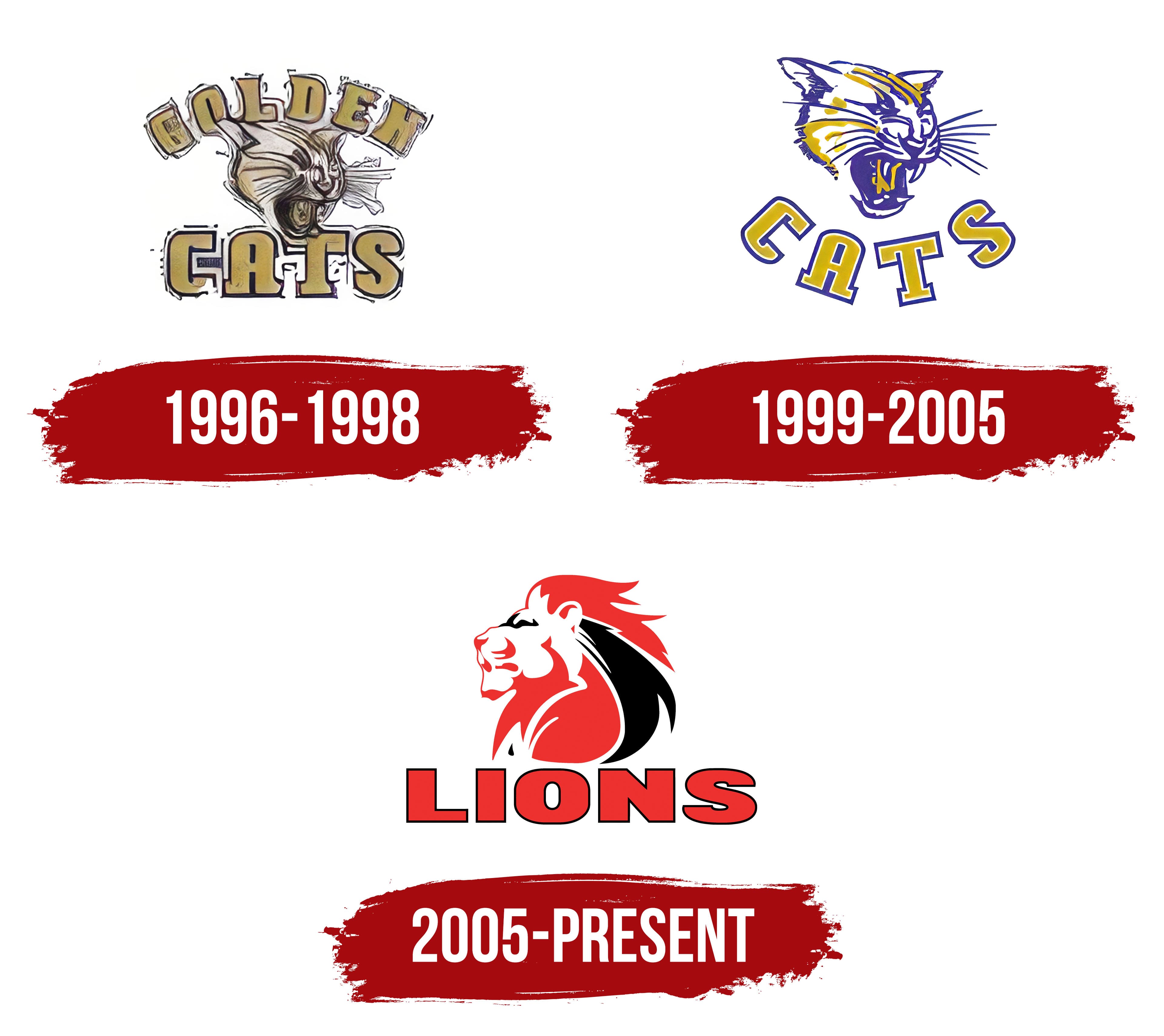
The logo of the Golden Cats rugby team, used since the franchise’s formation in the Super 12, features strong symbolism of aggression and readiness for battle. The centerpiece of the composition is a detailed cat’s head depicted in an aggressive pose. The wide-open mouth, clearly defined fangs, and pulled-back ears create the impression that the animal is actively engaged in a clash. This visually conveys the team’s wild and relentless sporting character, drawing a parallel to a predator’s behavior in confrontation with an opponent.
The color scheme combines a golden-gray tone for the animal’s head with additional shading and a subtle bluish outline, adding depth and dynamism to the image. The gold hue was deliberately chosen to align with the name “Golden Cats” and to symbolize the team’s power, status, and confidence.
The typography is uniquely styled and arranged in an arc both above and below the cat’s head. The letters are rendered in bold, three-dimensional forms, highlighted in gold and outlined in thick black, adding weight and strength to the design. The letterforms feature wide, heavy strokes, rounded corners, and somewhat rough contours, complementing the animal imagery and reinforcing the overall mood of aggression and physical power.
The choice of a cat as the team’s symbol reflects the merger of several provincial rugby unions, such as the Golden Lions, Leopards, and Pumas, whose identities are combined into a single image of a wild predator. This element symbolizes the unity and fighting spirit of the regions that have been brought together into the team.
The team was officially known as the Gauteng Lions, but its Super 12 branding as the Golden Cats highlighted the franchise’s unifying aspect.
1999 – 2005
Following a 1999 rebrand, the Cats rugby team introduced a refreshed visual identity featuring a striking depiction of a wild cat’s head. The new team emblem conveyed power, fighting spirit, and the athletic aggression characteristic of their style of play in the Super 12 tournament.
The animal’s head is depicted in a dynamic, aggressive pose, with an open mouth, fangs, and detailed whiskers. The color palette is based on a contrasting combination of purple and golden yellow. The main outline of the cat’s head is in deep purple, while the yellow elements highlight specific details such as stripes, eyes, and the inside of the mouth. This color treatment symbolizes energy, confidence, and ambition, helping the team stand out among competitors.
Below the illustration is an arched “CATS” inscription in a custom-designed typeface with unusual proportions and a mix of serif styles. The letters “C” and “S” have strict, angular shapes without serifs, while “A” and “T” feature heavy serifs, creating visual contrast and adding individuality to the typography. The letters are gold, framed by a double outline of white and purple that enhances the sense of depth and volume in the composition.
The choice of colors and letterforms reflects the intent to highlight the brand’s originality and bold character. The distinctive typography and unconventional artwork reinforce associations with aggressive and uncompromising sports competition. The gold of the letters represents the team’s ambitions and drive for victory, while the purple outline emphasizes the brand’s strength and authority in the sporting arena.
The emblem reflected the team’s sporting philosophy and its aim for unique positioning, setting the Cats apart from other Super Rugby clubs.
2005 – today

The updated Lions rugby club emblem was introduced following the team’s renaming and serves as a visual representation of its new identity. The design focuses on lion symbolism, emphasizing the team’s nobility, strength, and leadership ambitions.
The emblem features a lion’s profile with a textured, wave-like mane rendered in vivid red, black, and white. The following lines convey motion, power, and determination, while the bold lion silhouette adds stature and confidence. The lion faces left, a symbolic nod to tradition, strength, and stability.
Below the image is the word “LIONS” in a custom, bold sans-serif font with square letter proportions. The letters are heavy and geometric, creating a solid foundation for the composition and underscoring the club’s stability and authority. The dominant red color in the lettering represents passion, energy, and fighting spirit, serving as an integral element of the team’s identity.
The color choice emphasizes three key tones: red conveys passion, aggression, and the drive for victory; black represents determination and strength; white adds contrast and clarity, enhancing the sharpness of the lines.
This emblem has remained unchanged for a long time, confirming its effectiveness and alignment with the club’s long-term objectives.
Font and Colors

The Lions’ visual identity uses a four-color palette: red, black, white, and gold. Red is the dominant brand color, used in the logo’s lettering. It is vivid and emotionally charged, associated with passion, energy, and the team’s aggressive rugby style. Historically, the Lions did not always use this palette; in the Transvaal era, dark blue and white were predominant, but with the rebrand, the red, black, and white scheme became the defining colors.
The “LIONS” lettering is set in massive sans-serif glyphs. All the letters are square in proportion, and the heavy strokes convey the team’s reliability and confidence. This typographic approach ensures a strong visual impact, aligning with the team’s sporting nature and style. While there is no official information on the font used, its characteristics suggest a custom design developed specifically for the Lions to strengthen the association with power.