


 Ole Miss Rebels Logo PNG
The Ole Miss logo exudes energy, which is incredibly important for athletes to reach new heights and confidently move toward new victories. The emblem can concentrate positive momentum and move mountains toward the desired result.
The origins of the University of Mississippi’s athletics date back to 1893, when the first football squad entered formal competition with Southwestern Baptist University. Early teams relied on color-based identifiers, while the name Rebels appeared in print during the 1930s and later gained official status through a student vote in 1936.
Growth accelerated after Hemingway Stadium opened in 1927. Coach Johnny Vaught led the strong period of the 1940s and 1950s, including an SEC title in 1947 and a 1959 season ranked by the Dunkel System among the most successful in program history. Continued progress followed in the early 1960s with two SEC titles and an undefeated run in 1962.
In the later decades, uneven results emerged, yet broader investment in facilities and recruitment during the 1980s and 1990s helped sustain new momentum. The football team regained divisional success in 2003 under David Cutcliffe. A memorable moment came in 2008 with an upset against a highly ranked Florida roster coached by Houston Nutt, followed in the mid-2010s by notable victories under Hugh Freeze.
A new phase began in 2020 with Lane Kiffin. The 2021 campaign closed at 10-2 and secured an appearance in the Sugar Bowl. Matt Corral reached the finals of the Johnny Unitas Golden Arm Award during the same period, reflecting the team’s rising level of play.
Other programs advanced as well. Men’s basketball returned to the NCAA tournament in 2019; the women’s team began rebuilding under Yolett McPhee-McCuin in 2022; and baseball achieved its first NCAA national title in 2022, defeating Oklahoma in the College World Series. Track and field recorded a third-place finish at the 2021 NCAA Indoor Championships, adding another milestone to the university’s athletic record.
Meaning and History
The University of Mississippi’s sports department, the Ole Miss Rebels, consists of 18 men’s and women’s teams. Its foundation was laid in 1893 with the advent of football. The number of disciplines has increased a lot and includes golf, tennis, baseball, basketball, cross-country running, athletics, and other sports. The club competes within the NCAA and SEC. Until 1936, it was known as the Mississippi Flood, and then it received its current name, the Rebels.
What is Ole Miss?
This is the University of Mississippi, also known by this affectionate nickname. The esteemed institution is renowned for blending Southern hospitality with academic rigor, creating a unique student experience. The university boasts a beautiful campus, and during football season, its famous grove becomes the center of social life, known for its traditions. A vibrant sports culture is supported by programs competing in the Southeastern Conference (SEC), with a focus on football, baseball, and basketball. The university is highly regarded for its law, pharmacy, and liberal arts programs. It is known for its literary heritage, having nurtured writers like William Faulkner, and it holds an important place in the history of the Civil Rights Movement.
1970 – 2002

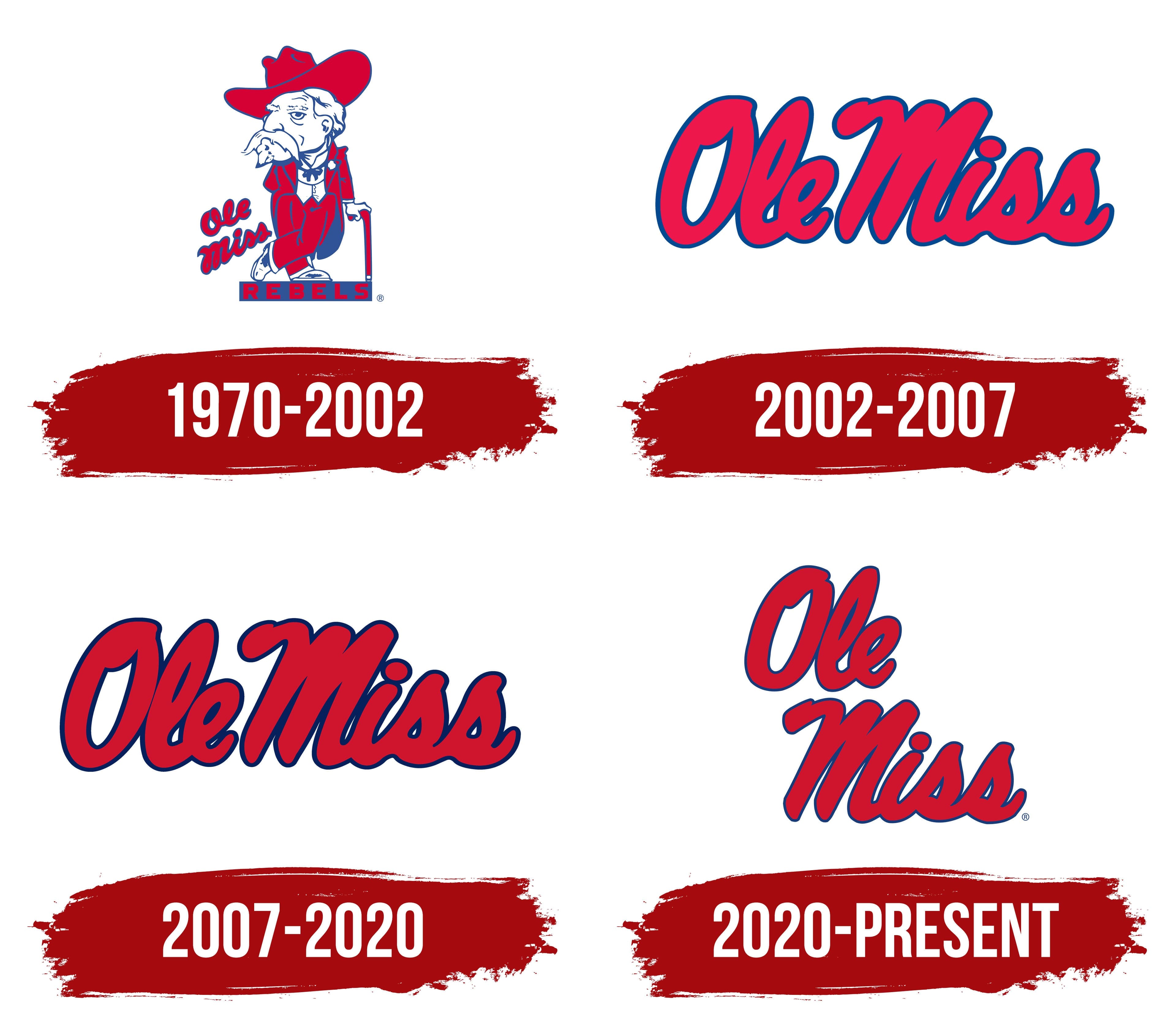
The first Ole Miss logo is far from energetic or athletic. Its design presents a calm, almost phlegmatic character. The image shows an unusual figure of an elderly man with gray hair, a long mustache, and a neat beard. He carries the spirit of decades long gone. His eyes hold a hidden spark ready to flare up when the moment comes.
The gentleman’s sly expression suggests he possesses knowledge unavailable to others. In sports, this hint reads as the hidden potential of a team capable of surprising at the right moment. His age underscores experience. He has been through a lot, learned a lot, and maintained a confident manner.
This interpretation fits well with the University of Mississippi’s athletic identity when it used the name “Mississippi Rebels.” Here we have an elderly man with a secret. His look conveys cleverness, thoughtfulness, a fit posture, and a cane, creating an interesting set of contrasts. It feels like he is passing on knowledge to the young, as if the elderly gentleman were a mentor.
A wide-brimmed hat and a rich red suit are paired with a white vest, a standing collar, and a neat bow tie. The outfit forms a complete image of a man with impeccable taste. He stands with his legs slightly crossed, which suggests restrained tension rather than indifference. This suggests inner readiness to react and a quiet alertness.
A blue outline around the figure helps the red color stand out on any background.
Below the symbol is a rectangular plate bearing the word “Rebels”. It uses a strict geometric sans-serif typeface. All letters are large and even and follow one rhythm.
The phrase Ole Miss on the left creates a vivid contrast. It is done in a handwritten style, with smooth, connected, italicized strokes. The two lines appear relaxed as if written with a quick, confident motion. The inscription conveys a sense of hidden potential that echoes the elderly man in the foreground.
2002 – 2007
The complex image of the older gentleman was replaced with a concise structure centered on a single wordmark. The sharp shift in visual identity came from a technical need. The logo had to fit on uniforms and helmets, so compactness became the priority. The change also reflected new habits of the audience for whom smartphones and the internet had become basic tools of communication.
The athletic division moved toward what fans needed. It abandoned the elaborate, gentlemanly format and adopted a format that was easier to adapt to any setting. The creators limited the design to text and made it the dominant element.
The name is placed horizontally. A single line looks organized. The smooth, relaxed character of the previous script is gone, replaced with a more official presentation. The text mark keeps a cursive foundation, but the letters sit closer together. The vertical proportion increased while the stroke density stayed the same.
The space between the words was reduced to a minimum. Since the neighboring elements touch, the designers outlined the glyphs with a thin border to prevent the lines from merging. The wordmark is raspberry-toned red. It supports an image of high energy, activity, and the drive to win. The associations include fire, sunlight, and vital momentum, which set an emotional tone and lift the team’s spirit.
A blue shade around the letters complements the vivid red.
2007 – 2020
The designers changed the color palette to emphasize determination, persistence, and the team’s drive for strong results. They turned to saturated shades with high emotional intensity. The Ole Miss wordmark took on a severe tone, cutting off any hint of relaxation. It conveys maximum tension, strength, focused nerves, and charged emotion. All of this is expressed through the blood red and dark blue colors of the letters and outline.
The soft lines of the glyphs create an opposite effect, softening the aggressiveness of the color scheme. Smooth curves, a unified type structure, tall letterforms, and the absence of sharp edges create a more approachable mood. The script’s handwritten character is fully preserved.
2020 – today
The new Ole Miss logo adopted a different style, though the change is subtle because the structure remained the same. The reason lies in the desire to preserve the university’s history, the roots of its athletic division, and an image that has stayed in fans’ memories for many years. All that remains of the elderly gentleman in the red hat and elegant suit is the red background and the blue outline.
The modern version uses the same wordmark as the dapper old man and the previous logo. The line is still free, relaxed, and naturally charming. The main change concerns the structure. Previously, the composition appeared on a single line, but the wordmark is now split across two lines, with the lower line slightly shifted to the right. Their placement creates a lighter, more open impression.
The original charm is preserved completely. The color changed as well. The red became one or two tones brighter, and the blue outline took on a deeper hue.
Ole Miss Cheerleading Logo

Ole Miss Cheerleading is part of the cheer and spirit groups division and runs summer and fall camps for athletes and students. Their work forms the basis for their own visual mark.
The main word is presented in a red handwritten style. A Script approach is used in the spirit of the Brush and Sign-Painter traditions. The university relies on the custom Ole Miss Script typeface created on the foundation of classic sign-painter practices. The contours are smooth with soft arc-shaped motion, slight tapering at the ends of strokes, and extension in the middle phase of the pen movement. The script word is slanted to the right, with the upper level shown larger, setting the overall rhythm.
The lower level is rendered in a dark blue tone and set in a geometric grotesque style. In character, it is close to Gotham, Trade Gothic, Helvetica Neue Condensed, or the university’s corporate adaptations. The letters are built with straight verticals and minimal contrast. The lower level is centered beneath the upper one, with increased letter spacing to maintain an even horizontal line.
The red tone corresponds to Ole Miss Red, and the blue matches Ole Miss Navy. The color base is part of the university’s corporate identity and preserves the symbol’s connection to the overall brand system.