


 Agip Logo PNG
The Agip logo conveys dynamism and strength, reflecting the company’s journey from its beginnings to global success. It connects the past with aspirations for growth, emphasizing its resilience and a progressive outlook on the future.
Agip was founded in 1926, when Mussolini’s government created Azienda Generale Italiana Petroli. Italy had no major domestic oil reserves and depended on foreign suppliers. At the same time, Standard Oil and Anglo-Persian Oil Company dominated the international market. The new state company was expected to handle exploration, refining, and retail fuel sales. However, its early years were limited by costly imports and stronger competitors.
World War II reduced Agip’s activity, and after 1945, Italy had to rebuild much of its industrial base. In 1953, the state created ENI, a national energy holding company led by Enrico Mattei, bringing Agip and other public energy companies under a single structure. Mattei saw Agip as part of a wider national policy, using it to reduce dependence on the large Western oil groups known as the “Seven Sisters.”
Under Mattei, Agip moved into international deals on terms that challenged the old concession system. In 1957, it signed an agreement with Iran that gave the producing state 75 percent of oil revenue, rather than the usual 50-50 split. The model angered the major oil companies and made Mattei one of the most controversial figures in the industry. In October 1962, his plane crashed near Milan, with later investigations raising claims of sabotage.
After Mattei’s death, Agip continued to expand in Africa, including Nigeria, Libya, Algeria, and Angola, while also entering North Sea offshore projects and exploring in Latin America. Its fuel stations became known across Italy and continental Europe through the six-legged fire-breathing dog Cane Sei, created in 1952. In 1992, the parent holding company became a joint-stock company, followed by partial stock market listings in 1995-1996. In 2003, Agip’s production assets were folded into Eni, while the Agip name continued to be used at fuel stations.
Meaning and History
What is Agip?
This Italian oil company specializes in producing high-quality motor oils, lubricants, and fuels. It operates an extensive network of gas stations and has developed the ENI line of lubricants designed for various engines, including industrial equipment, racing cars, and everyday vehicles. The gas stations are distinguished by their signature yellow-and-black color scheme. The company is actively involved in motorsports, allowing it to test and improve its products under high-stress conditions.
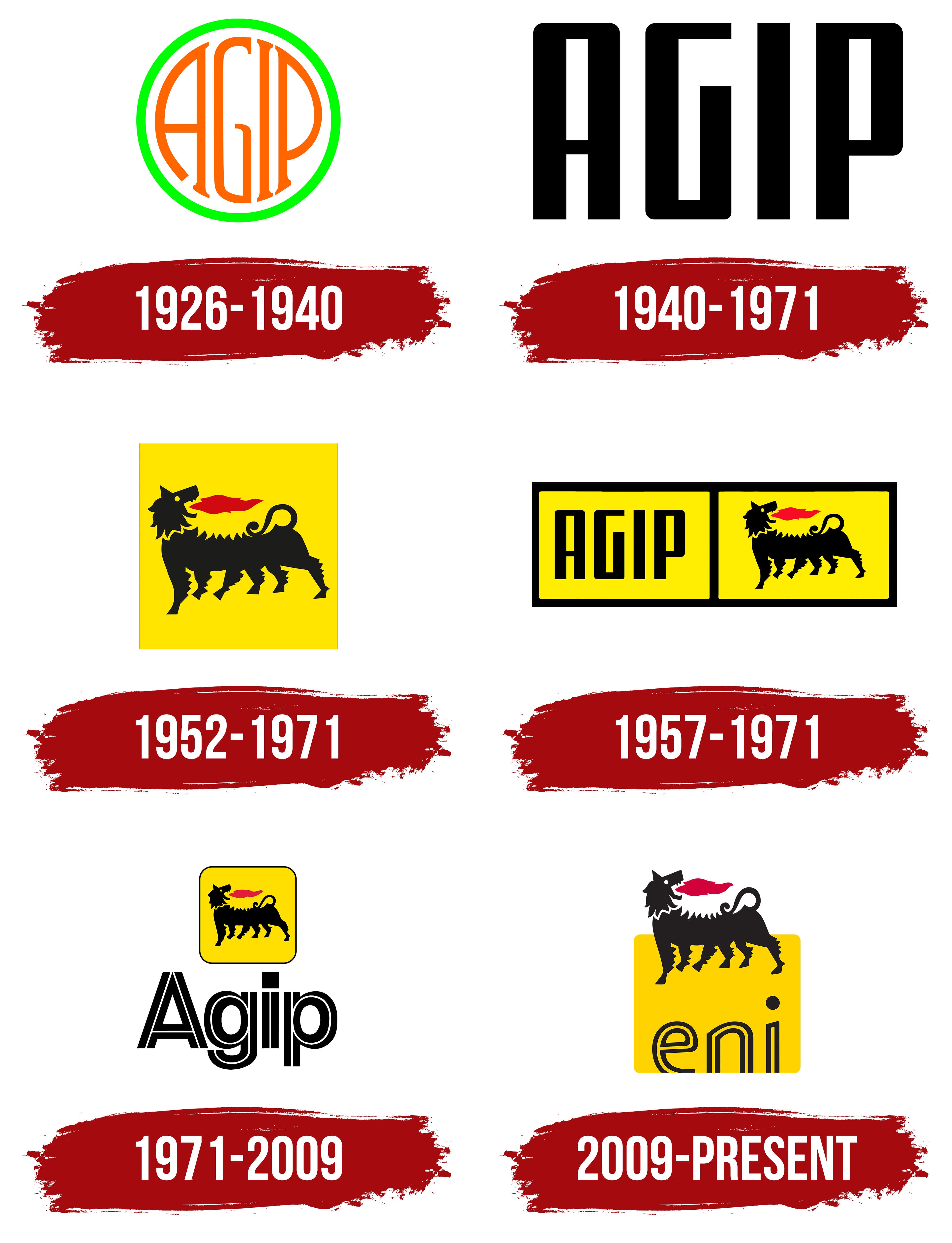
1926 – 1940
1940 – 1971
1952 – 1971
1957 – 1971
1971 – 2009
2009 – today
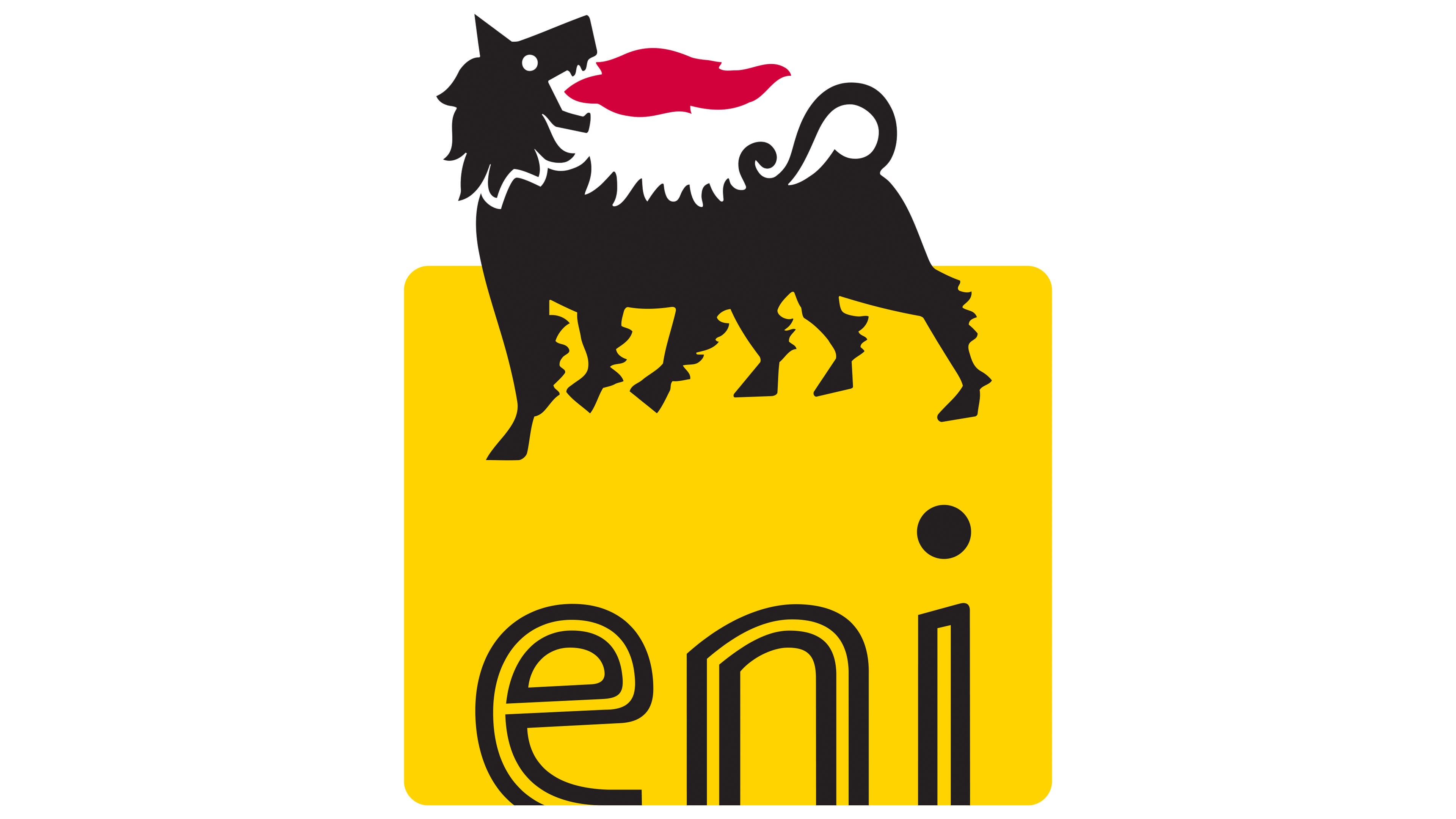
The ENI logo is one of the most memorable symbols in the energy industry. Its main element is a six-legged dog created by sculptor Luigi Broggini. This imaginative creature vividly embodies energy, strength, and movement. The six legs emphasize constant progress, reliability, and the ability to handle challenges. The red flame-like tongue from its mouth symbolizes activity, warmth, and energy qualities directly linked to the company’s operations.
The dog is depicted in black, giving it a strict and concise appearance. This color does not distract but enhances the sense of confidence and power. The silhouette has clear, expressive lines that create an impression of rapid forward motion.
The image’s background is a yellow square. The bright shade is associated with solar energy, warmth, and progress. The contrast between the yellow background and the black figure makes the logo noticeable and complete. This combination makes it stand out and recognizable even from a distance.
Below the image is the abbreviation “eni,” derived from the full company name Ente Nazionale Idrocarburi. The black font with thin lines gives the text a modern and minimalist look. Rounded letters add a sense of softness and stability. The dot above the “i” completes the composition, making it visually balanced.
Every detail of the emblem highlights ENI’s core values: energy, reliability, and a commitment to progress. The combination of shapes, colors, and symbols reflects the company’s history and mission.