


 Air Liquide Logo PNG
The Air Liquide logo conveys the connection between science and everyday life. Its design conveys the purity, precision, and reliability of a company that works with gases in the medical and industrial fields. The visual image creates a sense of stability and lightness, emphasizing the quality of the solutions.
Air Liquide was founded in Paris in 1902 by French engineer Georges Claude and Paul Delorme. The company was built around Claude’s patented method for liquefying air at very low temperatures and separating it into oxygen, nitrogen, and argon. The process gave industry a way to produce clean oxygen at scale, addressing a need that had limited the use of metallurgy, welding, and medicine.
The first major customers came from the French steelmaking industry, where oxygen welding transformed metalwork. Air Liquide expanded early, opening a Belgian subsidiary in 1906 and reaching Russia, Japan, and other markets by 1910. By the 1920s, it was present in the United States, Switzerland, and much of Europe, usually building local plants near customers because liquid gases were difficult to transport over long distances.
World War I raised demand for oxygen and acetylene in metalwork and munitions. Between the wars, Air Liquide added nitrogen, argon, and other industrial gases, while medical oxygen became a separate business line. After World War II, rebuilding in Europe created new demand, placing Air Liquide alongside Praxair and Linde as one of the key industrial gas suppliers.
From the 1960s, the company grew in petrochemicals through long-term pipeline supply contracts for hydrogen, oxygen, and other gases. In the 1980s and 1990s, it expanded across China, India, South Korea, and Taiwan, supplying high-purity gases to heavy industry and semiconductor production. In 2004, it moved to buy Messer Group, though regulators required asset sales. In 2016, Air Liquide acquired U.S.-based Airgas for $13.4 billion, strengthening its North American position as Linde later merged with Praxair in 2018.
Meaning and History
What is Air Liquide?
This French company is leading in producing medical and industrial gases, supplying gas mixtures for various industries, including aerospace and healthcare. The organization specializes in creating custom gas mixtures for specific applications and produces oxygen, nitrogen, hydrogen, and other gases for use in industries, medical facilities, and research centers. A distinguishing feature is its comprehensive approach to client service, encompassing gas supply and equipment installation, the development of technological solutions, and technical support. High safety and product quality standards are maintained through an extensive network of production facilities and gas pipelines, serving customers in more than 80 countries.
1991 – 2017
2017 – today
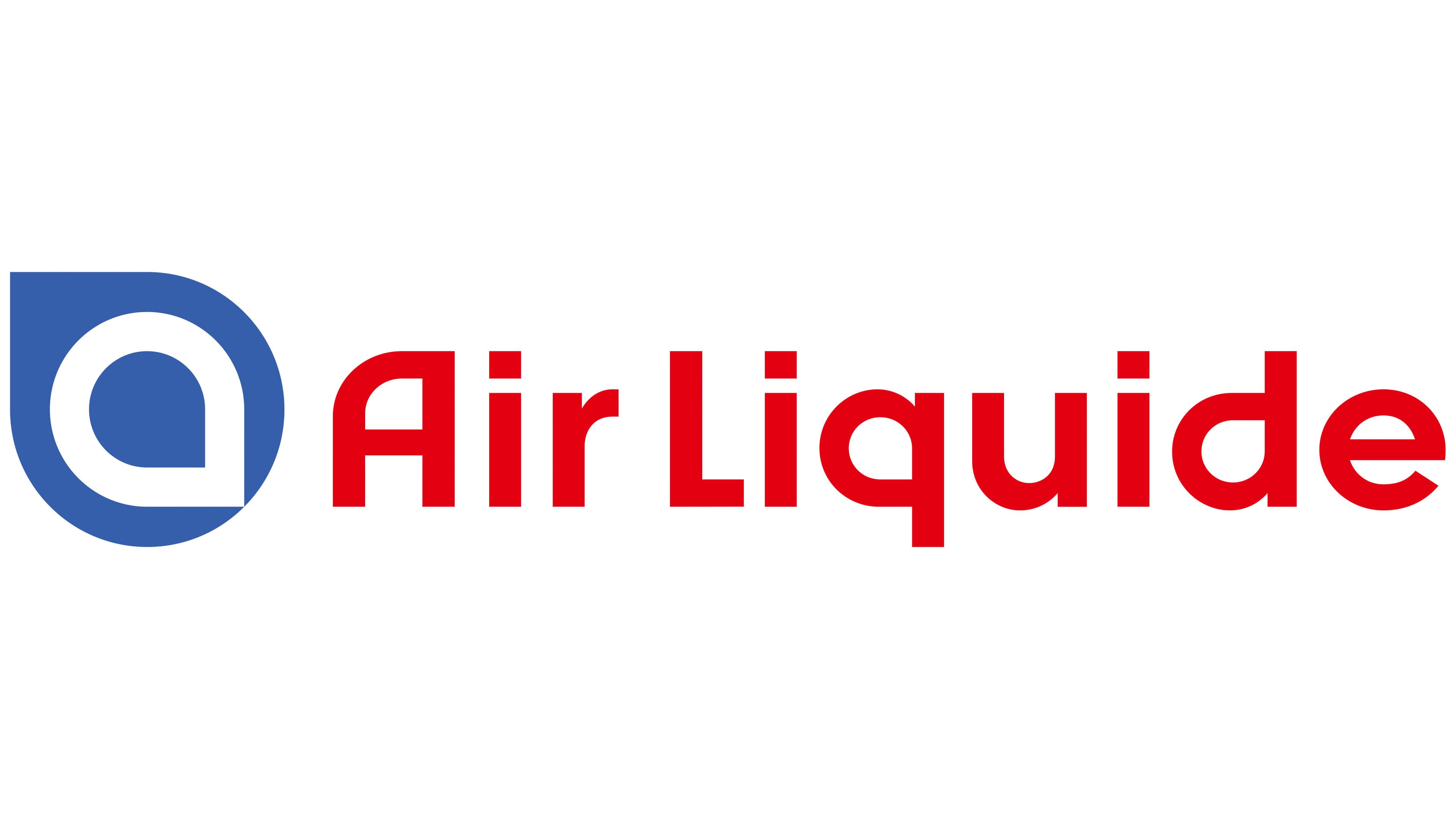
The Air Liquide logo features a minimalist design that reflects the company’s focus on industrial gases. It consists of two elements, graphic and textual, that complement each other seamlessly.
The graphic element on the left is shaped like a droplet. Inside the droplet is a stylized letter “A,” formed by a white stripe with rounded ends. This design conveys a sense of fluidity and purity associated with the company’s gases. The blue color of the droplet emphasizes the connection to air and technological processes. The outer contour of the droplet tapers upward and to the left, while the inner element points downward and to the right, symbolizing balanced movement and energy.
The textual element is placed to the right. The company name “Air Liquide” is rendered in rich red, creating contrast and emphasis. The sans-serif font features sharp lines and soft rounding, balancing formality and approachability. This makes the text structured yet visually easy to read. Even spacing between letters ensures clarity, making the name easily legible, even on small-scale applications.
The color palette includes blue, red, and white, creating a modern, clean visual identity. Blue represents air and technology, red conveys energy and confidence, and white highlights the company’s transparency and integrity.
The simplicity and precision of the design make the logo versatile and suitable for use across a range of materials, from corporate documents to industrial equipment. It reflects the company’s core values: reliability, innovation, and commitment to its mission.