


 Candy Logo PNG
The Candy logo is simple and thoughtful. The color, font, and style of the emblem reflect the company’s direction and core principles. The logo exudes a family atmosphere and a sense of intergenerational connection, complemented by innovation.
Candy began in Monza, Italy, where Eden Fumagalli founded Officine Meccaniche Eden Fumagalli in 1927 to make tools for precision machine tools. The move into appliances came after World War II, when his son Enzo sent sketches of a washing machine from an American prisoner-of-war camp. His brother Niso turned them into a working machine, while Peppino built the company’s commercial side.
In 1945, the Fumagalli workshop created the Model 50, the first fully Italian washing machine. It was shown at the Milan Trade Fair in 1946, the same year the company was officially registered as Candy, a name inspired by a popular song performed by Nat King Cole. In 1950, Candy moved to a new plant in Monza and introduced Bi-Matic, the first Italian semi-automatic washing machine.
The brand expanded abroad in the 1950s, opening offices in France in 1955 and Germany in 1958. In the 1960s, Candy launched Candy Automatic, the first fully automatic Italian washing machine, featuring shock absorbers, a thermostat, a 550 rpm spin speed, and 10 programs. In 1961, the company moved to Brugherio, where it built a new headquarters, factory complex, and research laboratories. In 1966, Candy added the Stipomatic dishwasher.
Candy later grew through acquisitions. It bought Spain’s Maytag-Otsein in 1992, the Italian refrigeration brand Iberna in 1993, and Hoover European Appliances in 1995, gaining Hoover rights across Europe, the Mediterranean, and former Soviet markets. By 2002, Candy exported to 111 countries. In 2005, it acquired Russia’s Vyatka and the Vesta plant in Kirov, followed by China’s Jinling in 2006. In 2018, Haier acquired Candy in full.
Meaning and History
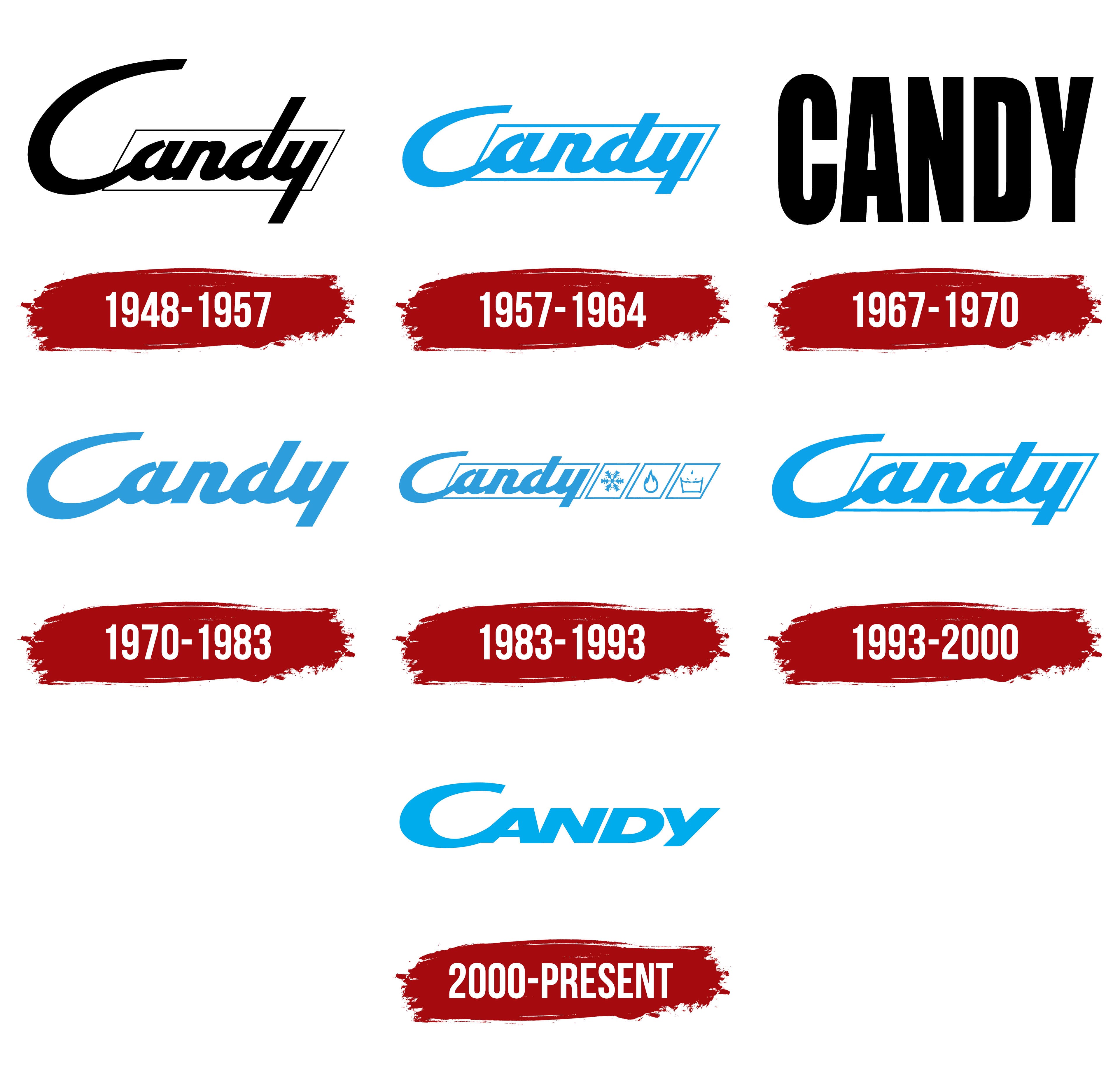
The brand’s emblems have changed frequently over 80 years. However, the company maintained a steadfast commitment to word marks, occasionally supplementing them with symbols demonstrating the properties of the manufactured appliances. The logos reveal the founders’ strong family ties and unity in their work towards achieving the primary goal. Even after the parent company changed, the new owners retained the brand’s familiar visual identity with almost no changes.
What is Candy?
Candy is a major Italian household appliance brand that offers washing machines, ovens, refrigerators, air conditioners, and more. For 12 years, it has held leading market positions. Since 2019, the brand’s owner has merged with Haier to form a new company, Haier Europe.
1948 – 1957

The brand’s first logo consisted of the name. It appeared only in 1948, although Fumagalli’s workshops were founded in 1927, the first industrial washing machine in 1932, and the household appliance in 1945. The reason lies in the gradual development of the idea. The machine was invented in 1945 but was not introduced to the public until the following year. When mass production began, they handled the logo.
Despite the sweet name, the brand’s product belongs to a completely different field. And the chosen name does not come from candies.
Candy is the nickname the founder’s father, Eden Fumagalli, gave himself for his very pleasant “sweet” voice. Eden can be considered the founder of the future Candy Group, as he opened the Officine Meccaniche Eden Fumagalli workshop. His sons only further developed his idea.
Another story behind the name is Nat King Cole’s 1944 song “Candy,” which became a hit. The composition is still considered an American classic. Fumagalli chose the name to make the brand more memorable and evoke pleasant associations for buyers. In the song, the beloved is compared to Candy and presented as understanding and always nearby. The founders wanted their products to have these qualities.
For most buyers unfamiliar with the brand’s history, the name is associated with desirable, pleasant, and well-functioning products.
Part of the inscription “andy” is enclosed in a thin rectangular frame. This technique symbolizes:
- Quality, durability, maximum product protection, and reliability.
- The shape of household appliances is often rectangular.
- Name. Andi, a diminutive form of Andrea. Possibly, it personified someone important in the family’s life. The name’s meaning, “manly and brave,” represents the brand as confident and strong.
The technique made the sign more recognizable. Capital letters connected indicated a family connection. All Fumagalli children participated in Candy’s work, each responsible for a specific area in the company. The inscription’s forward tilt spoke of innovation and development.
1957 – 1964

1964 – 1970

1970 – 1983

1983 – 1993

1993 – 2000

2000 – today
For a long time, Candy was private, belonging to the founder’s children and grandchildren. In 2019, it was acquired by the Chinese corporation Haier, which changed the brand’s logo.
The update did not bring major changes. The emblem still features the name in blue tones. The main innovations are a change of font and the abandonment of the frame.
The first two letters of the inscription are connected, resembling a lock and key. This technique demonstrates the company’s desire to solve consumer problems, its ability to find optimal device parameters, and its ability to achieve set goals. The connection of letters symbolizes the thoughtfulness and comfort inherent in the brand.
Font and Colors
The primary color of the logo is blue. It is associated with the following:
- Cold. Candy manufactures air conditioners and refrigerators.
- Water. The brand’s first and most famous product is washing machines.
- Cleanliness and ease of use of the appliances.
Blue is a symbol of dreams. Eden Fumagalli’s dream of creating a machine capable of washing autonomously came true. Since then, the brand has brought many ideas to life, improving people’s lives.
The font is unique because of the connection between the first characters.