


 Daikin Logo PNG
The Daikin logo symbolizes the ease of breathing and clean air provided by the company’s systems. The emblem focuses on the theme of air purification. The brand’s filters serve as a reliable barrier, preventing contaminants from entering living spaces.
Daikin began on October 25, 1924, when Japanese engineer Akira Yamada founded Osaka Kinzoku Kogyosho in Osaka’s Namba district. The small workshop employed about 15 people and produced copper radiator tubes for aircraft engines. Its original name meant “Osaka metalworking works,” reflecting the company’s early focus on precision metal parts for aviation.
In 1929, the company added lubrication devices for industrial equipment. In the early 1930s, it entered research into fluorine-based refrigerants. In 1935, it became the first company in Japan to produce fluorocarbon gas on an industrial scale. This gave Daikin a rare position in air conditioning, since it developed both the equipment and the refrigerants used inside it.
Daikin entered packaged air conditioning in 1951, becoming the first Japanese company to produce such systems. In 1957 and 1958, it introduced a rotary compressor and its first heat pump. In 1963, the company was renamed Daikin Kogyo Co., Ltd., with “Daikin” formed from the first characters of “Osaka” and “Kinzoku.” Daikin Europe N.V. was founded in Ostend, Belgium, in 1973, and in 1982, the company became Daikin Industries, Ltd.
In 1982, Daikin introduced the world’s first VRV system, enabling several rooms to be controlled from a single outdoor unit. Carrier did not have a comparable multi-zone product at launch. In 1984, Daikin reached one million packaged commercial air conditioners and released an inverter-controlled unit. The company bought O.Y.L. Industries in 2006, gaining McQuay International and AAF International, and then acquired Goodman Global for $3.7 billion in 2012. That deal strengthened Daikin in the U.S. HVAC market. It led to the establishment of the Daikin Texas Technology Park near Houston.
Meaning and History
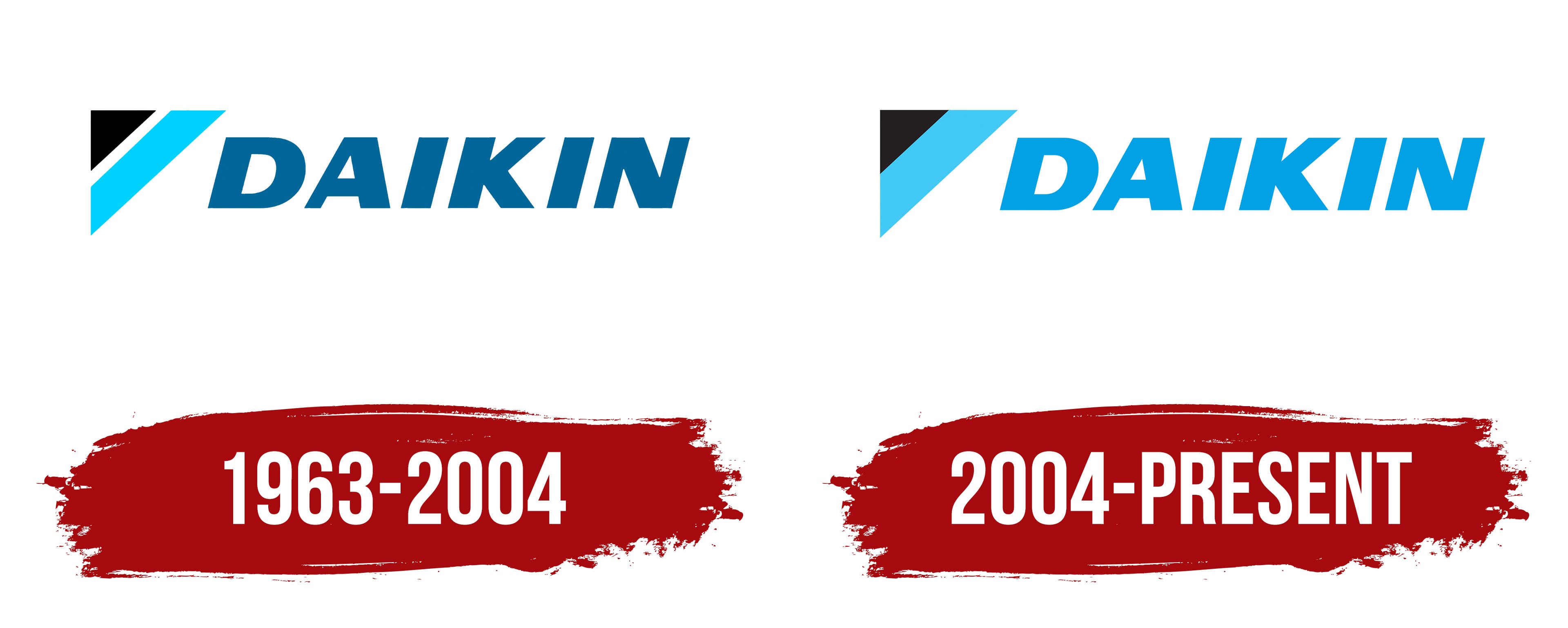
The company’s logo has remained virtually unchanged for the past 60 years. Minor changes have been made to better express the brand’s goals and showcase its products. The logo contains a symbolic image that can be understood in any language, which is important for a global brand with a worldwide presence.
What is Daikin?
This leading global manufacturer of heating and air conditioning systems offers a range of climate control equipment, including multi-zone VRV systems for large facilities, industrial cooling and ventilation systems, and residential air conditioners. A distinctive feature is that all key components, such as compressors and refrigerants, are produced in-house, ensuring strict quality control. The product lineup includes powerful systems for shopping centers, offices, and industrial facilities, as well as compact wall-mounted units for apartments. The company’s research labs develop the latest air purification technologies and energy-efficient solutions. Additionally, the manufacturer offers smart home solutions that enable users to control temperature-controlled devices via mobile apps.
1963 – 2004
The first emblem features a triangle in the upper-left corner and the inscription “Daikin” in large blue letters. The triangle represents an air conditioner, usually installed at the top of a wall, and is marked with black and blue stripes. The black part symbolizes polluted air, and the blue part symbolizes the air after the unit has cleaned it and enters the room. Daikin ensures the air is clean, so the lettering appears to come from the air conditioner into the room.
The logo visualizes the phrase: “Dirty air is cleaned thanks to Daikin systems.”
The name of the company comes from combining the Japanese pronunciation of the first two Kanji characters of Osaka (the place where the company was founded) and Kinzoku (metal).
2004 – today
With the launch of the manufacturer’s air conditioners in the USA and Canada, the logo changed. In the modern version, the inscription was slightly changed to accurately convey the original meaning. The black and blue stripes were combined, removing the space between them. In this form, the elements more accurately reflect how air passes through the device’s filter.
The name took on the same blue hue as the clean air entering the room. The association with the letters, as if they were coming out of the air conditioner, became even stronger.
The capital letters symbolize the scale of the company, as well as the large manufacturing installations and high-rise buildings.
Font and Colors
The emblem is built on the contrast between blue and black. The blue shade symbolizes clean air, while black symbolizes pollution. In addition, the color blue is associated with dreams, innovation, and development. The company is considered an innovator in its industry. The color black indicates stability and a constant striving for growth and development.
The font is reminiscent of Taz Extended Black Italic. The uppercase glyphs emphasize the company’s leadership and global presence. The angular glyphs mimic the rectangular shapes of the air conditioners, reflecting the company’s firm stance on build quality and performance.