


 MTN Logo PNG
MTN’s logo is airy and sophisticated, showing the transmission of information through the air and clear lines of communication to reach every subscriber. The emblem is minimalist, hinting at purity of sound, simplicity, and accessibility.
MTN was registered on March 17, 1993, and received its GSM license that September. The company was first known as M-Cell and was created by a consortium of South African investors. Its launch came during South Africa’s post-apartheid transition, when the country had only four million fixed phone lines, and just 1% of Black residents had access to a telephone.
MTN received one of South Africa’s first two GSM licenses and launched commercial service on June 1, 1994. That year, it introduced the country’s first GSM payphones with voice and data capability, along with free emergency calls. In 1995, M-Cell became public by listing 25% of MTN Holdings on the Johannesburg Stock Exchange. In 1996, MTN added PayAsYouGo prepaid service and SMS, while Vodacom, backed by Vodafone, grew as its main local rival.
In 1998, MTN International was formed to lead expansion beyond South Africa. Uganda became the first foreign market, followed by Rwanda, Swaziland, and Cameroon. The major break came in 2001, when MTN paid $285 million for one of Nigeria’s GSM licenses. Vodafone saw Nigeria as too risky and stayed out, but MTN entered the market. On May 16, 2001, the first GSM call in Nigeria was made on MTN’s network, and the country later became the company’s largest market.
MTN entered Iran in 2004 and received the second national GSM license in 2005 through MTN Irancell, in which it held a 49% stake. The deal later brought legal claims from Turkcell, which MTN denied. In 2015, Nigeria fined MTN $5.2 billion over unregistered SIM cards, later reducing the amount. The penalty helped push MTN to its first net loss in 2016. By October 2025, MTN said it had passed 300 million subscribers, becoming the first African-headquartered telecom company to reach that mark.
Meaning and History
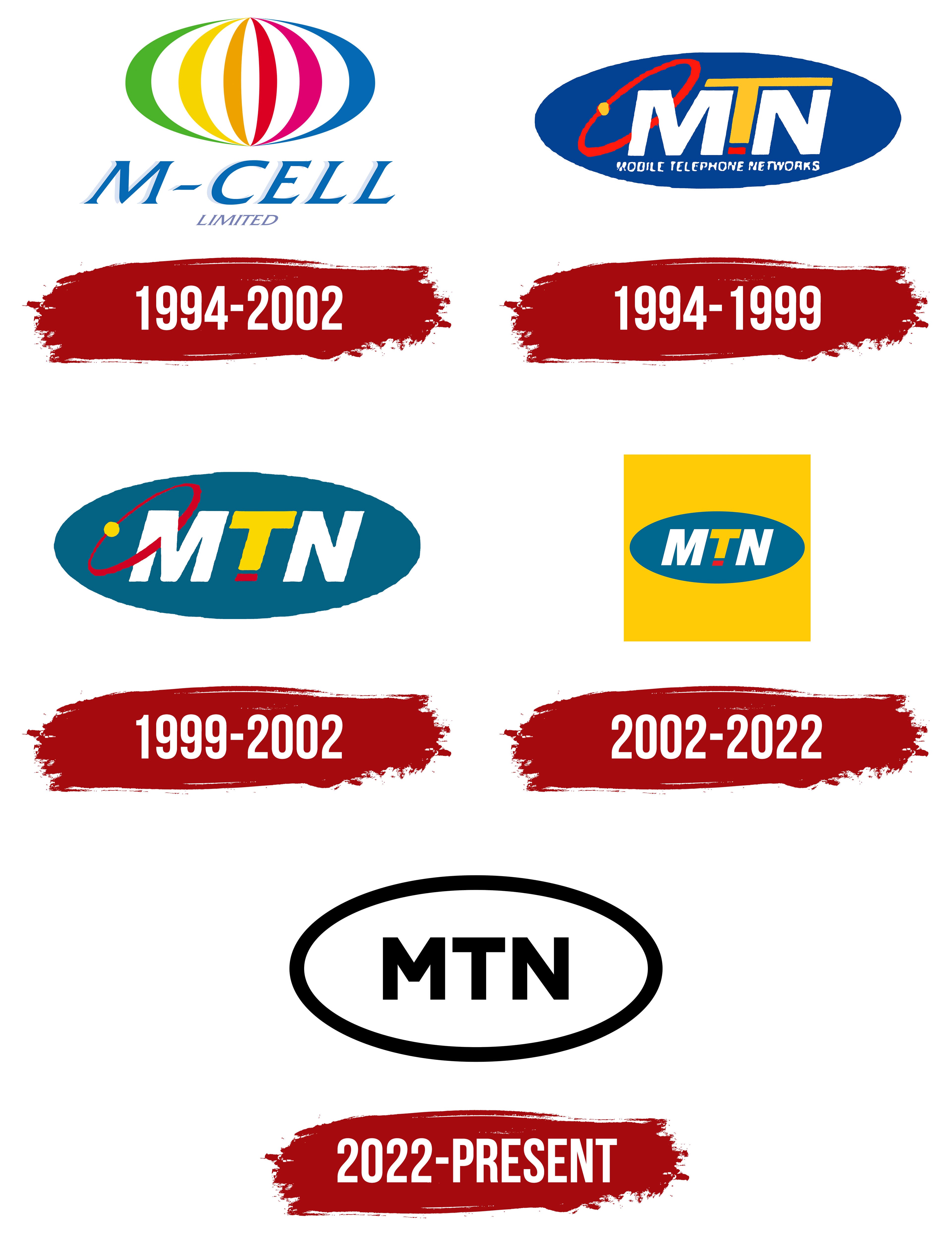
The brand’s logo has changed several times over its existence. Most often, rebranding is related to an operator’s acquisition by new owners, a change in the brand name, and a change in the scope of its activities. The unchanged oval symbol reflects the company’s commitment to flawless, high-quality performance across its functions, ensuring a strong market presence and broad user coverage. The transition from a bright color scheme to a monochrome one signals the market’s growth and expansion, as well as the company’s desire to present itself as reliable, stylish, and restrained.
What is MTN?
MTN is the eighth largest mobile operator, internet service provider, and electronic payment provider in the world. Its customers have access to HSUPA, 4G, 5G, LTE, and IP telephony services. It covers 88% of the population in its markets. The company is headquartered in South Africa.
1994 – 2002

The first logo was an oval with multicolored stripes inside, and the inscription “M-Cell”. The drawing symbolizes:
- The diversity and vibrancy of African cultures, especially in the founding countries, are evident. In South Africa, members of different ethnic groups, such as blacks, whites, mixed race, Asians, and Indians, make up more than 20 nationalities.
- The flag of South Africa uses white, green, red, blue, and black colors. Each color on the flag, as in the company logo, represents one of the population groups. Red represents English speakers, yellow represents Indians, blue represents Boers, and green represents mixed groups. The white stripes between the colors in the logo symbolize the unification of each nationality through mobile communication.
- Rainbow. The sequence of colors resembles the stripes of a rainbow, which carries a similar meaning to the previous points. In addition, it reflects the joy and positive emotions experienced when using M-Cell services.
The colorful composition demonstrates customer orientation. The encapsulation of the stripes in an oval speaks to the desire to provide services to all residents of the country, symbolizing equality and work for every African, regardless of nationality.
M-Cell is the corporation’s first name. “Mobile Cell” is a prototype of a living organism that would multiply and spread, taking over the market.
1994 – 1999
1999 – 2002
2002 – 2022
2022 – today
The modern logo, while retaining the general image, has significantly changed its content. The symbol has become transparent, consisting only of black lines and letters. The name of the corporation, consisting of three large capital letters, is inscribed in an oval.
In 2002, MTN Group acquired M-Cell and renamed the operator MTN South Africa. The modern acronym stands for Mobile Telephone Networks.
The black lines suggest a service area primarily for users of the Negroid race. MTN intends to increase its presence in this region in the coming years. The symbol’s airiness speaks to accessibility for most residents and illustrates the idea of reducing environmental impact. By 2040, the company aims to be 100% eco-friendly.
The oval represents Earth, highlighting Africa’s connection to the rest of the world. One of the company’s global goals is to integrate the African community into the global communication system, ensuring access to Internet information resources for all residents and equality. The logo reflects these aspirations.
The abbreviation MTN occupies the center of the composition, as the company sees itself as the realizer of these opportunities.
The closed figure symbolizes the full range of services. The composition also resembles a satellite dish, as the primary data transmission protocol relies on satellite communication. The black lines represent the cables and fiber-optic lines that cover the entire region, forming an extensive network. They also hint at antennas and cell towers.
Font and Colors
The main color of the emblem is black. It symbolizes the dark-skinned population associated with the African continent. This color emphasizes globality, stability, and a competitive advantage.
The white space between the symbols represents air. Mobile data is transmitted through the air and is invisible to the naked eye. In the logo, this is represented by large distances.
The name’s font is Novecento Sans Wide Bold, with elegant, clear letterforms that hint at the purity of sound and the speed of data transmission.