


 Conoco Logo PNG
The Conoco logo is concise and embodies experience and trust. Its concept is based on the company’s key task of connecting resources and people’s needs, transportation, fuel stations, or energy delivery systems to the right locations.
Conoco began in 1875 in Ogden, Utah, when Isaac Blake founded Continental Oil and Transportation Company. The business supplied kerosene, candles, and soap to mining settlements in the Rocky Mountains during the silver and gold rush period. Standard Oil quickly became its main threat, using price pressure to weaken smaller operators. In 1884, Rockefeller’s company absorbed Continental Oil into its western distribution network.
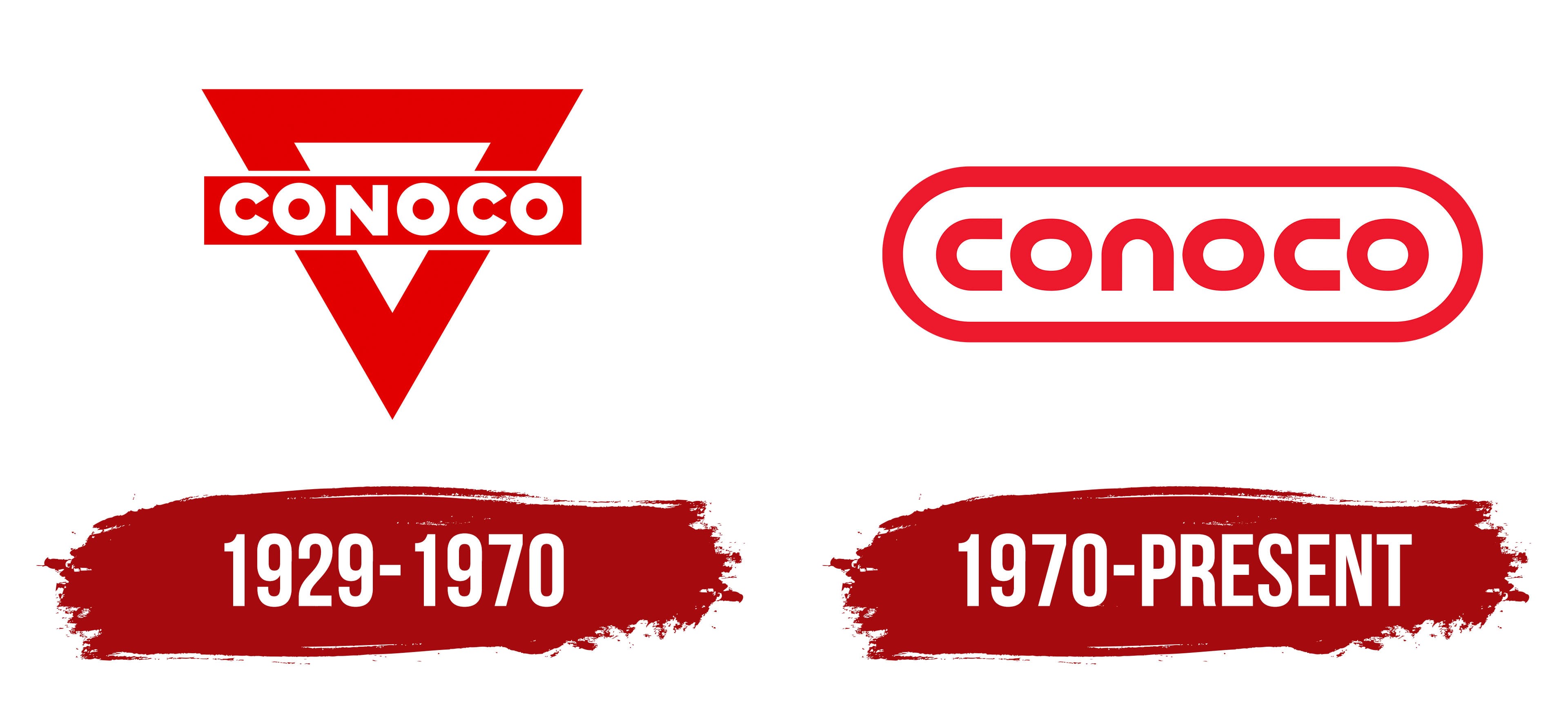
The company returned to independence in 1911, when the U.S. Supreme Court ordered the breakup of Standard Oil into 34 companies. Continental Oil then moved beyond distribution, buying wells, building pipelines, and adding refining capacity. In 1929, it acquired Marland Oil Company, gaining Oklahoma production assets, Midwestern stations, the red triangle, and the Conoco retail name.
In the 1930s, Continental Oil expanded production and refining under the Conoco brand. During World War II, part of its capacity was devoted to military supply, including aviation gasoline, naval fuel, and synthetic rubber. After 1945, rising car ownership increased gasoline demand, and Conoco grew its station network in the Midwest and Texas, competing with Sinclair Oil and Phillips Petroleum.
The company entered larger international exploration in the 1960s and 1970s, including Algeria, Indonesia, and the North Sea. It found Murchison in 1974 and Statfjord in 1975, in partnership with Statoil. In 1981, DuPont bought Conoco for about $7.54 billion after a contest with Mobil and Seagram. DuPont sold part of Conoco in a 1998 IPO and completed the separation in 1999. In 2002, Conoco merged with Phillips Petroleum to form ConocoPhillips, which separated refining and marketing into Phillips 66 in 2012.
Meaning and History
What is Conoco?
This is one of the world’s largest energy corporations, encompassing the American oil business. The organization is known for producing high-quality petroleum products, including lubricants, aviation, and automotive fuels, and operating an extensive network of gas stations across the United States. A distinguishing feature is its unique approach to customer service, which includes a loyalty program and additional services at gas stations, such as cafes and convenience stores. The company has developed proprietary oil refining technologies and established refineries nationwide to ensure the highest fuel quality.
1929 – 1970
1970 – today
The Conoco logo features a simple yet impactful design, with the company name at its center. The brand name is an abbreviation of the full name Continental Oil Company, highlighting its historical roots and longstanding connection to the oil industry.
The font is bold and strict, with soft, smooth lines. The rounded shapes of the letters stand out, particularly the consistent style of the letters “c,” “n,” and “o,” which resemble arcs or brackets, creating a sense of visual harmony. The letter “o,” distinguished by its elliptical shape, adds a unique touch to the entire inscription. The red font color symbolizes energy, strength, and confidence.
A bright red oval border frames the text. This frame gently surrounds the lettering, emphasizing its importance and giving the logo a sense of completeness. The oval, slightly horizontally elongated, conveys a sense of stability and visual balance. The white background inside the frame enhances the contrast, ensuring the text is legible.
This minimalist design underscores the company’s seriousness and solidity. The Conoco emblem combines clean geometric shapes, concise text, and an expressive font.