


 ConocoPhillips Logo PNG
The ConocoPhillips logo reflects the company’s journey through the years. It unites the stages from resource extraction to their everyday applications. It is an integral part of the environment, appearing on infrastructure facilities, documents, and other areas where the company implements its projects.
ConocoPhillips was formed on August 29, 2002, through the merger of Conoco and Phillips Petroleum. Conoco traced its roots to Continental Oil and Transportation Company, founded in 1875 in Ogden, Utah. After being absorbed by Standard Oil in 1884, it regained independence after the 1911 antitrust breakup and later acquired Marland Oil Company in 1929, adding Oklahoma assets and the Conoco retail name.
Phillips Petroleum began in 1917 in Bartlesville, Oklahoma, founded by brothers Frank and Lee Phillips. The company moved from oil wells into refining and natural gas, then opened its first filling station in Wichita, Kansas, in 1927. The Phillips 66 brand became associated with the Midwest and the South. In 1968, Phillips confirmed the Prudhoe Bay field in Alaska, which was later developed after the Trans-Alaska Pipeline opened in 1977.
Before the merger, both companies had changed scale. Conoco was acquired by DuPont in 1981 for $7.54 billion and later returned to public markets in 1999. Phillips bought ARCO Alaska in 1999 and Tosco Corporation in 2001. The 2002 merger created the third-largest integrated oil company in the United States, behind ExxonMobil and Chevron, with headquarters in Houston and assets from Alaska to the North Sea, Canada, Russia, the Middle East, and Asia.
In 2004, ConocoPhillips bought a 7.6 percent stake in LUKOIL. In 2012, it separated refining and retail into Phillips 66, leaving ConocoPhillips focused on oil and gas exploration and production. During the 2015-2016 oil price decline, it cut dividends and capital spending. In 2021, it acquired Concho Resources for $9.7 billion, followed by Shell Permian in 2022 for $9.5 billion.
Meaning and History
What is ConocoPhillips?
This is one of the largest independent organizations in the world focused on oil and gas exploration and production. It was formed through the merger of two well-known oil corporations. The company’s operations span 14 countries, with a focus on developing fields in North America, the Asia-Pacific region, the Middle East, and the North Sea. Its unique approach lies in concentrating on the most promising production projects and utilizing advanced technologies. Unlike many competitors, this corporation has achieved high efficiency by focusing exclusively on hydrocarbon extraction, excluding the refining and sale of petroleum products.
2002 – today
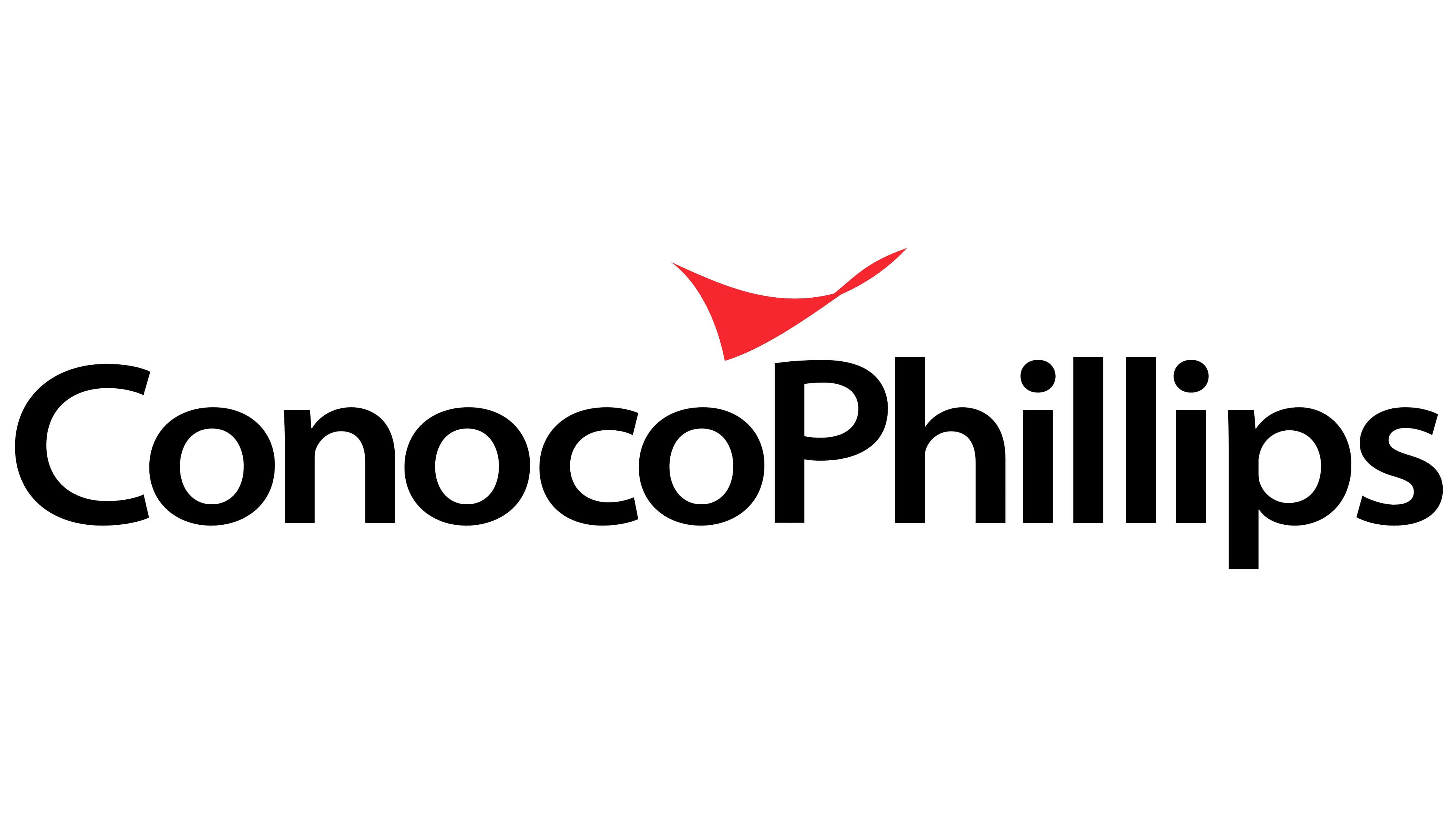
The ConocoPhillips logo is designed in a strict and minimalist style, emphasizing the professionalism of a company operating in the oil and gas industry. The primary focus is on the brand name, written in black font, symbolizing reliability and stability.
The font is concise and clear. The letters feature smooth, even lines, ensuring ease of readability. The name combines “Conoco” and “Phillips,” but they are visually separated by the differing heights of the letters “C” and “P,” adding a sense of dynamism to the composition. The design reflects the merger of two brands, Conoco and Phillips Petroleum, into a single company.
Above the intersection of the two words is a bright red element resembling a flame. This feature is shaped like a curved ribbon, seamlessly fitting into the overall design. The red symbolizes energy, warmth, and the company’s engagement with natural resources. This element adds expressiveness to the logo while maintaining its strict style.
The black-and-red color palette highlights the company’s core values: professionalism, responsibility, and confidence. Black represents stability, while red symbolizes dynamism, reflecting ambition and energy.
The ConocoPhillips emblem conveys the company’s character: strict yet energetic, reserved yet memorable. It unites the legacy of two well-known brands, underscoring their transformation into a single powerful force in the global energy industry.