


 Corsair Logo PNG
The Corsair logo is a symbol that allegorically conveys the meaning of the company’s name in the production of computer equipment. Although they seem unrelated at first glance, this impression is deceptive. A hidden thread is still present. It is like computer cables connecting two worlds: the real and the digital.
Corsair Gaming traces its history to January 27, 1994, when Corsair Microsystems was registered in Fremont, California. Andy Paul, Don Lieberman, and John Beekley came from the semiconductor industry and began with COASt level-two cache modules for Intel Pentium systems. The first niche disappeared after Intel moved L2 cache into the Pentium Pro, forcing Corsair to rebuild its product direction.
Under early employee Richard Hashim, the company shifted to DRAM modules. First, it worked with server customers, where speed and stability were critical. In 2002, Corsair entered retail with XMS memory kits for overclockers and dual-channel PCs. By 2003, the TwinX and XMS lines had made the brand familiar to performance PC builders and specialist media.
In 2006, Corsair moved beyond memory with HX power supplies that used modular cables and 80 PLUS certification. The company was competing with Kingston Technology and G.Skill in memory, so it expanded into related hardware. In 2007, Corsair reincorporated in Delaware. In 2009, it released the Obsidian 800D case. It formed a long-term liquid-cooling partnership with CoolIT, turning the company into a broader PC components maker.
EagleTree Capital bought a controlling stake in Corsair for $525 million in 2017, while Andy Paul stayed as CEO. Corsair then bought Elgato Gaming in 2018, adding Stream Deck, capture cards, and creator devices. In 2019, it acquired Origin PC and SCUF Gaming, entering custom PCs and professional controllers. Corsair went public on NASDAQ under the ticker CRSR in 2020, bought Drop in 2023, and completed the purchase of the Fanatec product lines from Endor AG in September 2024.
Meaning and History
At the time of launch, the company was named Corsair Microsystems, a name approved in 1994 during official registration. Later, the name was changed to Corsair Gaming. However, the rebranding did not affect the range of products produced, which still included various computer-related items.
To enliven the identity and add creativity and originality, designers proposed an unusual logo. It is unsuitable for a digital equipment manufacturer but perfectly resonates with its name, as the black sailboat symbolizes pirates, i.e., corsairs. The term originated from the Latin word “cursus,” meaning “course.” This meaning perfectly matches the concept of a company engaged in future technologies. Therefore, the sails inflated by the wind look like thin plates, resembling memory boards and other small modules, carried into the boundless ocean of computer developments.
What is Corsair?
This is an American manufacturer of high-end computer and gaming accessories. The product range includes memory, power supplies, cooling systems, cases, gaming keyboards, mice, headsets, and streaming equipment. The company specializes in creating comprehensive solutions for PC modding and customization, such as liquid cooling components and iCUE RGB lighting systems. In addition to offering extended warranties, the manufacturer strongly emphasizes material quality and build. Another focus area is the production of gaming PCs, where each component is carefully selected for maximum performance.
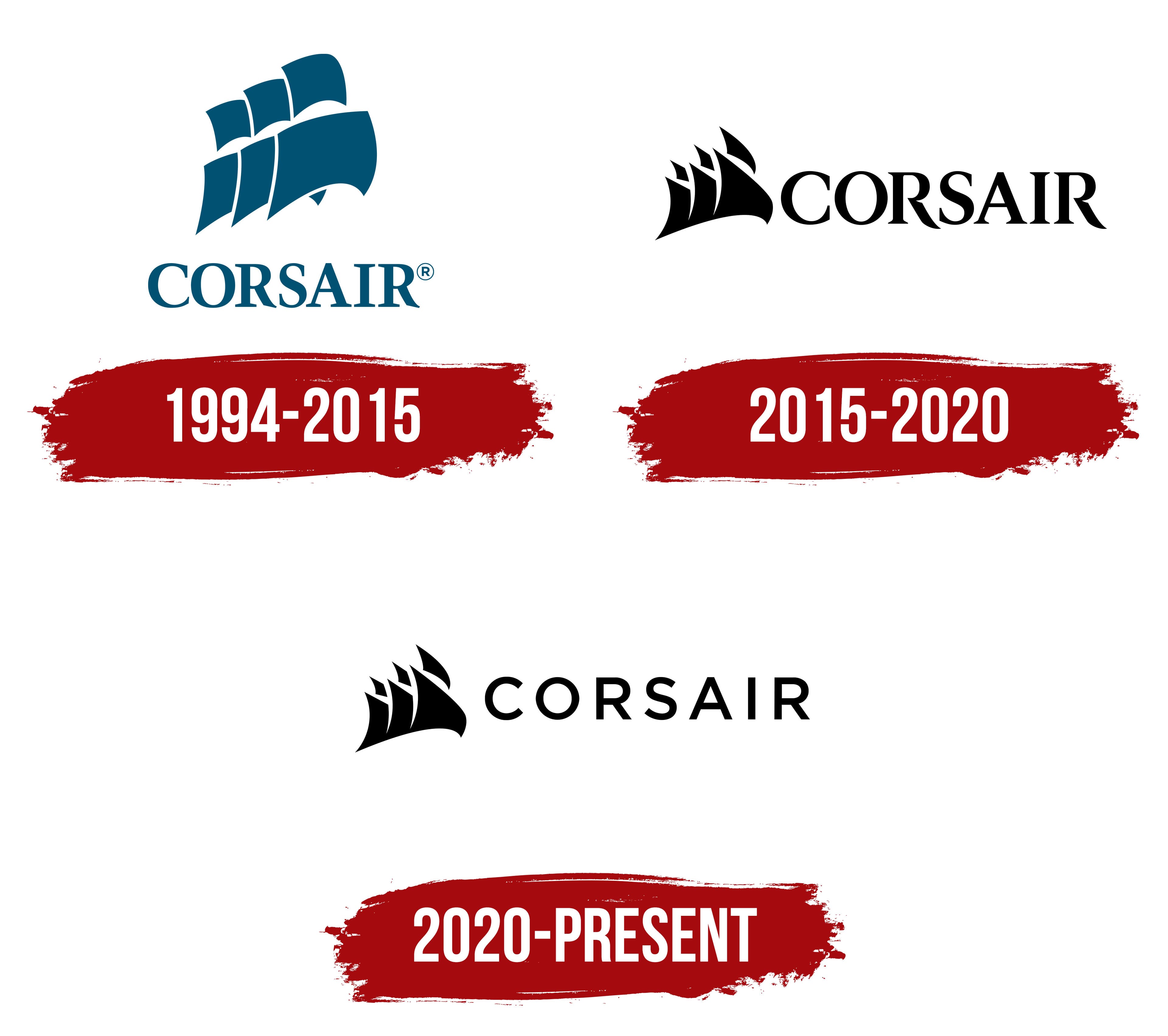
1994 – 2015
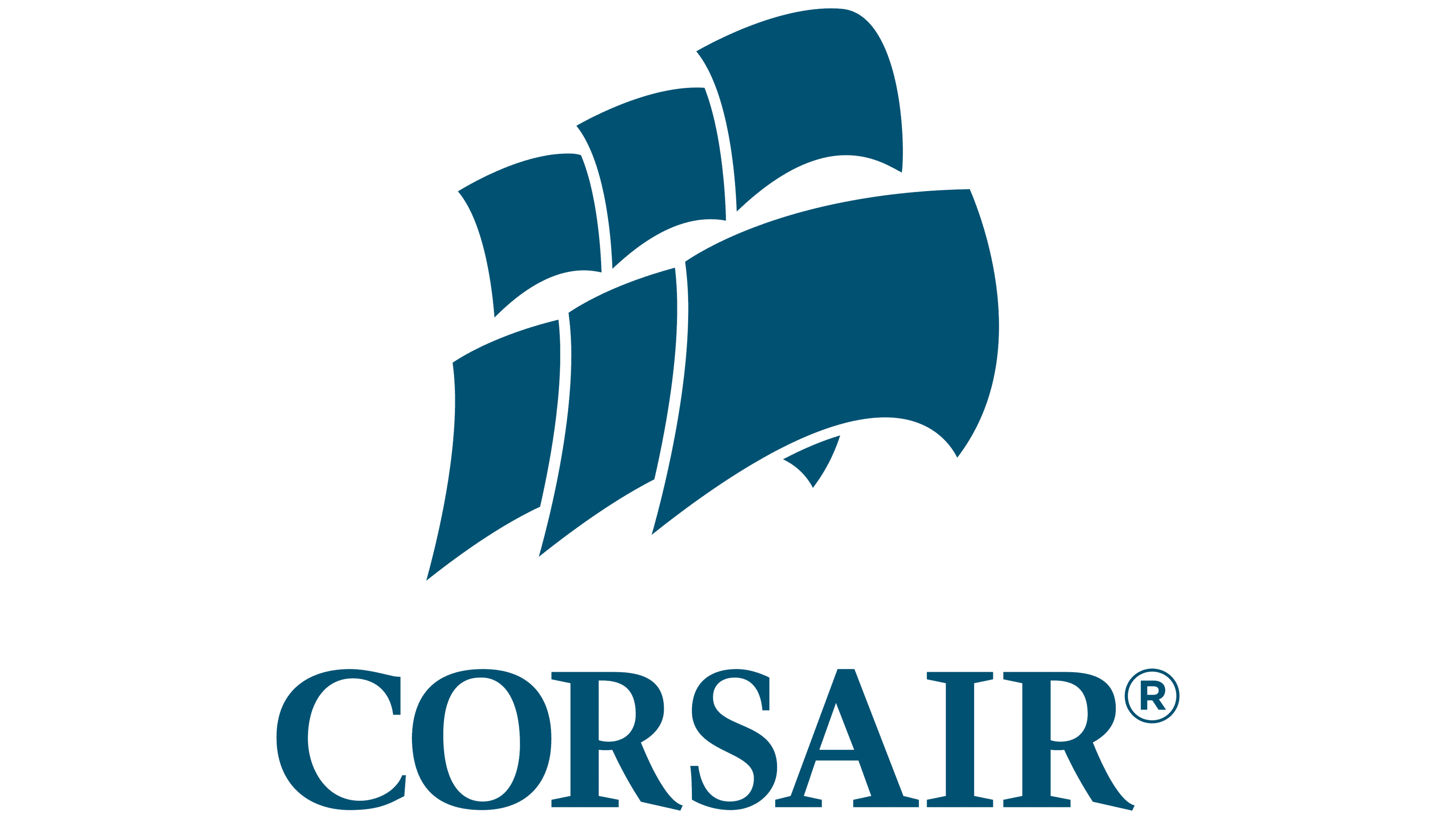
The key element of Corsair’s emblem is the sails. They consist of six sheets of different sizes arranged in two levels. Naturally, the perspective of placement on a single plane is taken into account, so the elements in the foreground appear larger than those in the background. This adds credibility and movement to the logo, turning an ordinary object into a dynamic one. The wind-filled sails move the “ship” on which they are located. Under such a ship, the company is implied, so there is no hull beneath the sails, allowing the viewers to draw the correct conclusions and arrive at the obvious creative parallel.
Below, the brand name is written in large upper-case letters. The letters are complemented by expressive serifs, adding authority and a business-like demeanor to the emblem. The lines used for the glyphs are uneven in thickness: thinner in some places and thicker in others. This approach to typography has turned the static inscription into an expressive element, linking the past with the future.
2015 – 2020

The era of black sails began. Moreover, the designers slightly changed their shape. They narrowed the right side, widened the left side, and, in some places, even cut off part of it to make the forward-movement effect more evident. The dark-colored logo gained more contrast, effectively attracting attention rather than repelling it. The adjacent inscription also changed. The designers chose a different font for it, also with serifs but sharpened at the ends. The letter “R” acquired an elongated right leg, which is figuratively curved and extends beyond the word “Corsair.”
2020 – today
The sails remained unchanged: narrow, cut-off, dynamic, connected at the bottom, and with sharp angles. However, the developers chose a different font, a slab serif. The disappearance of serifs automatically made the inscription more practical and modern, as flat elements began to dominate in logos. The fact is that flat elements look advantageous on any information carrier, including electronic and digital ones. The absence of serifs means the image lacks noise.
Font and Colors
Each Corsair logo has its own font, unlike the previous one. The inscriptions are made with typefaces reminiscent of Trump Medieval, Minion Pro Subhead Bold, Royal Romain Bold, Metropolis Semi Bold, or Montserrat Regular. The palette is restrained and has always consisted of two colors: white and black or white and dark blue.