


 CVS Health Logo PNG
The CVS Health logo reflects the journey from small stores to a large healthcare center. The company started as a retailer, providing easy access to essential goods, and has grown over time to become an important resource for millions, offering a wide range of medical services.
CVS Health began on May 8, 1963, when Stanley and Sidney Goldstein opened the first Consumer Value Stores location with Ralph Hoagland in Lowell, Massachusetts. The chain sold discounted health and beauty products, adopted the CVS name in 1964, when it had 17 stores, and opened its first pharmacy departments in Rhode Island in 1967. Melville Corporation bought the business for $12 million in 1969, supporting expansion through Clinton Drug, Mack Drug, and Peoples Drug.
In 1996, Melville spun off the chain as an independent public company. A year later, it acquired more than 2,500 Revco stores, followed by Arbor Drugs in 1998. The company launched an online prescription service in 1999, bought Eckerd operations from JCPenney for about $4.15 billion in 2004, added MinuteClinic in 2006, and acquired about 700 Osco and Sav-On pharmacies from Albertsons.
The 2007 merger with Caremark Rx, valued at about $21 billion, joined retail pharmacies with prescription benefit management. Longs Drug followed in 2008, and in 2015 it added Target pharmacy departments and Omnicare. In 2014, the group stopped selling tobacco and adopted the CVS Health name.
The company announced a $69 billion agreement to buy Aetna in 2017 and completed the deal in 2018, adding a major insurance business. Signify Health was acquired for $8 billion in 2022, followed by Oak Street Health for $10.6 billion in 2023, extending the company into home assessments and primary care for Medicare patients and Medicare Advantage coverage.
Meaning and History
What is CVS Health?
An entire healthcare ecosystem combines pharmacies, primary care clinics, and health insurance. They can buy medicines and health products, get advice from a pharmacist, get vaccinated, or seek basic medical care. The system works as a single mechanism by integrating insurance and medical services, offering millions nationwide convenient access to treatment and prevention.
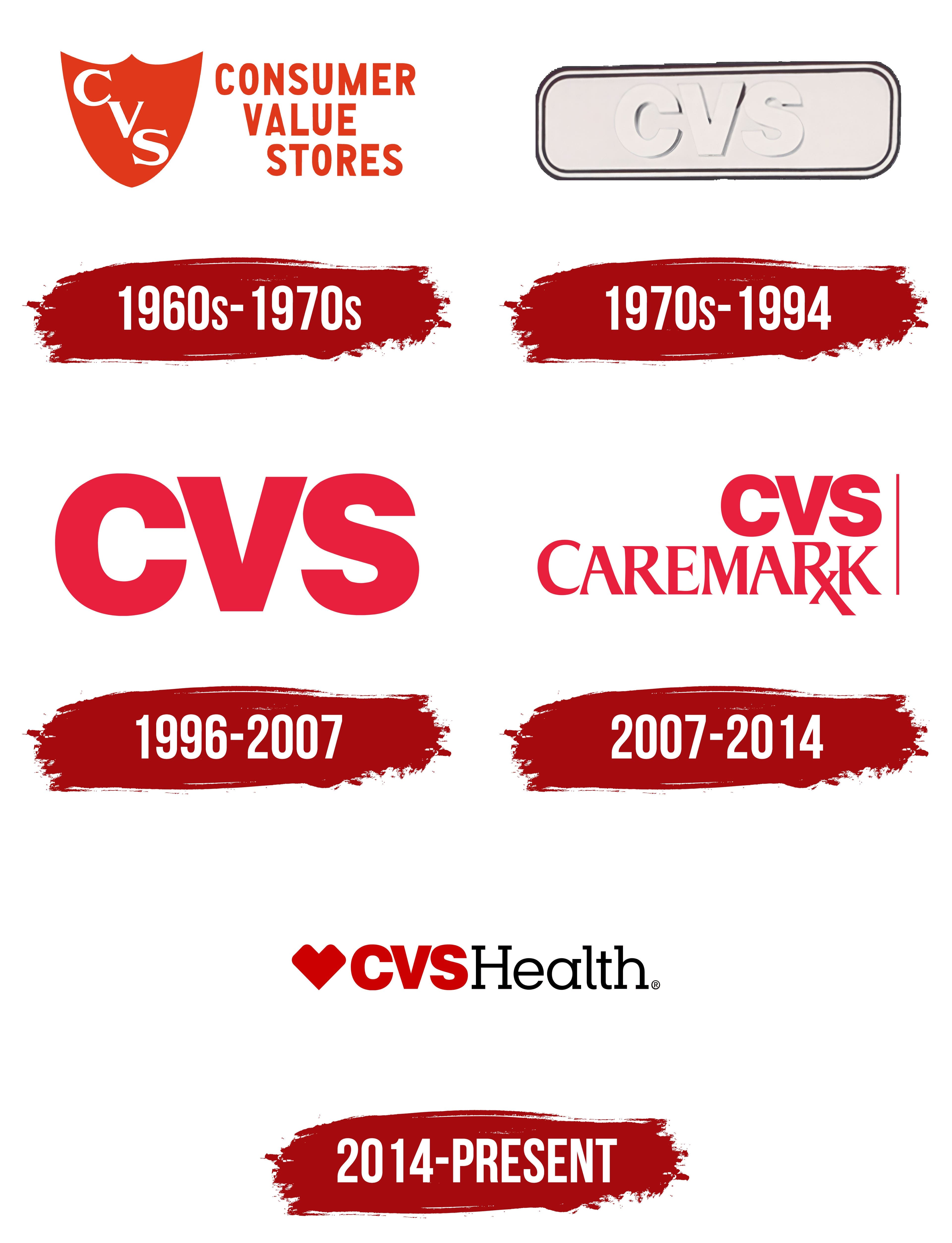
1960s – 1970s

The Consumer Value Stores (CVS) logo in the 1960s looked different from the style the brand later adopted. At the beginning of its journey, before it actively expanded and became a well-known pharmacy chain, CVS used a shield image. The shield was simple and large, rendered in rich, dark red. It symbolized protection and reliability, harmoniously complementing the initial cosmetics range and, later, the pharmaceutical products.
The company’s abbreviation “CVS” appeared on the shield in large white letters. The letters were arranged unusually diagonally: “C” at the upper left, “V” in the center, and “S” at the lower right. The typeface was neat with pronounced serifs, lending elegance to the letters. The letters slightly widened at the edges, adding a dynamic feel to the simple design.
To the right of the shield, the full brand name “CONSUMER VALUE STORES” appeared, divided into three lines. The sans-serif font was uppercase, neat, evenly spaced, and the same color as the shield, creating visual unity.
The color palette featured a calm, serious red shade, distinct from today’s brighter colors.
When the first CVS store opened in Massachusetts in 1963, it initially specialized in cosmetics, and the shield logo emphasized the promise of security and customer care. When pharmacy departments first appeared in 1967, the shield symbolism gained additional meaning, highlighting the brand’s medical orientation and role in health protection. This early visual style became the foundation for the trust and solidity that the brand later cemented in its image.
1970s – 1994

From the 1970s until the mid-1990s, CVS became part of Melville Corporation. During this period, the company used a logo unlike the previous shield; a horizontal rectangle with neatly rounded corners appeared instead. The logo was extremely simple and neutral in style.
A white plaque was the background, visually distinguished by a double contour and a shadow effect around the edges. Although also white, the letters “CVS” stood out because a shadow cast a subtle three-dimensional effect, raising them above the surface. The font was massive, wide, sans-serif, evenly proportioned, and rounded at the edges.
Choosing such a restrained, generalized logo design was due to CVS being a division of a large corporation at the time. The chain’s name was used without explanations or symbols, emphasizing a universal, accessible range of pharmacy and cosmetic products typical of the era.
1996 – 2007

The CVS logo, introduced in 1996, coincided with a significant event in the company’s history: its spin-off from Melville Corporation and its debut as an independent New York Stock Exchange brand. The updated logo reflected the company’s desire to emphasize the independence and strength of its new corporate structure.
The previous design was abandoned, and the frames and embossed effects on letters disappeared. A simple construction appeared, represented by three uppercase letters: “CVS.” They were written horizontally, without additional details or elements. The font was bold, sans-serif, with even line thickness. The spacing between letters was minimal, yet the letters did not merge, preserving readability.
The red color gave the logo dynamism and energy. The geometric and straight shapes of the letters C, V, and S added a formal style befitting the company’s position in the pharmacy retail sector.
The concise and vivid company name reflected its business profile, pharmacy chains, and the sale of health and beauty products, highlighting seriousness, practicality, and reliability in customers’ eyes.
2007 – 2014
The CVS Caremark logo, introduced in 2007 following the merger of CVS Corporation and Caremark Rx, visually reflected the merging process and the integration of two strong market players. Both company names were harmoniously presented in the logo on two levels, maintaining each brand’s recognizability.
The name “CVS” was placed in the upper part and shifted to the right. It retained the style from the previous logo, bold sans-serif letters, massive, even, and clear. At the same time, the word “Caremark” on the lower level was entirely different, stretched horizontally and rendered in a thinner, classic serif font with elegant details. The contrast between the upper text’s strict forms and the lower text’s refined lines created visual diversity.
A distinctive feature of the logo was the “Rx” symbol at the end of the word “Caremark.” This element was compactly integrated into the penultimate letter “R,” where its leg formed a cross-stroke representing “x.” “Rx” is a well-known symbol in the pharmaceutical industry, reflecting the company’s medical orientation and business profile, including pharmacy services, prescription drugs, and prescription management.
On the right side, the logo was completed with a thin vertical line, which, compositionally, united and stabilized the structure. The primary logo color was red, which added brightness and emphasized the brand’s professional and medical nature.
Thus, CVS Caremark’s logo illustrated the story of the merger and highlighted its healthcare and pharmaceutical profile, preserving the individuality of each merger participant.
2014 – today
The new CVS Health logo, introduced after the company’s rebranding and renaming, changed while maintaining the recognizability of previous styles. The company’s name change coincided with the decision to stop selling tobacco products in its stores, emphasizing a renewed focus on health care and medicine.
The composition is horizontal and balanced. The left side features a heart-shaped symbol executed in an unusual geometric style: the lines are straight and angular, lacking the typical smooth curves. The heart’s color is a rich red, harmonizing with the company’s brand color.
The company’s name is positioned to the right of the heart. The inscription consists of two parts, differing in style and color. The first part, “CVS,” is set in a bold, powerful red sans-serif font that matches the heart symbol. The letters are massive, with uniform line thickness and tight spacing. The typeface has remained largely unchanged compared to previous versions, preserving continuity in the visual image.
The second part of the name, “Health,” is written in a thin, serif font that provides contrast. It uses mixed case: the uppercase letter “H” stands out because of its wider, heavier form compared to the other letters. The black color of the word “Health” adds a graphic seriousness and emphasizes the brand’s medical focus.
The combination of red and black visually highlights the company’s commitment to health, medicine, and customer care. Blending different styles and font weights in the logo gives it a lively, solid, and professional appearance.
Font and Colors

The CVS Health logo has long been defined by its energetic red. Although the brand briefly experimented with shades, it repeatedly returned to this familiar color, maintaining continuity with its early years. Typography saw little change over the decades; the letters “CVS” maintained a stable, bold style, occasionally paired with different fonts for “Health” to refresh the design. Originally introduced in the 1960s, the red became CVS’s identity signature, helping customers instantly recognize their neighborhood pharmacy.