


 Aetna Logo PNG
The Aetna logo focuses on the company’s mission. In the center of the emblem is health care. Just as the heart is the source of life, the insurance company provides the funds that sustain it.
Meaning and History
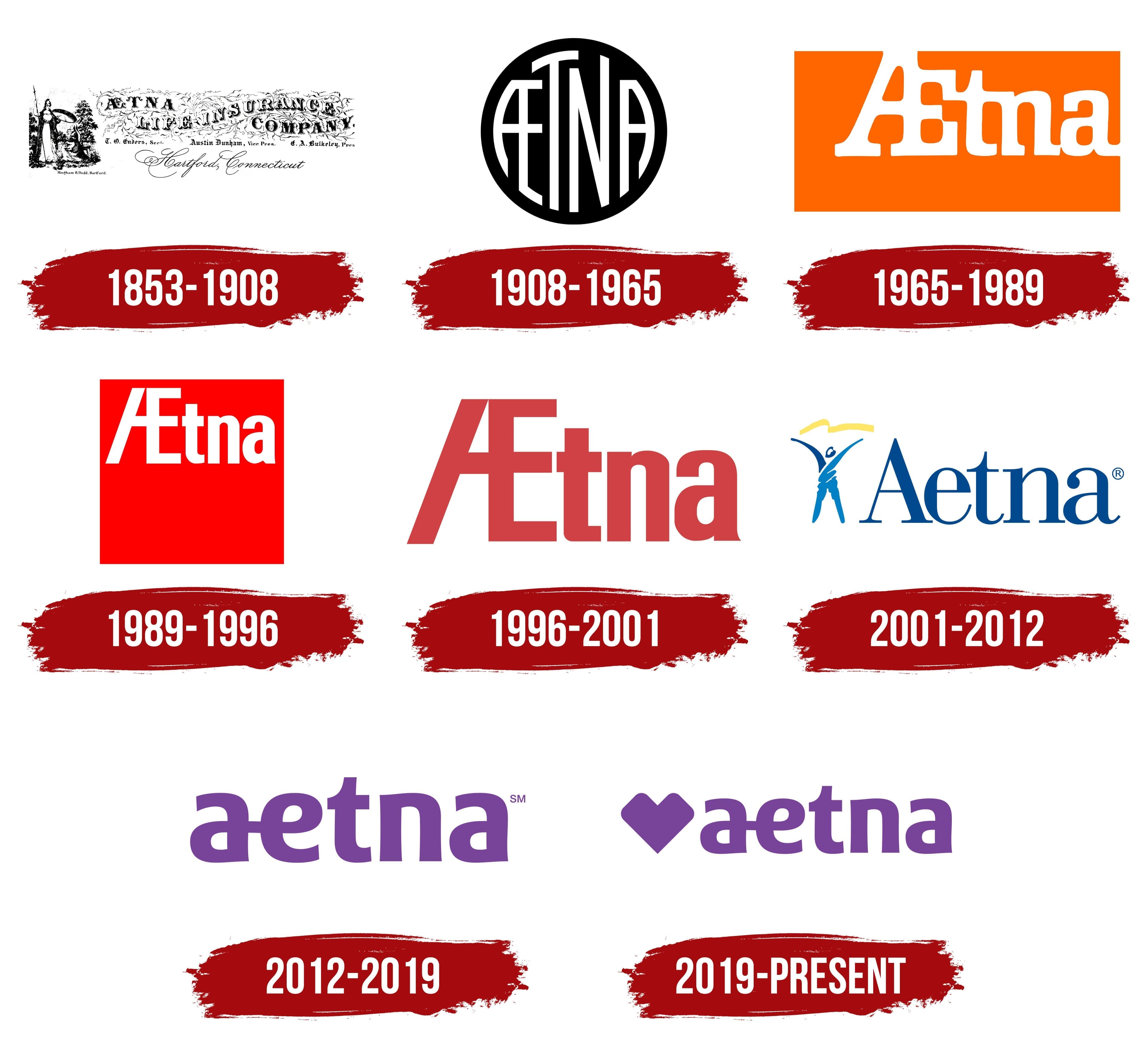
Aetna is a direct descendant of the insurance company of the same name, founded in the early 1800s. The modern brand’s foundation was laid in 1850, when the parent organization established a life insurance fund. In 1853, that division became independent. The executives decided not to change the name to avoid losing consumer confidence. It was inspired by the stratovolcano Aetna on Sicily’s east coast. It is the highest volcano in Europe, and in the 1800s, it was also the most active.
During the economic crisis, the company was slated for liquidation, but it avoided it. In 1856, its annual income exceeded $1 million. Thanks to its financial stability, it changed its strategy and greatly expanded its services. In 1899, Aetna was among the first to insure not only people’s lives but also their health. Later, it issued bonds to fund the Manhattan Project, the United Nations headquarters, and the rebuilding of the Statue of Liberty.
A company-wide reorganization helped it adjust to changing market standards. This process was accompanied by a constant renewal of its identity, which was also up to date. Thus, Aetna had at least eight logos. They were used across different eras, from the mid-20th century to the present. Like the others, the current version includes the brand name but differs in its original design.
1853 – 1908
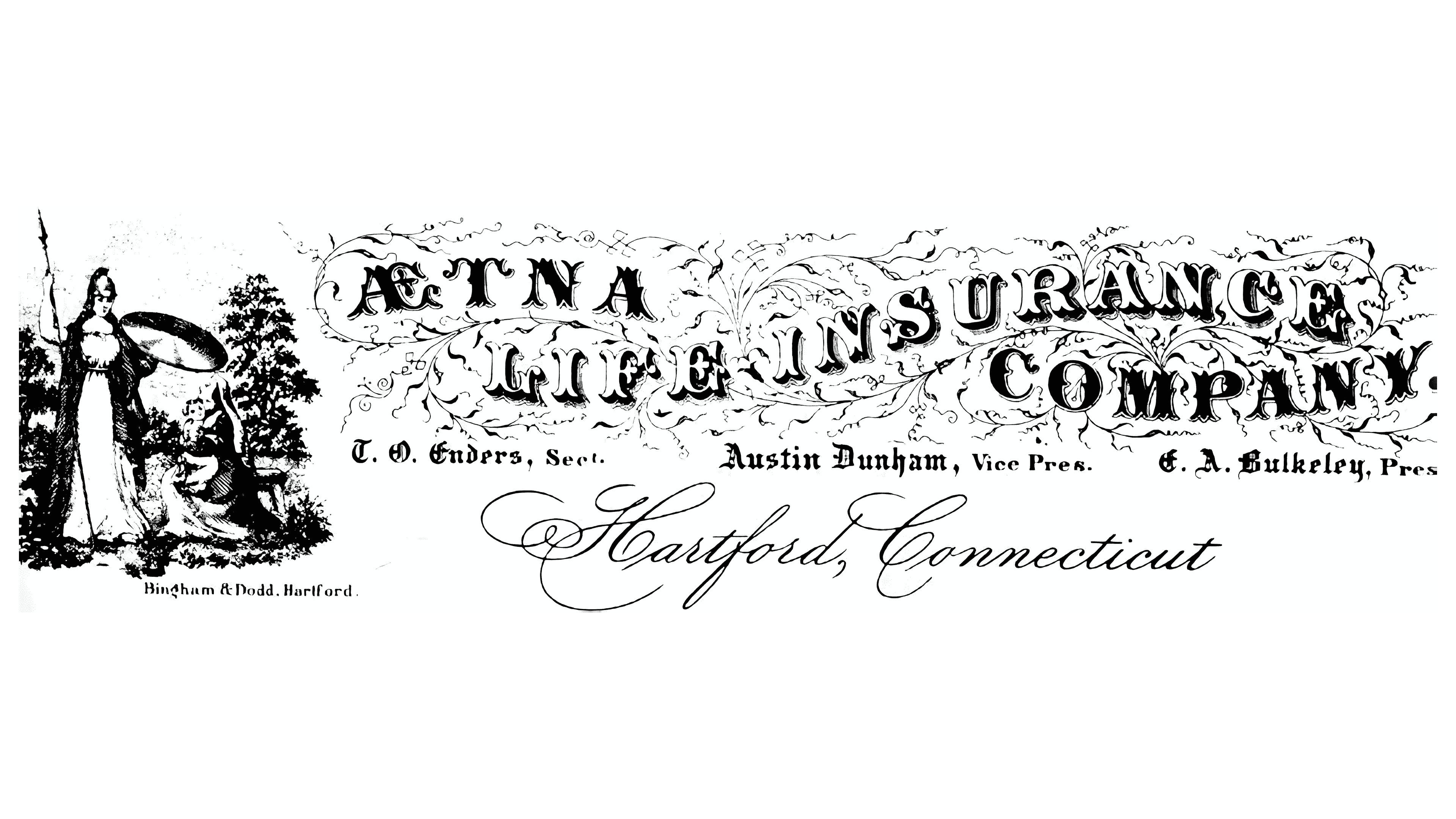
In 1853, a division of the original Aetna firm became the basis for the company that now offers life and health insurance. The new organization used a logo that read “AETNA LIFE INSURANCE COMPANY” for advertising. The initial “A” and “E” in the first word were spliced together. The floral ornamentation depicted in the background echoed the figurative Old English letter design. At the bottom was additional text, including the city and state where the insurance firm was established. The designers had the phrase “Hartford, Connecticut” in a fine calligraphic script.
On the left was an elaborate graphic composition. The central element was a woman with a lance and a sword, presumably the Roman goddess Minerva, patroness of wisdom, medicine, and the arts. She towered over a seated woman holding a child. Trees surrounded them.
1908 – 1965

Following the minimalist trend, the designers simplified the emblem’s structure. The new version contained a black circle with a white “AETNA ” inscription. The letters’ shapes were adapted to fit the circle’s size, filling the entire inner space. The first “A” and “E” were joined by horizontal lines to form a monogram or, more precisely, a ligature.
1965 – 1989

In 1965, Lippincott & Margulies updated Aetna’s corporate image. As a result, the logo became rectangular in shape and orange. The white lettering remained, but the font was completely different from previous versions. Specialists converted the “t,” “n,” and the last “a” to lowercase, using a custom bold font with massive serifs. The “A” and the “E” at the beginning remained uppercase. Only the ligature style was changed. At the same time, the letters merged, with very narrow intervals between them. The brand’s name was not centered in the rectangle but at the top, right-aligned.
1989 – 1996

After another redesign, the base turned into a red square. The letters were disconnected, but the ligature remained. The logo’s creators redesigned it by enlarging the “E” and removing the horizontal bar at the top of the “A.” They did this because the font changed to a bold geometric grotesque with balanced proportions. As in the previous case, the lettering was at the top of the quadrangle, only this time it was center-aligned.
1996 – 2001

The square base disappeared, and the insurance company’s name was repainted in terracotta with a pink tint. The letters became more angular. The last “a” has a miniature triangular serif at the bottom.
2001 – 2012

For the first time in many years, the designers removed the ligature at the beginning of the word, separating the “A” and the “E.” They chose a font that combined thin and wide strokes. They decorated the ends of the letters with long serifs. To the left of the inscription was a schematic figure of a man with his hands raised. A yellow ribbon waved above his head. Both the silhouette and the brand name were blue, but the icon used two different shades.
2012 – 2019

In 2012, Aetna reorganized to reflect the impact of healthcare reform on its insurance services. To confirm its intentions, it revamped the logo with help from the agency Siegel+Gale. The designers got rid of the human figure and focused only on the lettering:
- They made all the letters lowercase and reunited the “a” and “e”.
- They created a custom sans-serif typeface that combined wide lines, smooth rounding, and right angles.
- Navy blue was replaced by purple.
2019 – today
Aetna’s new corporate logo follows CVS Health Corporation’s acquisition of the brand. A purple heart-shaped icon was added next to the lettering to mark the occasion. The same element, but in red, adorns the CVS Health logo.
Font and Colors

Although Aetna’s main symbol is now the heart, it carries less significance than the ligature formed by the letters “a” and “e.” A crucial historical legacy reflects the insurance company’s commitment to cooperation and assistance. The symmetry among the connected characters speaks to the harmony between the organization and its clients.
The font was designed specifically for Aetna. It shares features with eSpectrum Extra Bold and FF Signa Round Pro Condensed, but differs in the smooth rounding of some fragments. All letters are lowercase, which corresponds to modern standards. Previously, the inscription used a Bodoni variety.

The logo’s color is unusual for an insurance company. As you know, financial institutions often signal conservatism with dark colors. Aetna chose to stand out with a bright purple palette.