


 Barbie Logo PNG
The first children’s toy for girls appeared and, at the same time, received the recognizable Barbie logo, which, through a series of changes, retained its recognizability, modern look, and compliance with new requirements. The logo’s color and style reflect the target consumer’s gender identity.
The Barbie concept emerged in the early 1950s, when Ruth Handler, co-founder of Mattel, noticed her daughter playing with paper dolls representing adult women. At the time, the market focused on baby dolls, leaving no equivalent for role-play.
In 1956, during a trip to Europe, Handler discovered the German doll Bild Lilli and brought several examples back to the United States. With designer Jack Ryan, they adapted the concept into a mass-market product and named it after her daughter, Barbara.
On March 9, 1959, Barbie debuted at the American International Toy Fair in New York. The first version, priced at $3, wore a black-and-white swimsuit and featured a high ponytail. Despite skepticism, the company sold about 300,000 units in the first year.
Marketing played a key role. Since 1955, Mattel had promoted toys through television, including sponsorship of the Mickey Mouse Club, and Barbie entered TV advertising at launch. Mattel sold clothing and accessories separately, establishing an ongoing sales model.
The product line expanded quickly. Ken appeared in 1961, followed by Midge in 1963 and Skipper in 1964. Dolls with different skin tones were introduced in 1968, while official Black and Hispanic versions arrived in 1980.
In 1961, Bild Lilli, Greiner & Hausser filed a patent claim. The dispute was settled, and in 1964 Mattel acquired full rights for $21,600.
Criticism over body proportions led to revisions. In 2016, Mattel introduced new body types and broader diversity. By 2006, over one billion dollars had been sold worldwide.
Meaning and History
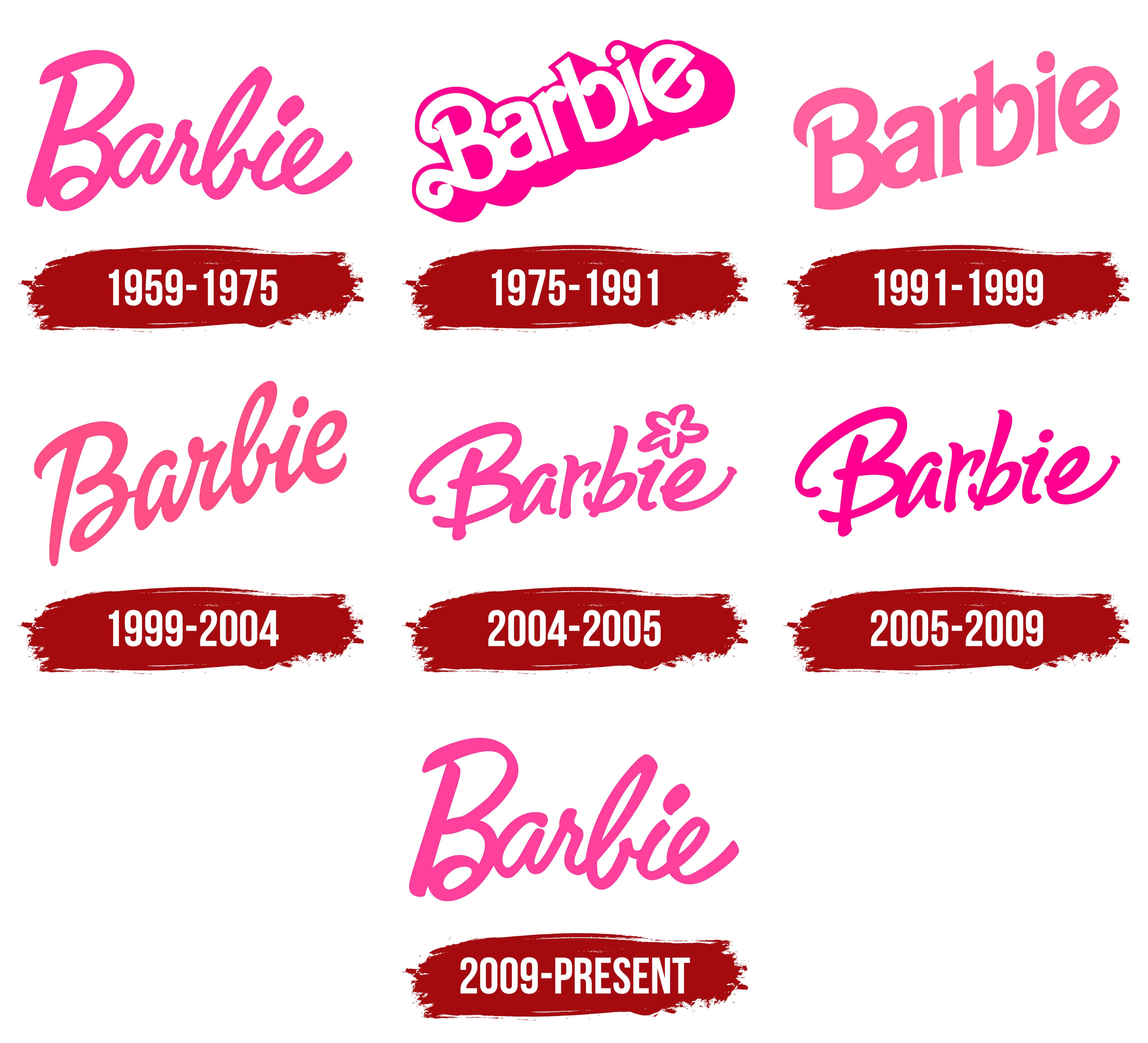
An adult doll with various outfits and accessories quickly gained popularity among girls, becoming a true brand. Its logo appeared simultaneously with the toy and has undergone about five modifications. Initially, the brand name was written in cursive; as the Barbie design expanded, it adopted a different style.
What is Barbie?
Barbie is an American toy brand. The brand name became the proper name for the dolls, first introduced in 1959. For a long time, they were the world’s best-selling dolls, but after the launch of the Bratz doll, their popularity began to decline. Mattel is the dolls’ primary owner and manufacturer.
1959 – 1975
The original emblem was handwritten in a childlike, semi-glamorous style. The first letter is capitalized; the rest are lowercase. The lowest are “a,” “r,” and “e.” The top loop of the second “b” is almost as tall as the capital “B.” Thanks to the dot, the symbol “i” appears quite large and is only slightly smaller than “b.”
The text symbol has two highlights. The main one is the jumping letters, which are arranged randomly rather than in order. They have completely different tops and bottoms, which makes the logo look light and casual. This stylistic technique supports a playful mood, airiness, naivety, and charm. Another feature is a curl on the capital letter “B.” It sits at the bottom and curves inward, forming a miniature oval.
1975 – 1991
The debut logo lasted for more than 15 years before being revised. An attempt to modernize the trademark led to a volumetric, practical, background-free name in a cheerful mood. The main emphasis is on strictness and shadows, which give the word a 3D effect.
All letters in the logo are the same height and lowercase, except for the capital “B.” The line is straight, and the symbols are aligned. The only thing that dilutes the emblem’s seriousness is the rising inscription, as the word is positioned diagonally. This technique conveys happiness and optimism. The most unusual letter is “B,” consisting of two elegant curls. The other letters look stretched and wide because of overly large shadows.
1991 – 1999
In 1991, designers returned the logo to its joyful and childlike lightness. They simplified it by removing bulky details. The letter shapes remained unchanged, except for the removal of unnecessary curls from the letter “B.” This version was perceived as much more interesting despite the restrained writing style. The lowercase letters “b” and “i” are now almost the same height.
1999 – 2004
In 1999, the logo developers revisited it. As a result, the font became cursive, with a slight rightward tilt. The capital letter “B” regained its lower inner curl, making it airy and elegant. The word “Barbie” appears to be written in one stroke, without breaking the connection between the characters. The logo’s color is close to red.
2004 – 2005
The previous version of the logo lasted only one year before being adjusted. The artists made the first letter expansive and bold, with the top and bottom parts extending far beyond the front legs. The symbols are written without internal connections and arranged differently, so the name looks like it’s galloping. The lowercase letter “b” has a tail, and “i” is a five-petal flower instead of a dot. Thus, the company’s management ensured the logo was as childlike as possible.
2005 – 2009
After four years, the logo changed again: the flower disappeared, and a classic dot took its place. The letter “a” remained unclosed, and “e” had an upward-stretched leg.
2009 – today
The debut emblem, established in 1959, is still in use. It has been adopted unchanged and is recognized as the standard for both style and color.
Font and Colors
Across the Barbie brand, designers have used only the word “part” in the logo; it has never included graphics. The word is positioned diagonally and reads from bottom to top.
barbie head logo
The emblem’s font is custom, primarily in an italicized, handwritten style. The brand’s color has been a gentle candy pink since its inception and has remained consistent.
FAQ
What is Barbie’s signature color?
Mattel owns Barbie’s signature color, Barbie Pink (Pantone 219C). To emphasize this, Mattel and Pantone jointly released a new doll in a pink dress featuring numerous Pantone 219C markings.
Why is the Barbie logo pink?
Designers relied on gender stereotypes to choose a color for the Barbie logo. They made the wordmark bright pink because they believed this shade would attract the attention of the target audience, girls and women.
What does the Barbie logo look like?
The Barbie logo is a bright pink wordmark. The inscription is in a handwritten font, which looks elegant and relaxed. All letter edges are slightly rounded.