


 DTS Logo PNG
The DTS logo is bright, like a paradise bird. The emblem conveys a play of sound, shifts, and the merging of audio at different pitches, creating a rich and voluminous flow. It demonstrates the tandem of various company technologies.
DTS was founded in October 1990 by audio engineer Terry Beard, a Caltech graduate with two decades of experience in stereo recording equipment. Beard believed cinema sound formats in the early 1990s fell short of modern filmmakers’ needs. Through mutual contacts, he reached Steven Spielberg. He demonstrated a remastered version of “Close Encounters of the Third Kind” in the DTS format.
Spielberg chose DTS for his next film, and development began in 1991, four years after Dolby Laboratories had started work on Dolby Digital. DTS reached theaters on June 11, 1993, with “Jurassic Park,” about a year after Dolby Digital debuted in “Batman Returns.” With support from Universal Pictures and Matsushita Electric, more than 1,000 U.S. theaters adopted the system.
“Jurassic Park” made DTS known through five independent channels and a subwoofer, giving the dinosaur sound mix more depth than analog optical tracks could provide. Universal Pictures supported DTS exclusively until late 1997. In January 1997, “Jurassic Park” became the first home video release with DTS sound on LaserDisc, two years after the first Dolby Digital home release.
DTS then moved into licensing for home theater, DVD, Blu-ray, and digital broadcasting. In 2008, it separated its cinema unit as DTS Digital Cinema, later renamed Datasat Digital Sound. DTS bought SRS Labs in 2012 for about $148 million, adding more than 1,000 audio patents and trademarks, and then acquired Manzanita Systems in 2014. Tessera Holding Corporation completed its acquisition of DTS on December 1, 2016, and the combined company was renamed Xperi Corporation in February 2017.
Meaning and History
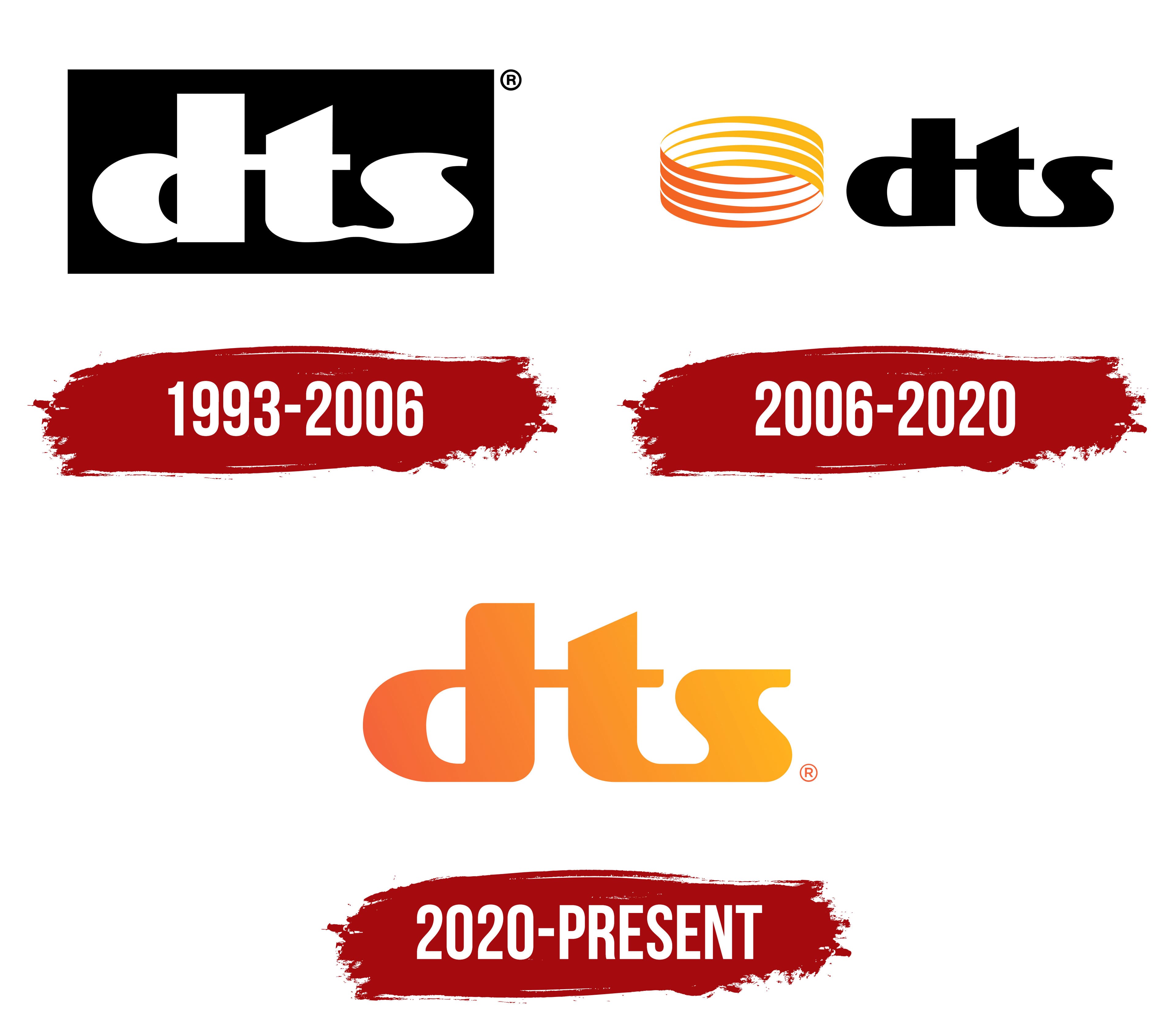
The inscription format chosen in 1993 has been maintained in the company’s logo for the past 30 years. It indicates DTS’s connection to the film industry and film reels. It explains the product’s operating principle. The surrounding elements of the inscription changed with ownership changes, but the overall message remained constant. The logo represents the product as a modern sound system, indispensable for an enjoyable viewing experience.
What is DTS?
Surround sound technology was developed in the United States in 1993 and is used in cinema, on DVDs, and for home theaters. Modern systems have 5-7 audio channels, plus one for the subwoofer. For movie theaters, the sound is stored on special discs, read by the processor, and combined with the image.
1993 – 2006

The first logo likely appeared after 1995. Before that, the program was called The Digital Experience since its inception. The logo consists of a black rectangular background and lowercase white letters DTS, connected.
The black background resembles a dark movie theater screen displaying credits or a section of a filmstrip. The program focuses on sound creation for video content, which is why DTS is often used in movie theaters. The system also debuted in cinemas. Hence, the choice of background.
The interconnected glyphs resemble a filmstrip. They represent the unification of all channels, or audio tracks, into a single sound. It also hints at the product’s history of being brought to light.
A young university graduate developed the system, and perhaps no one would have learned about it if Terry Beard, through acquaintances of acquaintances, hadn’t managed to reach the famous Spielberg, who liked the sound. After that, all the movie theaters showing “Jurassic Park” began using DTS. Therefore, the product’s emblem encodes the importance of connections between people.
The letters stand for Digital Theater Systems. The lowercase writing represents the system as an auxiliary tool during viewing. All consumer attention is focused on the screen. DTS works behind the scenes and, with video, lighting, and costumes, creates a unique tandem visible to the viewer.
The white lettering indicates the product’s novelty.
2006 – 2020

2020 – today

In 2020, the company owning DTS merged with TiVo, forming Xperi Holding Corporation. This caused a review and update of all the company’s brands.
The modern logo is brighter and lighter. The dark background is gone, and the letters now have a gradient. The technique connects DTS to the parent holding, whose emblem also features a changing color palette.
The merged letters still demonstrate the connection among all audio channels, which, when combined, create volume. The technique also illustrates the theater system’s operation: the processor reads sound stored on separate CD-ROM discs and combines it into a single stream.
Font and Colors
The logo’s color scheme gradually transitions from orange to yellow. The shades embody comfort and enjoyable viewing. The palette lifts the mood, evoking the sun and gold and presenting DTS as a popular system that has earned recognition and a high position. The gradient suggests the harmonious merging of multiple sounds into a single background.
The inscription’s font is unique because of its merged lettering, resembling a Dolmen. All the elements’ angles are smoothed, hinting at the sound’s smoothness.