


 EMC Logo PNG
The EMC logo is interesting and rich in symbolism. The emblem reflects the company’s team as a group of outstanding, unconventional programmers, enabling the firm to lead the industry.
EMC Corporation was founded on August 23, 1979, by Richard Egan and Roger Marino, former Northeastern University classmates. Egan studied at MIT, worked on guidance systems for Apollo missions, and later gained data-storage experience at Cambridge Memories, later known as Cambex. To raise early capital, the founders even sold office furniture. The name EMC came from the initials of Egan and Marino.
The company’s first real product arrived in 1981, a 64 KB memory board for Prime Computer systems. By 1983, EMC had expanded into DEC VAX and Wang Laboratories systems and reached $6 million in annual revenue. Rapid growth exposed product-quality problems in the late 1980s, especially with faulty disk drives. In 1988, Michael Ruettgers was appointed president and CEO.
EMC’s turning point came in 1987, when it hired engineer Moshe Yanai to build an enterprise disk array for IBM mainframes. In 1990, EMC launched Symmetrix 4400, a 24 GB cached disk array that connected to IBM mainframes as native storage while using cheaper small-form-factor disks. Two months later, Delta Air Lines signed a $10 million contract, and by June 1993, EMC had sold more than 2,000 Symmetrix systems.
Under Ruettgers, who became CEO in January 1992, revenue grew from $120 million to almost $9 billion within a decade. EMC entered the Fortune 500 and challenged IBM in mainframe storage. In 1993, it bought Epoch Systems and Magna Computer Corporation. In 2004, EMC acquired VMware for about $625 million and kept it as a separate unit, giving EMC a major software asset against rivals such as Hitachi Data Systems. Dell completed its acquisition of EMC in October 2016, creating Dell Technologies, while the EMC name continued to be used as Dell EMC.
Meaning and History
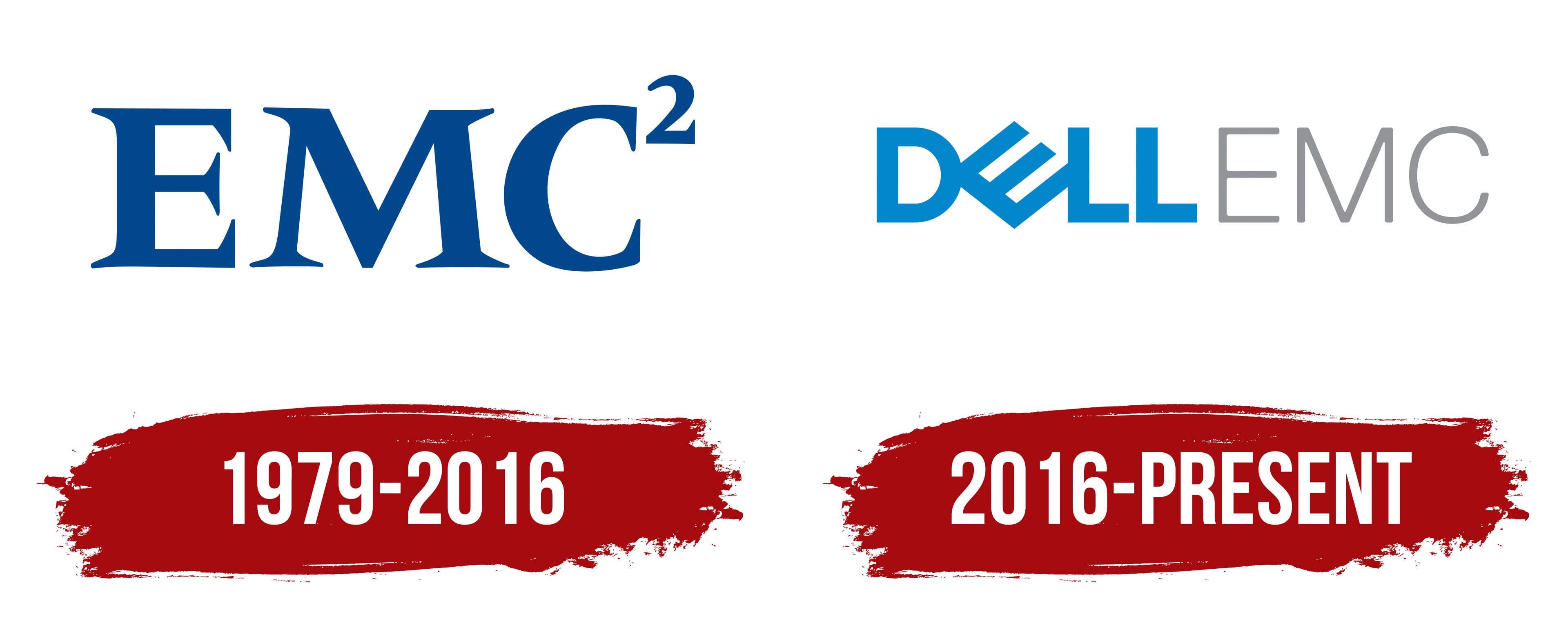
The logo’s history is brief, but the transformations it has undergone have significantly changed the visual symbol. The main transformations relate to changes in the corporation’s name. The owners of both companies that became Dell-EMC possessed extraordinary thinking and embedded important messages in their emblems, which intrigue and provoke thought. The unconventional approach to visual identity made the branding memorable.
What is EMC?
EMC specializes in developing software, network, and storage devices for data storage. The developer’s portfolio includes systems such as Symmetrix, Atmos, VMAX, and Data Domain. After merging with Dell to form Dell-EMC, the corporation made its products available to customers in 180 countries.
1979 – 2016

The first logo features the capital letters EMC, arranged in a square, resembling a mathematical formula. Calculations, logic, and computing systems are necessary to store and structure data and make choices appropriate to the company’s field of activity.
The serifs reinforce the impression. These elements symbolize attention to detail, rigor, and individuality. The letters E and M stand for the founders’ surnames: Egan and Marino, while C has a double meaning:
- Company.
- Initial letters of the surnames of two employees who later left the firm. Since there were two of them, C is represented in a square.
The logo’s composition fully replicates Einstein’s formula E=mc², thereby enhancing the emblem’s recognizability and memorability.
The saturated color of the inscription symbolizes development and the absorption of competitors. After 2000, the company acquired five companies and created two joint ventures. In 2012, it ranked second among computer organizations in Fortune’s ranking.
2016 – today
In 2016, EMC was acquired by Dell. The new owner renamed the merged company Dell-EMC, added it to the Dell Technologies portfolio, and redesigned the logo. The prefix “Dell” appeared before the letters “EMC” in the emblem.
The two parts of the name are written in different fonts, emphasizing the distinction between the two brands. Designers also used color separation.
In the word Dell, the letter E is turned sideways. The idea was developed by the branding agency Siegel+Gale. The company’s founder, after whom it was named, dreamed of changing the world with his products, “turning it upside down.” The symbol’s rotation made it one of IT’s most memorable logos.
The first part of the name Dell-EMC appears fresh and confident. The blue color and bold glyphs indicate a leading position. The EMC inscription became less bright. The lines appear thin, almost vanishing. This approach signals the brand’s retreat into the background and foreshadows its gradual absorption.
The subtle representation of EMC also reflects the joint venture’s shift in focus, now concentrated on cloud servers with enhanced security. Data storage systems in their previous form are now a thing of the past.
Font and Colors
The logo’s main colors are blue and gray. Light blue represents calculations, calmness, and stability, reflecting the company’s aspirations, dreams, and plans. Semi-transparent gray symbolizes painstaking work, lengthy calculations, and program code- everything that remains invisible to the user. The two parts of the inscription represent two sides of the coin in the technological world: the first, the presentable appearance and pleasant interface; the second, the constant routine work necessary for the system to function stably.
The font of both parts of the word is straight and smooth, suggesting flawless operation without bugs or complexity, along with an efficient command system and convenient data storage.