


 Gateway Logo PNG
The Gateway logo is unique and does not resemble the emblems of other IT companies. The sign focuses on the audience the company serves. The emblem brings the manufacturer closer to customers and evokes trust.
Gateway was founded in 1985, after Ted Waitt left the University of Iowa and spent 9 months selling computers in Des Moines. With coworker Mike Hammond, he started TIPC Network in his parents’ farmhouse in Sioux City, Iowa, using a $10,000 loan from his grandmother. The company first sold peripherals and software for older Texas Instruments computers through a $ 20-membership-discount catalog.
In 1987, the business was incorporated as Gateway 2000, Inc., and it moved into IBM-compatible computers, selling at prices below competitors’. Its 1988 full-page magazine campaign used the line “Computers from Iowa?” and helped push sales to $70.6 million in 1989. The cow-spotted shipping boxes, tied to Waitt’s family cattle background, became one of Gateway’s most recognizable marks in the 1990s.
Gateway moved to North Sioux City, South Dakota, in 1989, opened a new 33,000-square-foot plant, went public in 1993, and reached $6.3 billion in annual revenue by 1997. The company bought Amiga assets from Escom in 1997 and built Gateway Country Stores across suburban America. In 1998, it shortened its name to Gateway, Inc. It moved its headquarters to San Diego, a shift that Waitt later linked to a cultural split within the company.
The dot-com crash hurt Gateway badly as it lost ground to Dell and low-cost rivals. On April 1, 2004, it closed its 188 remaining retail stores. On March 11, 2004, it bought eMachines for $30 million before moving to Irvine, California. Acer acquired Gateway in October 2007 for $710 million, adding the brand to its U.S. push against HP.
Meaning and History
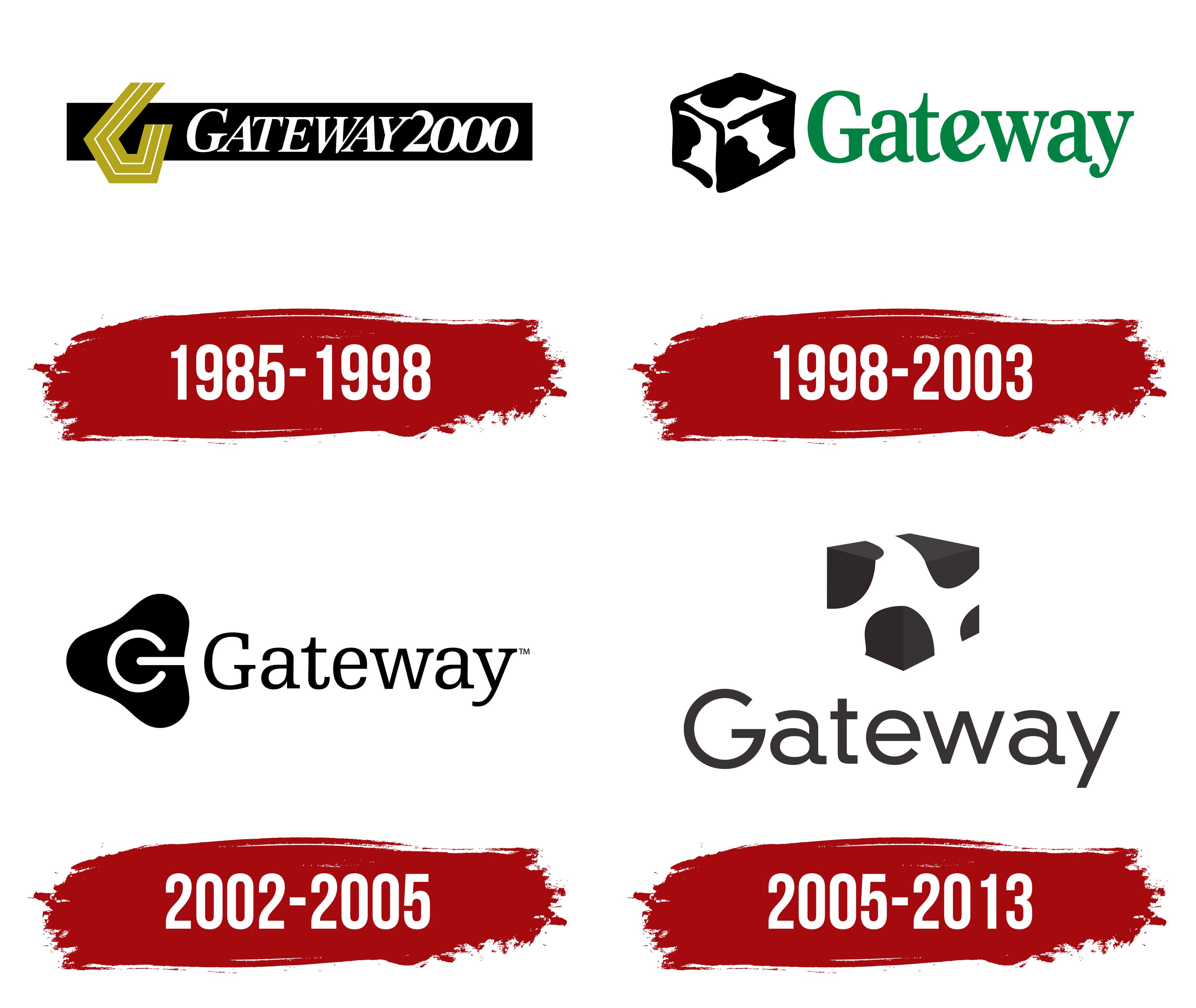
Throughout its existence, the company has developed a unique style, evident not only in the logo but also in packaging, naming, and even the location of its head office. Multiple changes to the sign have formed the main elements of the composition. With each update, the logo became more harmonious. By 2005, it had acquired ideal proportions, which were preserved until Acer acquired the company and temporarily suspended Gateway’s activities until 2020.
What is Gateway?
This American computer hardware business is known for its “cow” reputation. This manufacturer’s products were packaged in boxes with black-and-white spots resembling a Holstein cow. The “farm” theme became the company’s distinctive mark, beginning as a small family business in Iowa, where cows were a familiar part of the rural landscape. Becoming one of the largest PC manufacturers in the United States, the company produced personal computers, laptops, and monitors. Branded stores called the Country Store offered customers a unique sales strategy, providing detailed recommendations on how to use the equipment.
1985 – 1998
The company began as TIPC. However, after introducing custom-built computers to the price list, it changed its name to Gateway 2000. The name reflected the path to computerization and technological development for residents of small settlements with whom the Waitt brothers worked.
The idea of the path is reflected in the logo twice: with a black stripe and a brown road bend, personifying the letter G. On the black asphalt highway, the name Gateway 2000 is placed forward toward the future.
The intricate canvas of the highway reflected the idea of remoteness, distant settlements, and villages, to whose inhabitants the company helped move towards technical progress.
1998 – 2003
2002 – 2005

2005 – 2013
Over time, Gateway associated its identity with cows. The logo consists of a black inscription and a white cube with black spots reminiscent of animal coloration. The unusual solution is inspired by the desire to reach residents of small towns, ranches, and farms.
Pride in their country. After all, the Holstein breed, whose coloring is used in the emblem, was developed in the United States. The animals are widespread in small farms and are associated with American farming. Using their coloration is a message: the brand is as American and “native” as the familiar animals found in every home.
An attempt to show that the company’s computers and laptops have reached such a technological level that they have become practically alive.
The desire to convey the message: the brand’s product will become a reliable friend capable of solving important life tasks.
The analogy to cows, which produce a lot of milk, indicates the corporation’s high productivity and growing income. It also hints at the childhood of founder Ted Waitt, who spent many years living and working on his parents’ farm in Iowa.
The cube is a symbol of artificial intelligence and a prototype for packaging goods in spot-marked boxes.
Font and Colors
The combination of black and white creates contrast, representing Gateway as a unique brand against a common background. White reflects innovation, discoveries, and development. Black represents a reliable foundation and many years of experience. Interestingly, the cube’s corners are painted in a dark shade, indicating the brand’s stable, resilient position in the market.
The logo font resembles DINNeuzeitGroteskStd-Light but with a unique twist in the lower part of the glyph “a,” which seems to point the way forward. The thin light letters of the inscription symbolize high technology, the company’s narrow profile, and its individuality.