


 Gulf Oil Logo PNG
The Gulf Oil logo reflects the company’s long history, resilience, and respect for its roots. The concise design maintains a connection to tradition, emphasizing stability and professionalism. It creates the image of a company that values its heritage and looks confidently to the future.
Gulf Oil began with the Spindletop discovery near Beaumont, Texas, in January 1901. The well sent oil about 50 meters into the air and produced roughly 100,000 barrels a day, more than all other U.S. wells combined at the time. Pittsburgh banker William Larimer Mellon moved quickly into the field, backing J.M. Guffey Petroleum Company and then Gulf Refining Company.
In 1907, the Mellon family combined production, pipelines, and refining into the Gulf Oil Corporation, based in Pittsburgh. Gulf was vertically integrated from the start, with its own fields, transport system, and refineries. Its main early rival was Standard Oil, but the 1911 antitrust breakup of Rockefeller’s monopoly opened more room for independent oil companies.
In 1913, Gulf opened a full-service gasoline station on Baum Boulevard in Pittsburgh. This format changed fuel retailing in the United States. Before that, gasoline was often sold through pharmacies and general stores. Gulf’s station model used a canopy, pump, and trained staff, while the orange-and-blue disk became familiar along the East Coast and across the South.
International production later reshaped the company. In 1938, Gulf received a Kuwait concession with the Anglo-Persian Oil Company, later BP. By 1946, its Kuwaiti output exceeded the Gulf’s U.S. production. Nationalization in Kuwait in 1975, shifting terms in Angola and Nigeria, and political-payment scandals in 1975-1976 weakened the company. In 1984, Chevron bought Gulf for about $13.2 billion after a takeover fight involving Mesa Petroleum. In 2010, Cumberland Farms acquired North American rights to the Gulf brand.
Meaning and History
What is Gulf Oil?
This is a large-scale oil corporation that began as a small business and, over time, became one of the largest players in the global oil industry. Its extensive network of gas stations and the high quality of its petroleum products have earned it recognition and visibility, symbolized by its distinctive orange-and-blue logo. The organization’s motor oils, fuels, and other petroleum products are in demand among consumers across regions, including the United States, Europe, and Asia, underscoring their importance in the global energy industry.
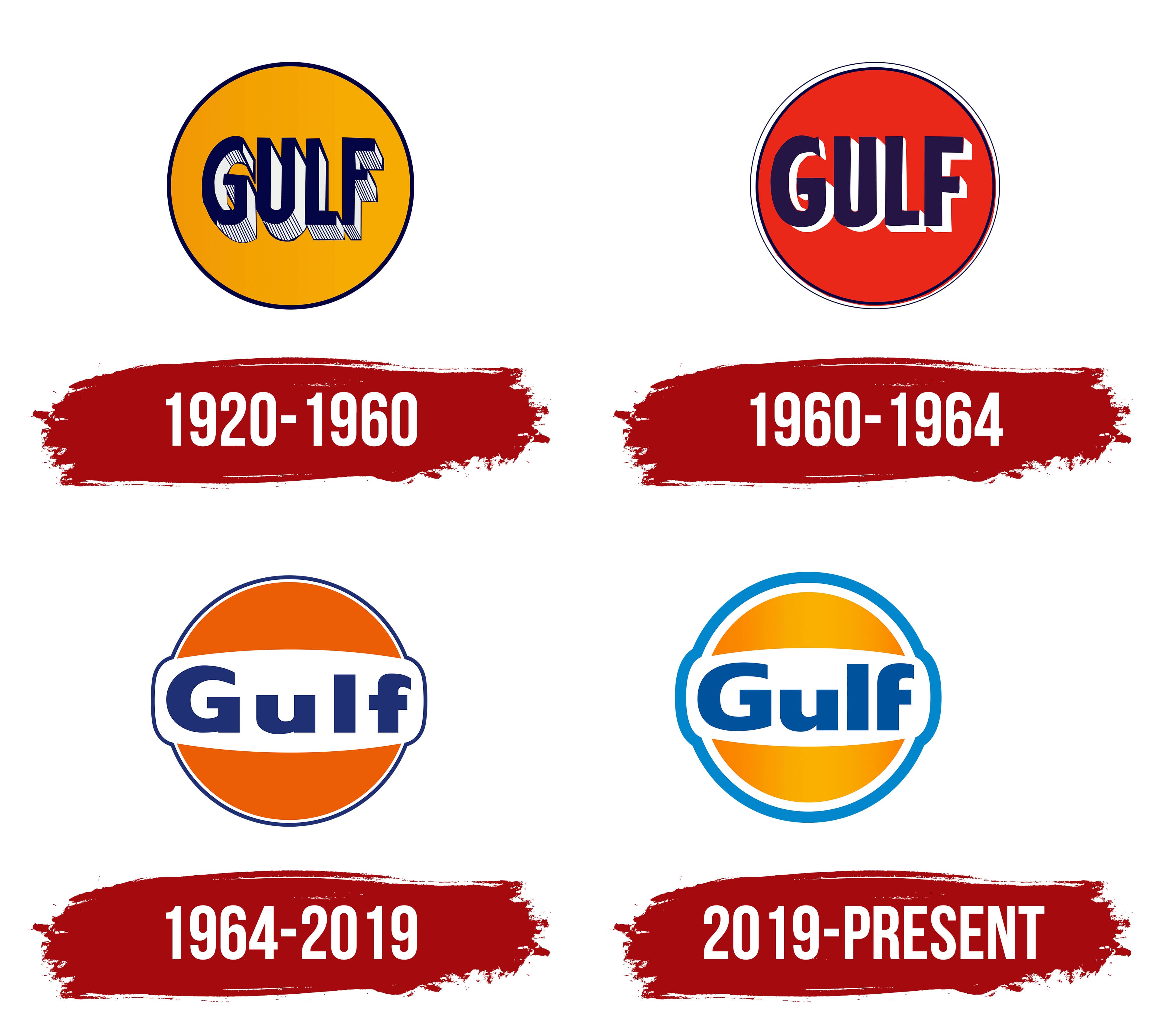
1920 – 1960
1960 – 1964
1964 – 2019
2019 – today
The Gulf logo features a simple circular design that emphasizes the company’s connection to the fuel and energy industry. The primary element is a circle, symbolizing unity and the global scale of the company’s operations. The circle is divided into upper and lower sections and rendered in a bright orange with a soft gradient. This shade conveys energy, warmth, and strength, reflecting the nature of the company’s work.
At the center is a horizontal white stripe that serves as the background for the text element. Positioned on the stripe is the company name, “Gulf.” The capital letter “G” stands out with its boldness and precise geometric lines, setting the tone for the visual symbol. The other letters are in a bold block style with rounded corners, balancing seriousness and approachability. Their deep blue color is associated with reliability and stability.
The outer edge of the circle is outlined with a thin blue line, completing the overall composition and adding cohesiveness to the logo. Subtle bulges along the edges of the circle give the design a dynamic, modern look. This small but expressive detail adds character and helps the emblem stand out among others.
The emblem combines a clear design, symbolism, and a well-thought-out color palette. It showcases how the company blends tradition with a modern approach, maintaining its recognizable presence in the oil industry.