


 NRL Logo PNG
The National Rugby League (NRL) logo conveys strength, dynamism, and athletic discipline. Clear lines and strict shapes highlight rugby’s tough, demanding character, appealing to a broad audience.
Australian rugby league grew from a dispute over professionalism. The Southern Rugby Union, founded in Sydney in 1874, had expanded to 79 clubs by 1900. Players challenged the amateur system, seeking payment for matches and compensation for injuries. In August 1907, supporters of payment formed the New South Wales Rugby Football League.
The competition began in 1908 and attracted a working-class audience. Dally Messenger’s move from rugby union gave the professional code credibility. That year, Australia toured England, and its national team adopted the nickname the Kangaroos. Rugby league established its main support in New South Wales and Queensland, becoming a major east-coast spectator sport by the 1950s. The 1965 final drew more than 78,000 people.
State of Origin began in 1980, matching players according to the state where they were born or developed. The series between New South Wales and Queensland became one of the sport’s main events. During the 1990s, Rupert Murdoch’s News Limited backed the rival Super League and recruited clubs and players from the Australian Rugby League, dividing competitions and audiences.
The organizations reunited in 1998 to form the National Rugby League. The NRL combined clubs from both systems and developed a new management structure after the conflict. By the mid-2000s, it had become a major Australian sporting competition alongside the AFL. The league later reached 17 teams, with expansion plans involving Papua New Guinea and Western Australia.
Meaning and History
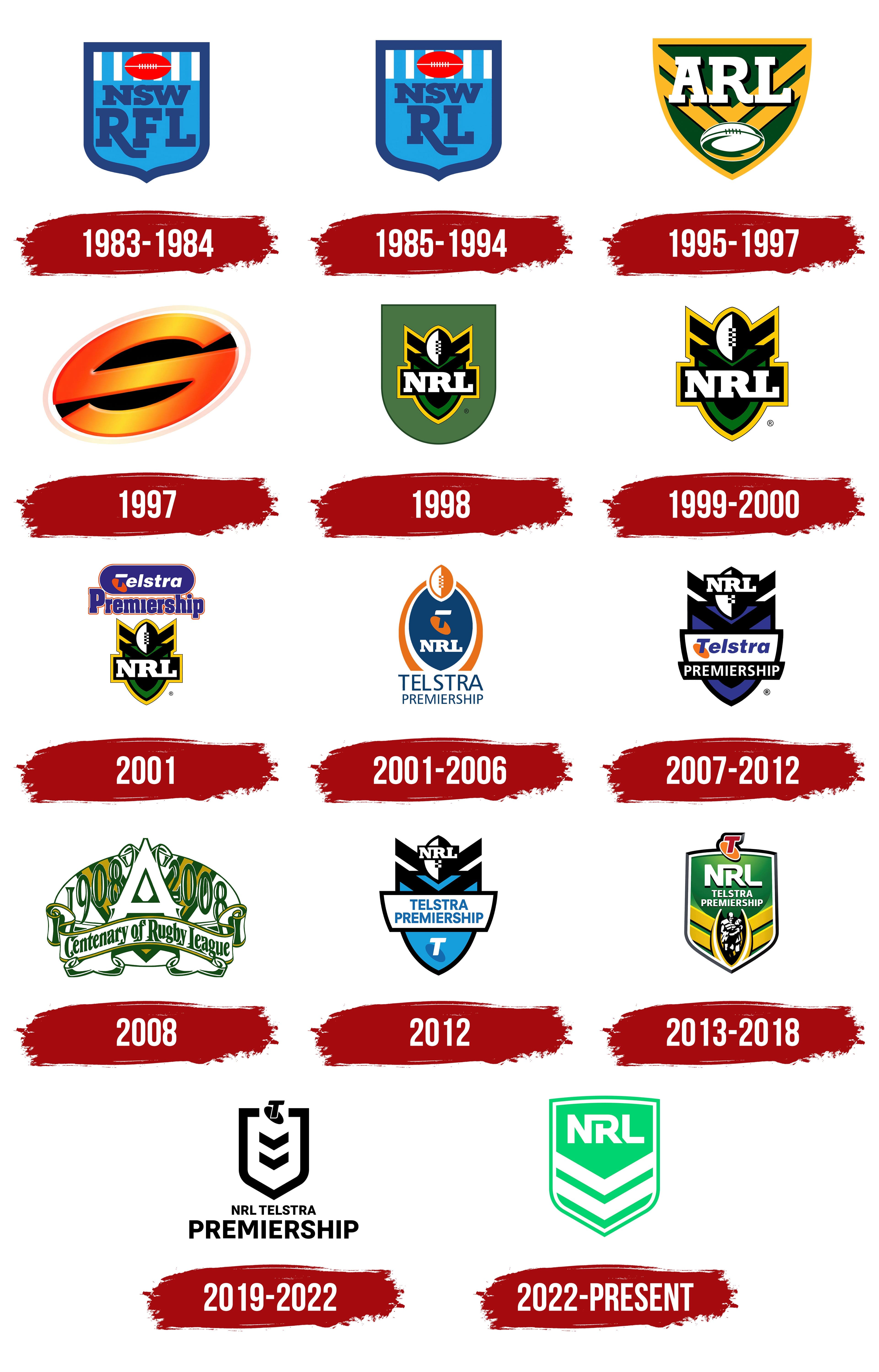
What is NRL?
It is the leading professional rugby league competition, uniting clubs from two Pacific countries. The tournament features 17 teams, including one from New Zealand, with the remaining clubs representing Australia. The main match of the season gathers over 80,000 spectators at Sydney’s largest stadium. The most exciting games are considered those between teams from Australia’s two major states.
1983 – 1984
The first logo of the New South Wales Rugby Football League (NSWRFL) was created in a modern style with a classic heraldic base. The logo’s foundation is a shield divided into two compositional sections.
The upper part of the emblem is filled with vertical white stripes alternating with light blue stripes. Against this background is a red rugby ball in a horizontal oval shape with white stitching. This design emphasizes the organization’s connection to the sport.
The lower part of the shield is light blue and bears the abbreviation “NSW RFL” in two lines. The letters are set in a bold typeface with rectangular serifs. The letter “R” features an elongated, curved tail that extends beyond the character, adding expressiveness. The letters in the lower row (“RFL”) are larger than those in the upper row (“NSW”), highlighting the league’s purpose.
The shield is outlined with a dark blue border, enhancing the contrast. The color scheme is associated with regional symbols and traditions.
1985 – 1994
In 1985, the New South Wales Rugby League logo was updated after the league’s name was shortened from NSWRFL to NSWRL. The shield’s design retained its heraldic shape, characterized by a rounded base and a flat top.
The shield is divided into two sections. The upper part contains vertical white and light blue stripes. Against this background is a red oval rugby ball with white stitching, indicating its connection to the sport.
The main change was removing the letter “F” (Football) from the abbreviation. The shield now displays the letters “NSW” and “RL,” set in a geometric serif typeface. The letter “R” has an elongated stroke extending under the “L,” adding expressiveness.
The colors remained the same: the shield’s background is light blue, the letters and border are dark blue, and the red ball serves as an accent.
The updated logo maintained its recognizability while simplifying the league’s identification.
1995 – 1997
In 1995, the New South Wales Rugby League was renamed the Australian Rugby League (ARL) due to expansion and the addition of new teams. This change was reflected in the organization’s logo, which was redesigned with an entirely new structure, color palette, and typography.
The emblem is presented as a classic shield with a flat horizontal top edge and smoothly curving sides that meet at the bottom.
The shield’s color scheme is a contrasting green-and-yellow palette. The central section features a dark green background with a repeating yellow chevron pattern composed of sharp, downward-pointing V-shaped elements.
The inscription “ARL,” occupying the upper half of the shield, is set in a massive, ultra-bold sans-serif typeface with rectangular glyph shapes. The white letters are accented with a black drop shadow, adding depth and visual contrast.
Beneath the text block is a stylized white oval-shaped rugby ball with simple green detailing. Its placement at the bottom of the logo maintains the emblem’s visual balance and reinforces the organization’s sports focus.
The overall visual composition of the ARL logo conveys confidence, authority, and professionalism.
1997

The league underwent another rebrand, becoming the Super League. Although it lasted only two seasons under the new name, this period was marked by a bold, radical change to the logo.
The new Super League logo is highly simplified, consisting of a single central element: a stylized letter “S” in a dynamic, right-leaning shape. The glyph features massive, horizontally elongated proportions and a complete absence of serifs, giving it a distinctly futuristic character. Special attention is given to its three-dimensional rendering, with volumetric shading and pronounced highlights that enhance the sense of speed, energy, and a forward-looking approach to the sport.
The emblem’s color scheme features vivid orange tones with smooth gradients that transition from bright yellow to deep orange. The color symbolizes the league’s energy, passion, and ambition, emphasizing its drive to be an innovator and leader in the sports arena. The letter is outlined with a light contour, creating visual contrast and highlighting its form against any background.
The minimalist composition reinforces the idea of pure athletic power, innovative vision, and ease of brand recognition.
1998

In 1998, the National Rugby League (NRL) adopted its modern format, leading to the creation of a new logo.
The emblem is shaped like a shield with a flat horizontal top edge and a smoothly rounded lower edge, symbolizing protection and reliability for the sports organization. The main field of the logo is colored in a muted shade of green, evoking the playing field and rugby tradition, and symbolizing growth, stability, and the league’s development.
The central feature of the logo is a complex chevron design consisting of two symmetrical elements, colored black and outlined in bright yellow. These downward-pointing chevrons symbolize dynamic motion and determination. The visual composition of the chevrons is complemented by a stylized rugby ball placed vertically at the center of the upper part of the shield. The ball is divided into black and white halves, visually emphasizing balance and fair competition in the sport while symbolically expressing unity and the opposing forces that meet on the playing field.
The text portion features a bold white “NRL” inscription set in a heavy typeface with large rectangular serifs. The white glyphs are outlined in solid black, enhancing contrast and definition. The font choice conveys seriousness, confidence, and authority, reflecting the league’s status as the largest organization in Australian rugby.
The use of yellow in the outline and details highlights energy, sporting spirit, and ambition for high achievement. At the same time, the combination of green and black visually reinforces the connection to tradition.
1999 – 2000
The updated version of the NRL logo retained the core compositional elements but introduced changes in structure and visual presentation.
The most notable change was the removal of the shield’s green background. The mark now appeared as a standalone emblem without the shield or enclosing outlines. This decision enhanced the contrast of the elements, making the design more open and adaptable to various backgrounds and surfaces.
The configuration of the chevrons was also refined. They became sharper and more geometric thanks to thicker yellow outlines and solid black interior shapes, which added more depth and dynamism. Reducing the green areas and emphasizing black enhanced the perception of structure and improved the clarity of the graphic forms.
The typography remained the same, but with the more open design, the white “NRL” lettering gained greater impact. Its bold, blocky glyphs with rectangular serifs became more legible thanks to the strong contrast with the background and the chevron’s geometry.
2001

In 2001, the NRL’s visual identity was supplemented with Telstra Corporation branding elements as part of a new sponsorship agreement. The updated composition became three-part, with the iconic NRL chevron now accompanied by two new text and graphic blocks placed above the main symbol.
Above the central emblem is the Telstra corporate mark, consisting of a horizontally elongated oval in blue outlined with a double border in white and orange. The sponsor’s name is set in a white sans-serif typeface. The initial “T,” partially overlapping the orange oval, forms Telstra’s signature combination and emphasizes the sponsor’s integration into the NRL brand.
Directly beneath the Telstra logo is a large “Premiership” inscription in uppercase serif letters with a condensed width. The glyphs feature smooth, rounded contours and have a complex three-color structure, with the main color being blue, complemented by white and orange outlines. This reinforces the prestige of the Telstra-sponsored championship and visually ties all parts of the updated logo together.
These additions to the original symbol highlight the commercial partnership and the league’s advancement, visually representing a new stage of professional growth and an elevated championship status.
2001 – 2006

A few months later, the NRL logo was redesigned with a new compositional structure and a color scheme based on Telstra’s corporate palette. A vertically oriented blue oval shape with pointed top and bottom edges forms a balanced silhouette.
Two symmetrically placed orange brackets flank the blue element, resembling the outline of a trophy or cup and symbolizing competition and the championship’s prestige. Positioned slightly away from the central figure, they enhance the perception of depth and give the emblem a more expressive appearance.
A rugby ball in an orange-and-white combination is placed at the top of the logo, serving as an accent reminiscent of a crown.
The abbreviation “NRL” is retained in the composition, rendered in white and set in a bold typeface with strong rectangular serifs. Above it is a simplified Telstra symbol. It features a stylized white-and-blue “T” on an orange oval. The symbol further emphasizes the integration of the sponsor’s brand into the league’s structure.
At the bottom of the emblem is a two-tiered “TELSTRA PREMIERSHIP” inscription in a thin, clean sans serif font.
2007 – 2012
In 2007, the NRL logo was redesigned with a new palette and a revised composition. Telstra’s corporate colors were replaced with a strict combination of black, white, and blue, which increased contrast and improved logo legibility.
The chevron shape was reimagined and simplified through minimalist, defined blue forms without additional outlines. Above the chevron sits a stylized rugby ball in a two-tone black-and-white scheme, with the colors divided vertically.
The abbreviation “NRL” was set in a large, bold typeface with rectangular serifs, remaining in white. Its placement changed, now positioned directly above the ball, visually lightening the emblem’s upper part.
A refreshed sponsor block was added. The “Telstra Premiership” banner is a rectangular structure with two distinct color zones. The upper section features a white background, showcases the Telstra mark, and includes the name in a blue sans-serif typeface and an orange graphic element on the left. The lower black section features the concise word “PREMIERSHIP” in uppercase white letters, set in a strict geometric grotesque font, to emphasize the competition’s official status.
2008
An anniversary emblem was created to mark the centenary of rugby in Australia, highlighting its historical significance. The overall outline of the logo mirrors the silhouette of a rugby ball with smoothly curved upper and lower lines.
The design features a combination of green and yellow, both iconic colors associated with Australian rugby and the nation’s colors. The years “1908” and “2008” are placed symmetrically on the left and right, written in elongated, elegant glyphs with vertical proportions to emphasize the sport’s century-long history.
Between the years is a large letter “A” in a stylized typeface with sharp geometric edges and an internal triangular counter. This glyph represents the country’s name, Australia, highlighting the national importance of the centenary.
The lower part of the composition features a scroll-like ribbon in white and green, outlined in thin yellow. The inscription “Centenary of Rugby League” is rendered in a decorative, calligraphic typeface with smooth curves, prominent serifs, and variable stroke widths, giving the text a sense of formality and significance.
2012
In 2012, the logo underwent targeted changes, affecting mainly the sponsor block. The palette was simplified by removing orange and replacing it with shades of blue and white.
The inscription “TELSTRA PREMIERSHIP” was combined and placed on a single white rectangular background. The font for both words is the same: a strict, geometric sans serif in uppercase blue glyphs. This made the text block clean and neat, emphasizing the official status and clarity of communication.
The Telstra mark (“T”) is placed separately beneath the white banner on the lower segment of the chevron, rendered in white and light blue to create additional color contrast and stand out against the rich blue background.
2013 – 2018
The update changed the NRL logo’s visual concept, introducing a new shield with a three-dimensional perspective and a glossy surface that reflects the league’s modern and dynamic character.
The emblem’s shape is a formal shield with straight upper corners and a pointed base, evoking associations of protection, stability, and authority. The shield’s background is a deep green with a gradient from dark to lighter from top to bottom, emphasizing depth and volume in the design.
The upper part of the composition features the white “NRL” inscription in large, bold geometric sans-serif glyphs. Below it is the text “TELSTRA PREMIERSHIP,” also in white but smaller, establishing a clear hierarchy of elements.
Traditional yellow chevrons are positioned in the lower part of the shield. They have thin black outlines and point upward, symbolically expressing the league’s pursuit of progress and victory. In the center of the chevrons is a stylized black-and-white figure of a player holding a ball, enclosed within decorative, curved yellow-and-white lines that frame it and emphasize the importance of sporting achievement.
At the top of the composition is the updated sponsor mark: a red letter “T” in a dynamic italic form on an orange oval with a thin white outline. Placing the sponsor’s logo above the shield symbolically represents its support and partnership with the league.
2019 – 2022

The logo update marked a shift toward strict minimalism. The new version has no color elements and is rendered in black and white, emphasizing its severity, simplicity, and modern design approach.
The shield outline was made as bold and rigid as possible, drawn with a thick line and sharp corners, giving the image a sense of firmness and confidence. The inner space of the shield is structured as two downward-pointing chevrons, symbolizing dynamism and forward movement. Their placement and shape reflect the league’s sporting nature and ambitious character.
At the top of the emblem is a stylized Telstra “T” positioned within a slightly horizontally elongated oval. The graphics of this element are minimalist and flat, making visual perception easier.
The text portion of the logo is structured and positioned beneath the graphic. The top line, “NRL TELSTRA,” is set in uppercase letters in a simple sans serif of moderate weight. Below it is the word “PREMIERSHIP,” set in the same style but in a bolder weight, creating a visual emphasis.
The logo update marked a shift toward strict minimalism. The new version has no color elements and is rendered in black and white, emphasizing its severity, simplicity, and modern design approach.
The shield outline was made as bold and rigid as possible, drawn with a thick line and sharp corners, giving the image a sense of firmness and confidence. The inner space of the shield is structured as two downward-pointing chevrons, symbolizing dynamism and forward movement. Their placement and shape reflect the league’s sporting nature and ambitious character.
At the top of the emblem is a stylized Telstra “T” positioned within a slightly horizontally elongated oval. The graphics of this element are minimalist and flat, making visual perception easier.
The text portion of the logo is structured and positioned beneath the graphic. The top line, “NRL TELSTRA,” is set in uppercase letters in a simple sans serif of moderate weight. Below it is the word “PREMIERSHIP,” set in the same style but in a bolder weight, creating a visual emphasis.
2022 – today
The current logo is executed in a radically simplified form, reduced to the silhouette of a classic shield with rounded lower corners and a pointed bottom. The color scheme is dominated by a bright lime green shade, symbolizing freshness, energy, and the league’s renewed image.
The abbreviation “NRL” is positioned at the top of the emblem and set in a geometric sans-serif typeface. The letters are connected and stylized, with the “N” and “R” sharing a horizontal bar and having shortened vertical strokes, creating a sense of compactness.
The lower part of the shield features two white downward-pointing chevrons with sharp angles and defined edges.
The use of a vivid, monochromatic palette makes the logo feel modern, enhancing its visual impact and emphasizing the league’s connection to innovation and a younger audience.
Font and Colors

The typography of the NRL logo is based on a geometric sans-serif with large proportions and increased line weight. The “NRL” glyphs have stylistic features, most notably the partial connection of the strokes in the “N” and “R.” This technique adds density and unity to the lettering. At the same time, sharp horizontal cuts emphasize the visual identity’s dynamic and decisive nature.
The logo’s color palette has undergone a radical transformation, moving from a strict monochrome to a bright lime green. This color conveys freshness and novelty, reinforcing the league’s perception as energetic, modern, and forward-looking.