 Teva Logo PNG
Drug manufacturing involves developing, producing, and distributing medications used for treatment and health maintenance. Such products are used in everyday medical practice and require quality control at every stage. The Teva logo represents a pharmaceutical company that produces medications for a wide range of patients.
Teva Pharmaceutical Industries was founded in 1901 in Jerusalem. The company’s original name was Salomon, Levin, and Elstein Ltd. The organization supplied pharmaceutical products. In 1951, three enterprises, Salomon, Levin, and Elstein, Assia, and Zori, merged under the single brand Teva. The company’s name in Hebrew means “nature”.
In the 1960s, the company began industrial production of medicines and export preparations. A new stage of development began in 1985. The company’s management focused on generic drug production and was listed on the Tel Aviv Stock Exchange. Later, Teva shares appeared on NASDAQ.
In the 1990s, the company began expanding through acquisitions. Teva acquired Pharmachim, Biocraft, and Copley Pharmaceutical. In the 2000s and 2010s, the organization made several major acquisitions, including Ivax, Barr, and Ratiopharm. These purchases strengthened the company’s position as a global leader in generic drug production.
In 2016, Teva acquired Allergan’s Actavis division. The deal amounted to $ 40.5 billion. However, the integration increased debt and strained finances. In 2017, Kare Schultz began a large-scale restructuring. It included cost reductions, the sale of non-core assets, and workforce reductions.
By 2021, the company had strengthened its financial position and maintained its presence in the U.S. and European markets. From 2022 to 2024, Teva reduced its debt burden. The main focus was on developing biosimilars and resolving legal issues related to the opioid crisis.
The company continues to operate as one of the world’s largest manufacturers of generic and specialty medicines. It supplies products to more than 60 countries.
Meaning and History
What is Teva?
Teva is an Israeli pharmaceutical corporation and the world’s largest generic drug manufacturer. It produces more than 3,500 types of medicines covering cardiology, neurology, oncology, and respiratory diseases, and also manufactures active pharmaceutical ingredients. The company owns about 80 facilities in 60 countries and supplies products to more than 120 nations. Its portfolio includes the original drug Copaxone for treating multiple sclerosis. The acquisitions of IVAX, Pliva, Ratiopharm, and part of the Actavis assets drove growth.
1986 – 2006
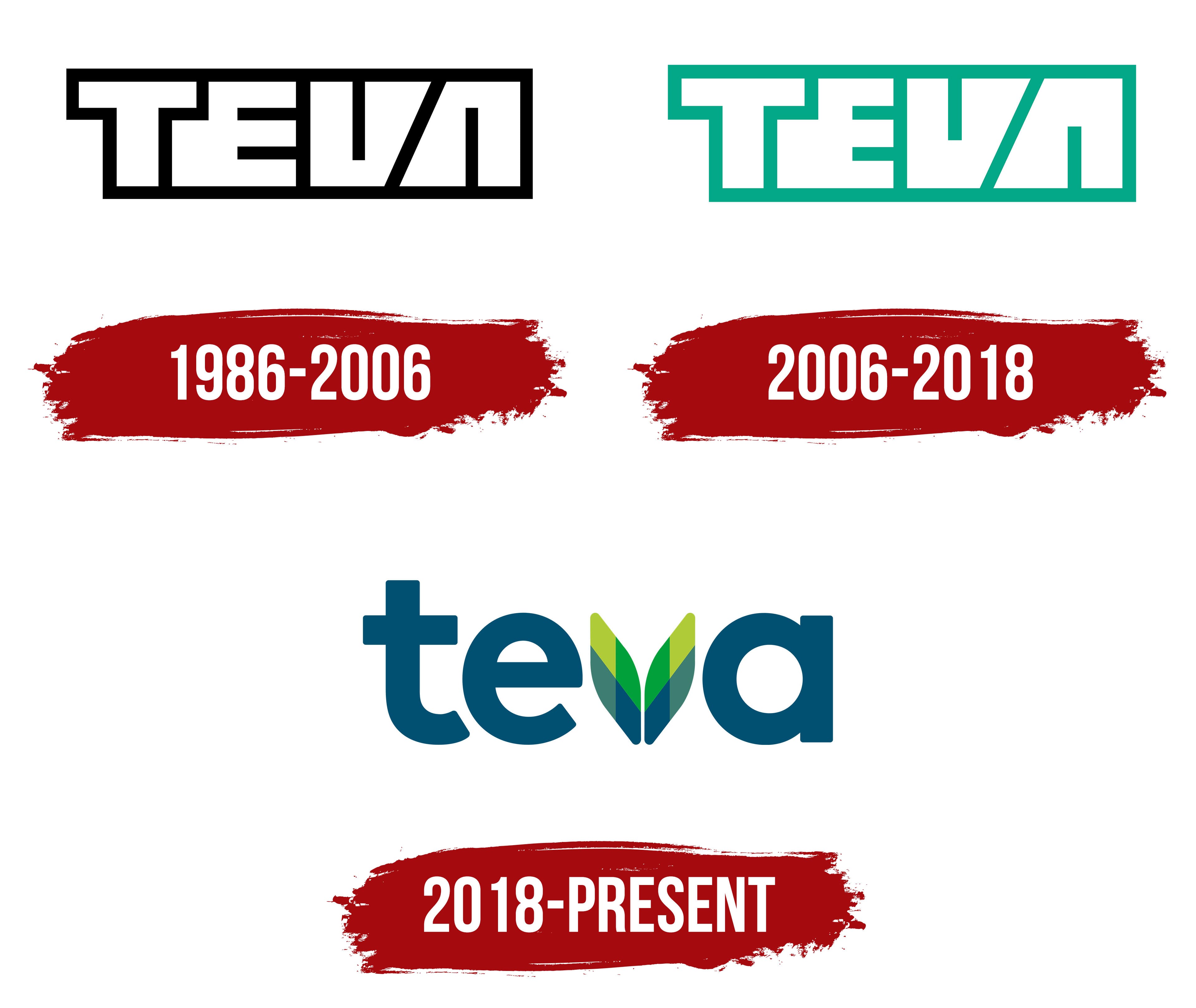
In the first half of the 1980s, Teva began using the Latin-letter TEVA as a standalone logo as it entered the U.S. market. Dan Reisinger designed the wordmark, which appeared on pharmaceutical and veterinary products. In its international version, it represented the company separately from the Hebrew name while preserving the short historic name.
Teva, טבע in Hebrew, means “nature.” The word became part of the name Teva Middle East Pharmaceutical & Chemical Works, founded in Jerusalem on May 1, 1935, by pharmacist and chemist Günther Friedländer and his aunt, Else Kober. The name connected drug manufacturing with natural raw materials and their scientific processing.
The future group also had an earlier predecessor. In 1901, Chaim Salomon, Moshe Levin, and Yitzhak Elstein opened the trading firm Salomon, Levin and Elstein in Jerusalem. It supplied imported medicines throughout Ottoman Palestine, transporting shipments by camel and mule caravans. The manufacturing company Teva, established later, was listed on the Tel Aviv Stock Exchange in 1951.
In 1976, Teva merged with Assia and Zori to form Teva Pharmaceutical Industries Ltd., and Eli Hurvitz became the company’s leader. Adding “Pharmaceutical Industries” clarified its specialty to international partners. In 1982, the Ikapharm facility in Kfar Saba received approval from the U.S. Food and Drug Administration. By the middle of the decade, Teva had begun establishing its American division.
In the logo, heavy uppercase “TEVA” lettering fit inside a frame. Horizontal and vertical lines of equal thickness formed an enclosed structure. The angular letters connected to the outer contour. The name and frame formed a unified design resembling an architectural drawing.
The black-and-white treatment distinguished the letters through thick dark strokes and white counters. Straight cuts and geometric contours maintained a consistent construction throughout the wordmark.
2006 – 2018
The acquisition of IVAX in January 2006 expanded Teva and created a need for a shared identity across numerous markets and manufacturing sites. The logo’s color changed during the same period. By the mid-2000s, a light green-turquoise shade had replaced the previous black.
By 2006, the frame, the shapes of the TEVA letters, and the spaces between them almost entirely retained the construction of the early single-color version. Colored lines surrounded a white interior, distinguishing the name’s contours from the background. The enclosed frame allowed the logo to appear as a complete block on packaging. Green connected the international brand to Teva’s meaning: “nature.”
Teva Pharmaceuticals USA used additional branding versions for prescription drugs. The name TEVA was placed inside the outline of a capsule or a round tablet. The dosage-form depiction supplemented the manufacturer’s name. These versions appeared on products alongside the main framed logo.
2018 – today
In February 2016, Teva announced a program to unite its operations under a shared brand. Following numerous acquisitions, the group included businesses with different local names, packaging, and audience communication guidelines. The acquisition of Actavis Generics in August 2016 expanded the company’s presence to dozens of markets. The shared identity system was intended to show that the local brands belonged to one organization.
Preparations drew on research conducted in 20 countries between 2015 and 2017. Participants included more than 13,500 patients, 9,300 caregivers, and 1,000 healthcare professionals. The findings helped account for the everyday needs of patients and healthcare workers. An approachable, open communication style complemented the brand’s scientific rigor.
The new logo introduced lowercase “teva.” The previous frame was removed, and rounded sans-serif lettering with thick strokes and generous spacing replaced the angular uppercase letters. The main lettering was dark blue. A figure made of 2 leaves replaced the “v,” integrating the image into the word. Soft contours gave the name a friendly appearance.
The diamond-shaped leaves spread upward in a symmetrical pair. Together, they resembled a young shoot or an open book. Within them, geometric sections set at different angles divided the image into colored facets. Light green at the top transitioned into green and turquoise tones, while the lower edges converged at a dark blue point. The plant design referred to the meaning of Teva, “nature.” It could also be used separately from the name.
Dark blue represented the company’s pharmaceutical focus. Turquoise, dark green, and bright lime green added associations of life and health. The new green shade was intended as a warmer, more vibrant complement to the primary color.
The rollout began in France, Russia, and Argentina. In February 2018, the updated brand was introduced in the United States and Canada, with other countries subsequently joining the program. The guidelines covered corporate materials, division names, and pharmaceutical packaging.
Fixed positions were established on packaging for the drug name, active ingredient, strength, and dosage form. The information layout was developed based on research involving patients, physicians, and pharmacists. Color coding helped distinguish product variants. In Italy, the new brand went into use in 2018. Packaging work continued from 2019 through 2020, after which the identity was extended to over-the-counter and generic medicines. In Ukraine, the update was introduced in October 2018, drawing on local research and bringing hundreds of products into a shared system.