


 Vattenfall Logo PNG
The Vattenfall logo creates a sense of balance and stability, emphasizing the brand’s connection to nature and energy. It symbolizes a reliable energy supply and a careful approach to resources, combining natural motifs and modern technologies in a concise, clear design.
Vattenfall, whose name means “waterfall” in Swedish, was founded in 1909 as a state-owned enterprise. The Swedish government created the company to manage the country’s hydropower resources, and hydropower became the basis of its early development. Over time, Vattenfall grew into one of Europe’s major electricity producers and remained one of the region’s largest hydropower companies.
In 1954, Vattenfall commissioned its first nuclear power plant. During the 1960s, the company began diversifying its energy portfolio and entered the nuclear and coal power sectors. It also expanded beyond Sweden, acquiring assets in Germany, the Netherlands, and Poland. In 1968, Vattenfall entered the German market through the acquisition of PreussenElektra.
In the 1990s, Vattenfall transitioned from a state enterprise to a publicly traded company. Its privatization in 1995 marked a new stage of growth and wider European operations. During this period, the company also began shifting part of its activity toward renewable energy, including wind and solar power, while keeping hydropower, nuclear energy, and coal in its portfolio.
In 2000, Vattenfall Sweden acquired the Dutch energy company Nuon, adding to its European business. In 2011, Vattenfall sold its Polish assets, changing part of its international structure. By then, it operated in Sweden, Germany, the Netherlands, Poland, the United Kingdom, and Denmark. In 2017, Vattenfall announced a goal to phase out coal generation by 2030, while continuing work across hydropower, nuclear energy, coal, wind, and solar power.
Meaning and History
What is Vattenfall?
This Swedish state-owned energy entity has evolved from a national electricity producer to one of Europe’s largest energy operators. Its operations encompass a wide range of generation assets, including offshore wind farms in the North Sea, thermal power plants in Germany, and hydropower stations in the mountains of Sweden. A distinctive feature is its comprehensive approach to energy: the organization generates electricity, maintains distribution networks, offers industrial energy solutions, and provides heating for major cities in Northern Europe.
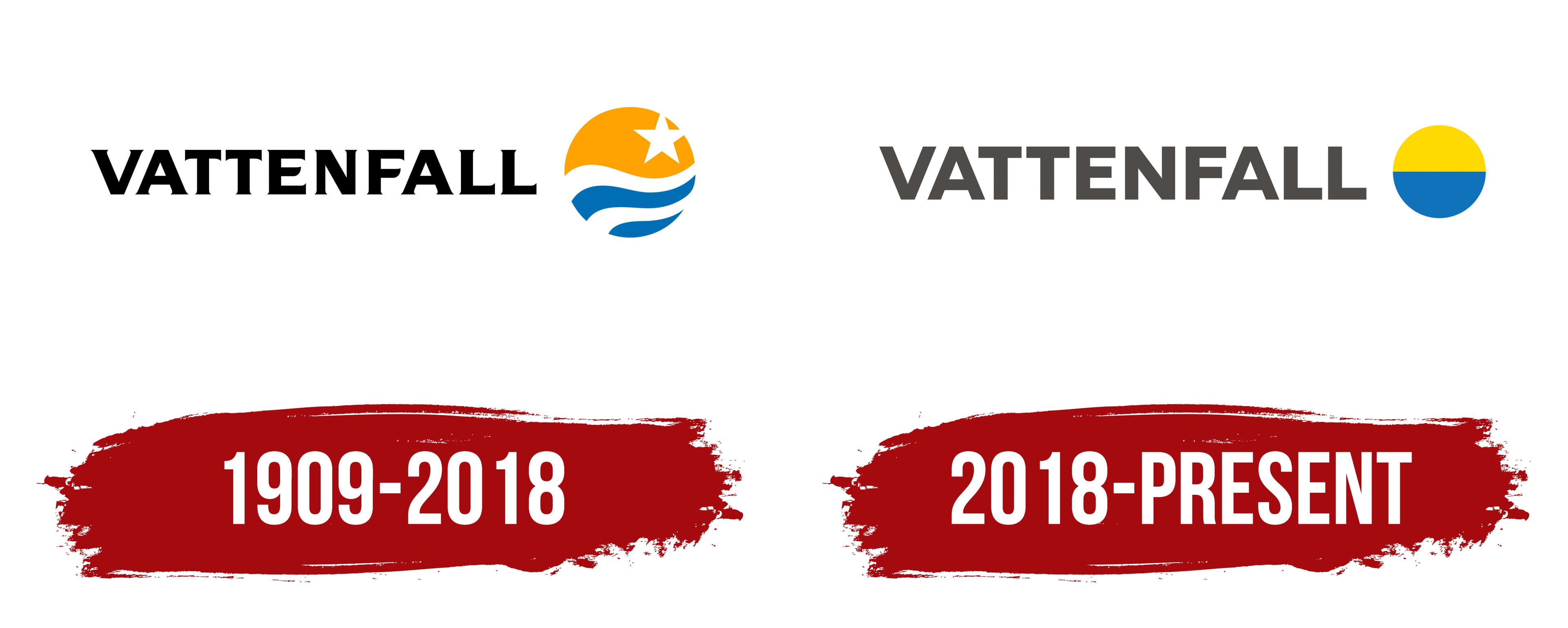
1909 – 2018
2018 – today
The Vattenfall logo is appealing in its simplicity and thoughtfulness. The company name is rendered in large, all-uppercase letters, straight and without unnecessary details. The grotesque font with clean lines conveys a sense of strictness and reliability, while the dark gray text color enhances the brand’s professional, serious character. This design choice emphasizes the company’s stability and confidence in its abilities.
Next to the text is a circle, visually divided into two parts. The upper half is bright yellow, while the lower is deep blue. This contrasting element symbolizes sunlight over water, natural imagery, and energy. The yellow evokes solar energy and optimism, while the blue evokes water and tranquility, hinting at hydroelectric power. This combination highlights the natural resources and modern technologies that underpin the company’s operations.
The company name, when translated from Swedish, means “waterfall.” This word reflects the company’s origins in hydroelectric power. The two-tone circle with elements of the sun and water complements this meaning, visually uniting the brand’s past and present.
The minimalist design of the emblem focuses attention on the company’s core values. The text and circle create a balanced composition in which every detail speaks of stability, innovation, and respect for nature. The simplicity of the design makes the logo memorable and modern, underscoring the company’s commitment to staying current.