


 H&M Logo PNG
The trendy Swedish brand aims to be accessible to most consumers, so H&M chose a simple logo. It consists of only two letters from the company’s abbreviated name, connected by an ampersand. The focus on the consumer and the simplicity of the H&M logo have paid off: the clothing manufacturer has gained widespread popularity. Of course, product quality is not a minor consideration.
H&M began in October 1947 when Erling Persson opened a women’s clothing store called Hennes in Västerås after studying mass retail in the United States. The idea focused on fashionable items at accessible prices.
In 1952, the flagship moved to Stockholm, and in 1964, the first international store opened in Norway, followed by Denmark in 1967. A key shift came in 1968 when Persson acquired Mauritz Widforss, adding menswear and forming Hennes & Mauritz.
The company went public in 1974 to support expansion and entered the UK market in 1976. After Persson died in 1980, his son Stefan Persson took over leadership.
In the 1990s, H&M expanded globally. In 1998, it launched online stores in Sweden and Finland, and in 2000, it opened a store on Fifth Avenue in New York, entering direct competition with Zara and Inditex.
In 2004, a collaboration with Karl Lagerfeld set a new model for mass retail partnerships, followed by projects with Stella McCartney, Comme des Garçons, Versace, and Balmain.
The group diversified in 2007 with COS, and later with brands such as & Other Stories, Monki, and Arket. Expansion into China began in 2013 and spread across Asia and other regions.
By 2017–2018, H&M operated about 4,500 stores across over 70 countries but faced pressure from unsold stock and criticism of its fast-fashion model, prompting a shift toward online retail.
Meaning and History
The brand’s logo evolved from the word “Hennes.” This word was on the company’s first logo. Translated from Swedish, it meant “She,” which was declared on the original emblem. This continued until the brand’s founder bought another retailer, a competing trade network.
The company’s name and logo then changed to H&M. At the same time, designers added a graphical element to the verbal designation. But gradually, the phrase “narrowed” to two letters, laying the foundation for a recognizable image. The retail chain has three main logo variants and one variation.
What is H&M?
This is a Swedish mass-market retailer that has developed a unique fast-fashion model, offering clothing for the whole family at affordable prices. Under several brands, including a premium line and a youth-oriented collection, it provides a wide range of products, from basic apparel and trendy collections to home goods, cosmetics, and accessories. A distinctive feature is our regular collaborations with renowned designers and companies to create limited-edition collections, making designer fashion more accessible to a wider audience. The company also produces its lines of children’s clothing, sportswear, and underwear.
1947 – 1968
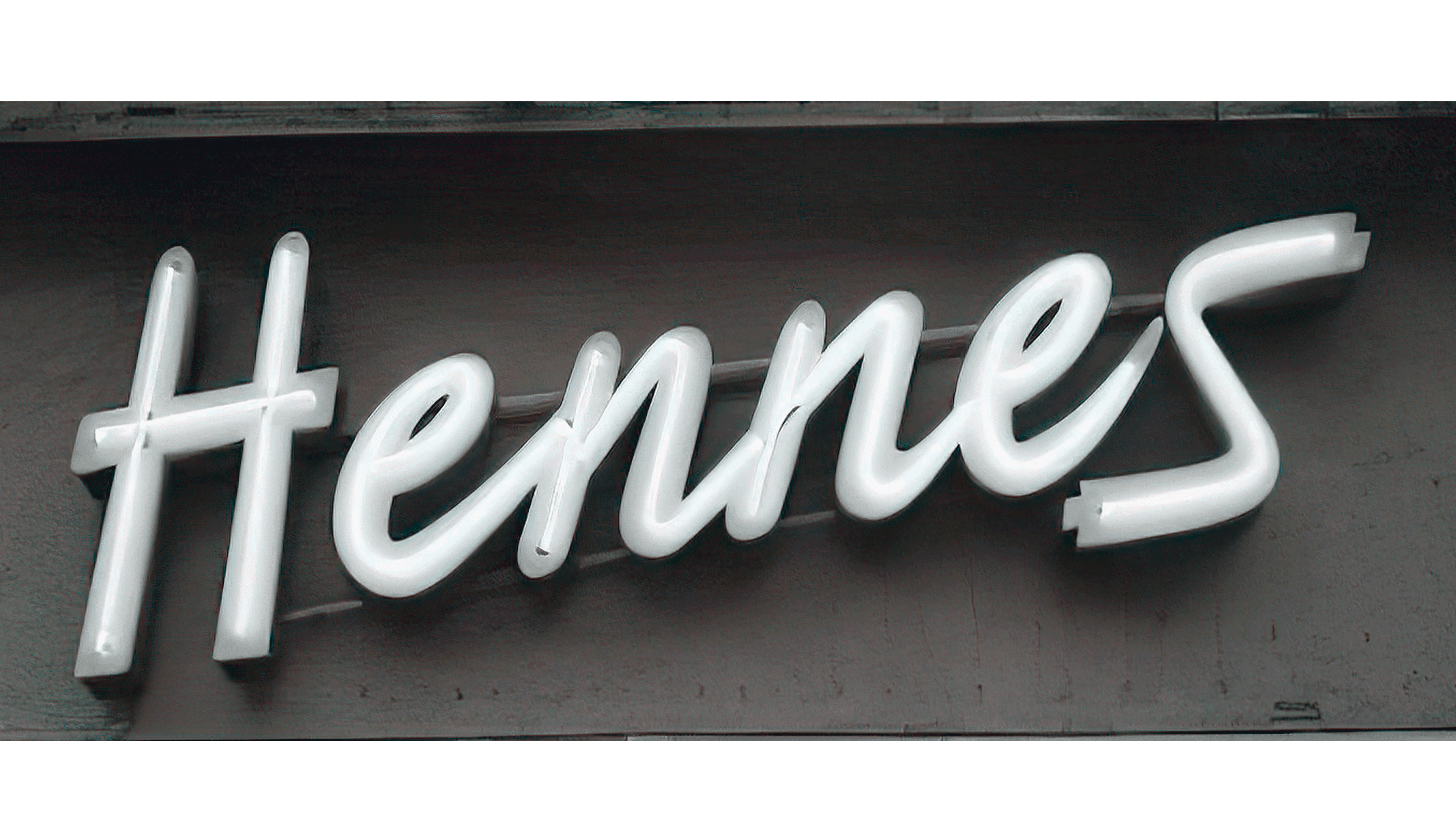
In its founding year, the company adopted a simple logo: a light name on a dark background. The word “Hennes” is written in italics and positioned at an angle, stretched upwards. This is an interesting psychological technique, as optimists write just like this, directing the end of the line not down but upwards.
The letters “H” and “S” are uppercase, and the rest are lowercase. Two lines follow the word, so the inscription appears nailed to the rails. The logo’s 3D effect creates this impression. The field darkens unevenly, with intensification along the upper and right edges.
1968
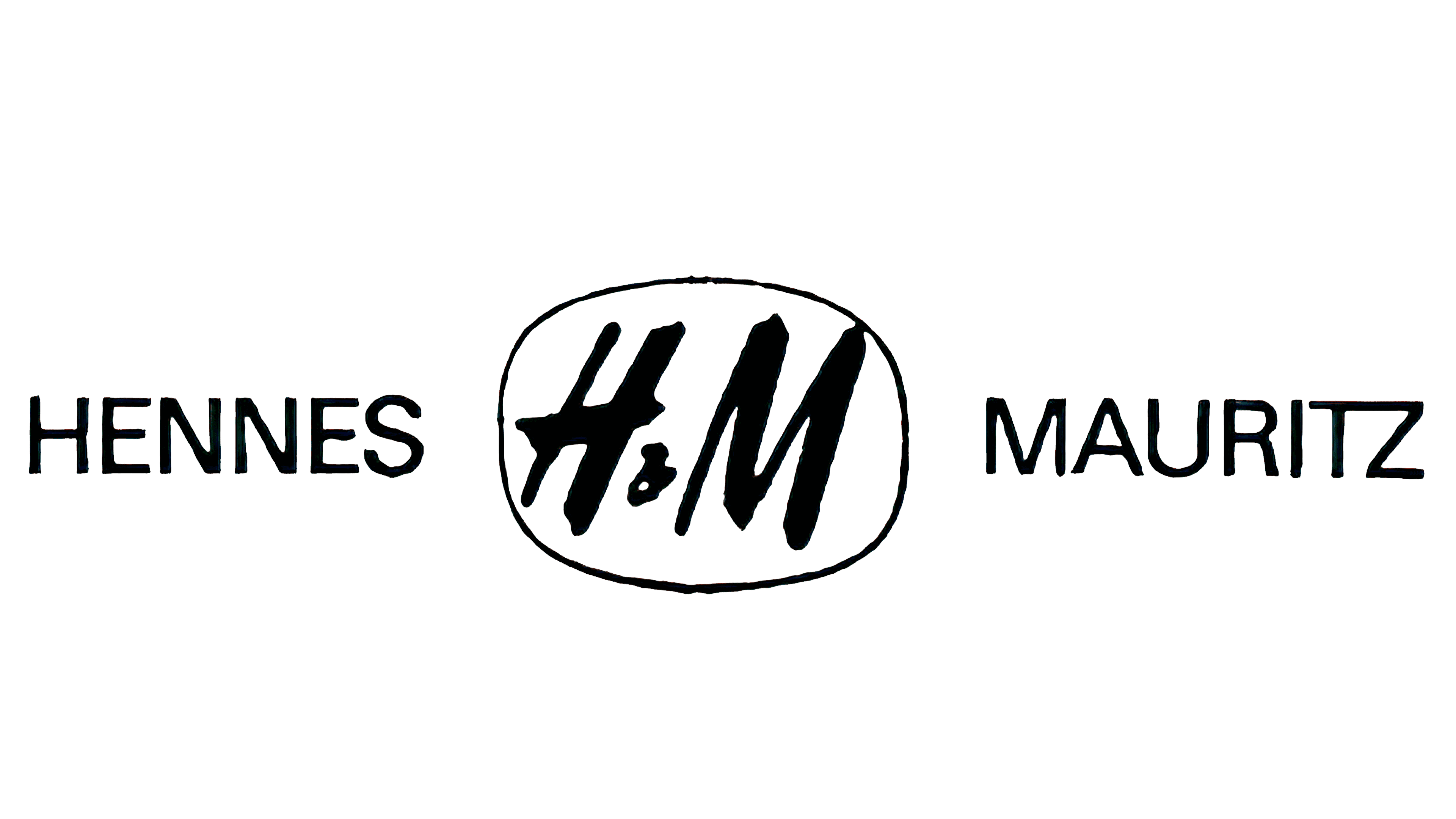
Interestingly, two emblems appeared almost immediately during this period: one in an extended version and another in a minimalist one. The full symbolism encompassed both graphic and textual components. This was the double name “Hennes Mauritz,” obtained after another company joined the main one. The words sit to the left and right of the trademark in a thin, all-caps font. Between them is the abbreviation “H&S,” divided by an ampersand and set in an uneven circle.
1968 – 1999

The second logo is short and bright. If the first version is presented in black and white, this one is in rich red. It features the letters “H & S,” executed with careless brush strokes, as in the previous version.
1999 – today
The logo of that time featured saturated colors: designers replaced scarlet with a darker shade of red. The letters were slightly adjusted and elongated, and the rightward tilt was slightly increased.
Font and Colors
The modern version consists only of letters and an ampersand, so the developers paid great attention to the font. It is individual and italicized. Its distinctive feature is the crossbar of the letter “H,” which is much wider than usual in classic writing and extends beyond the vertical sides. In particular, the developers focused on simplicity, energy, youth, and passion, which influenced their color choice.
The “H&M” inscription on the logo uses a personalized font. The letters are handwritten, not printed; the strokes vary in thickness and resemble a brush. The horizontal bar of the letter “H” is slanted and extends far beyond the two vertical lines. Although the font was created specifically for the company, it vaguely resembles Dom Diagonal by Peter Dombrizian.
As for colors, H&M prefers bright reds and whites. The first is used for the inscription, and the second serves as a contrasting background. But it wasn’t always so: until 1968, the emblem was black-and-white.