


 Louisiana Ragin Cajuns Logo PNG
The Louisiana Ragin’ Cajuns logo is powerful, energetic, and unique. The emblem emphasizes the history of the university’s founding territory, as well as the players’ active style and tenacity on the field.
Louisiana Ragin’ Cajuns athletics began after Southwestern Louisiana Industrial Institute opened in Lafayette in 1898. Organized competition was recorded by 1901, and the teams first used the Bulldogs nickname. In 1963, football coach Russ Faulkinberry renamed his squad the Raging Cajuns after noting that 35 of 39 players came from Louisiana. The shortened form Ragin’ Cajuns became official in 1974.
Men’s basketball brought early national exposure. The team reached the NAIA tournament in 1965 and 1967, then advanced to the Sweet Sixteen in 1972 and 1973 after winning Southland Conference titles. Those later results were vacated because of rule violations. Baseball, first played in 1903, won three American South tournaments from 1988 to 1991, then reached the College World Series in 2000 after eliminating top-seeded South Carolina and finished third nationally.
Softball became the program’s most consistent postseason sport under Yvette Girouard, who coached from 1981 to 2000. Her teams reached the Women’s College World Series in 1993, 1995, and 1996. From 1990 through 2024, the program appeared in nearly every NCAA tournament and won more than 20 conference tournaments.
Cajun Field opened in 1971, football moved to Division I in 1978, and the university joined the Sun Belt Conference in 1991. The Cajundome opened in 1994. Football won the New Orleans Bowl in 2005, 2011, and 2013. However, the latter two victories and 22 games were later vacated over recruiting violations.
Meaning and History
What is Louisiana Ragin’ Cajuns?
These are the athletic teams of the University of Louisiana at Lafayette, competing in NCAA Division I as part of the Sun Belt Conference. They compete in baseball, softball, basketball, soccer, and other sports, playing games at Cajundome and Cajun Field. The teams wear bright red and white, and the Cayenne mascot reflects their character and connection to the region’s culture.
1984 – 1999
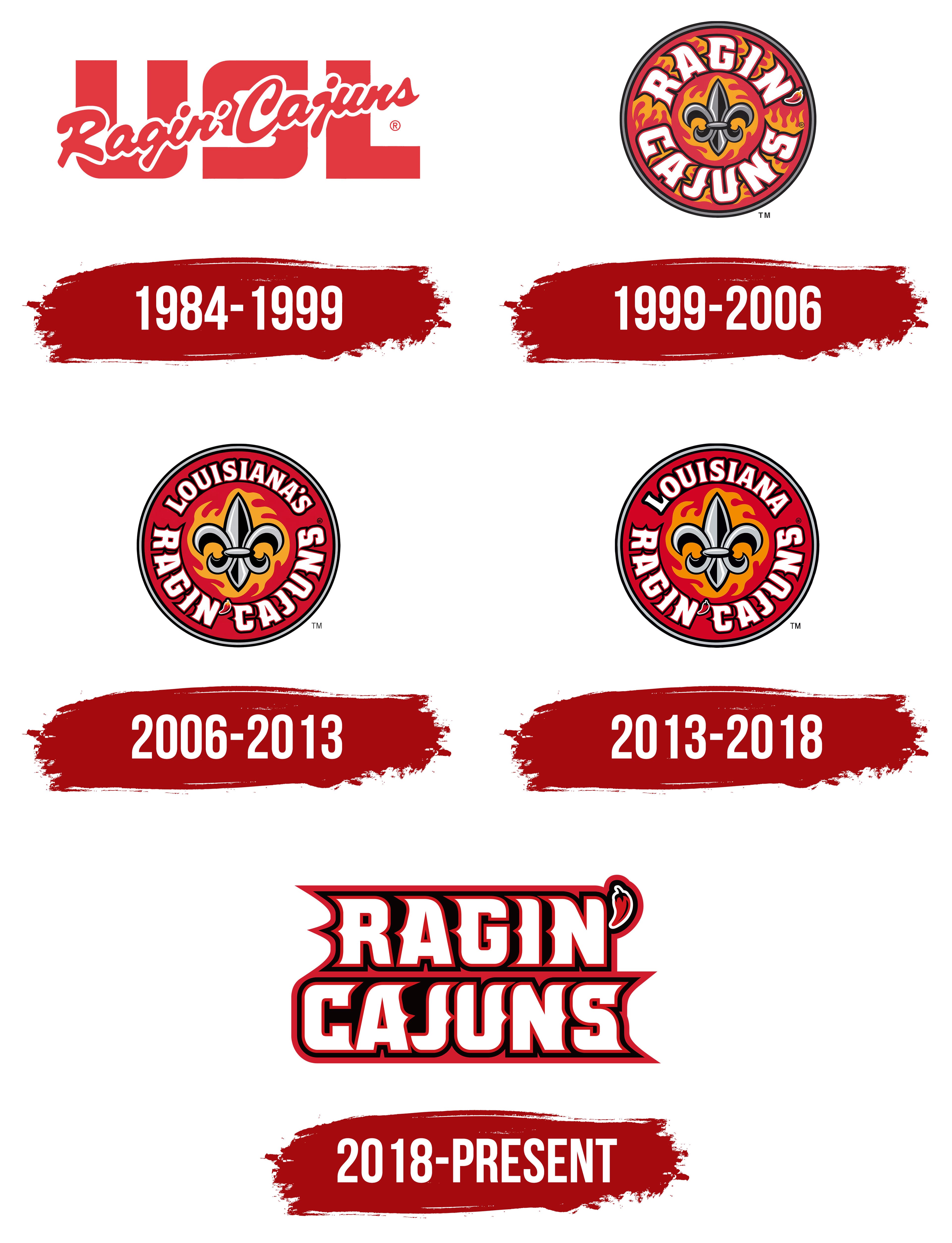
The emblem features a massive abbreviation, “University of Southwestern Louisiana (USL),” with the inscription “Ragin Cajuns” placed diagonally over it in a script font. The team’s modern nickname has been used since 1963; before that, it was called the Bulldogs.
The name “Ragin Cajuns” originated from football coach Russ Faulkinberry, who selected it based on the players’ heritage. Approximately 90% of the athletes were from Louisiana, which is home to the Cajun ethnic group of French descent. The team’s energetic playing style and skill emphasized this choice.
The upward tilt of the inscription and the vibrant red color highlight the athletes’ dynamism, activity, and resilience. The logo was created when the university returned to its original name, which was temporarily changed to the University of Louisiana in 1984.
1999 – 2006
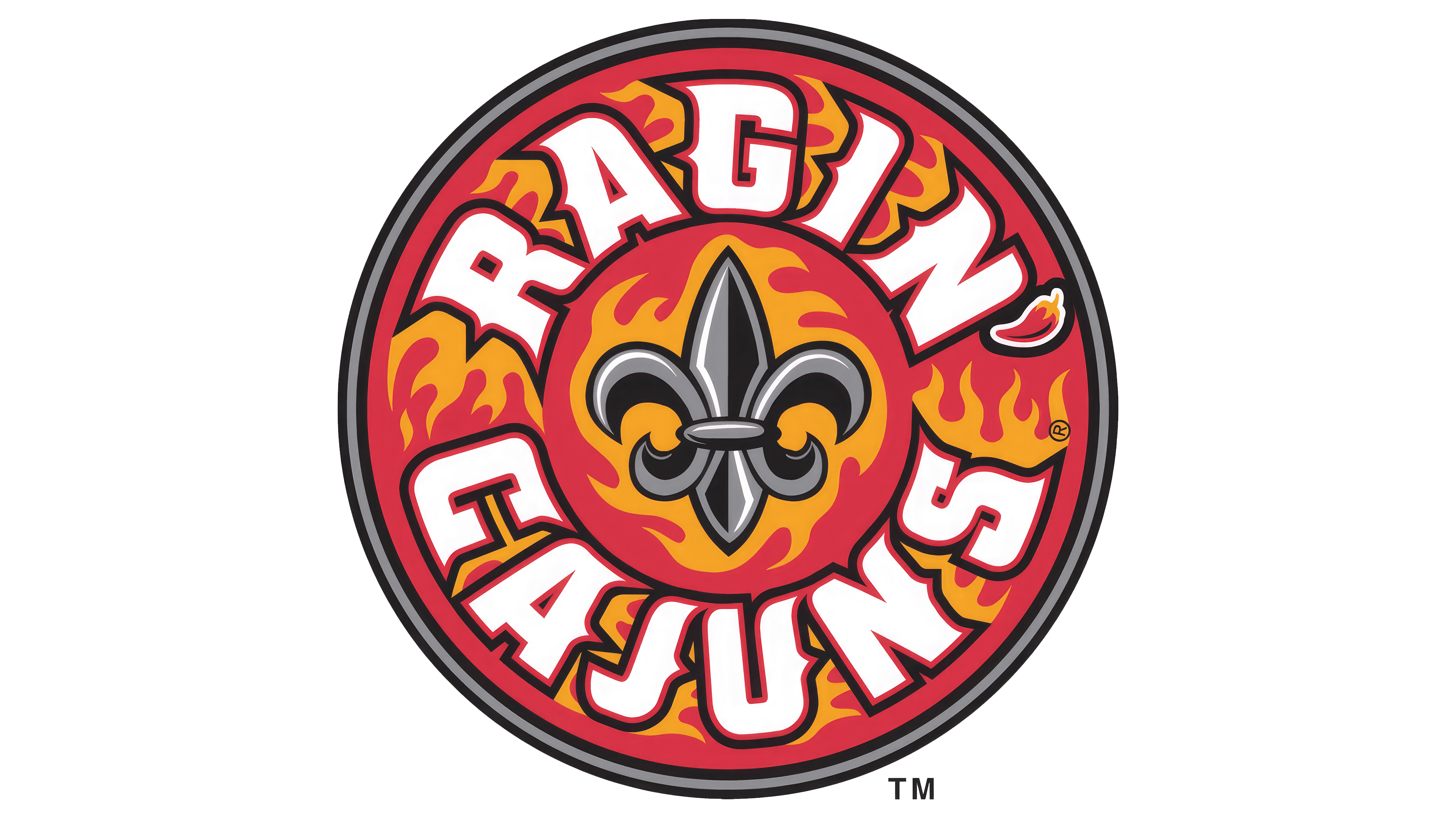
This team emblem is designed as a circle, resembling a boiling cauldron, a ball, a seal, or a wheel. White serif letters placed on the rim create the impression of rotation and forward motion, reinforcing the association with a ball in flight.
At the center is a fleur-de-lis tied to the Cajun ethnic group, after whom the team is named. This heraldic symbol is associated with the French and appears on the Acadiana flag. The university was the first to initiate the revival of French-Acadian culture and the region’s history. The Acadiana flag, designed by a university professor, was later officially adopted. The logo design includes one of its elements, emphasizing the team’s connection to historical heritage.
Flames surround the letters and the fleur-de-lis on the red background, highlighting the word “Ragin.” The logo’s energy and movement reflect the team’s drive for achievement and victories. It was created to commemorate the university’s renaming to the University of Louisiana at Lafayette (UL Lafayette).
2006 – 2013
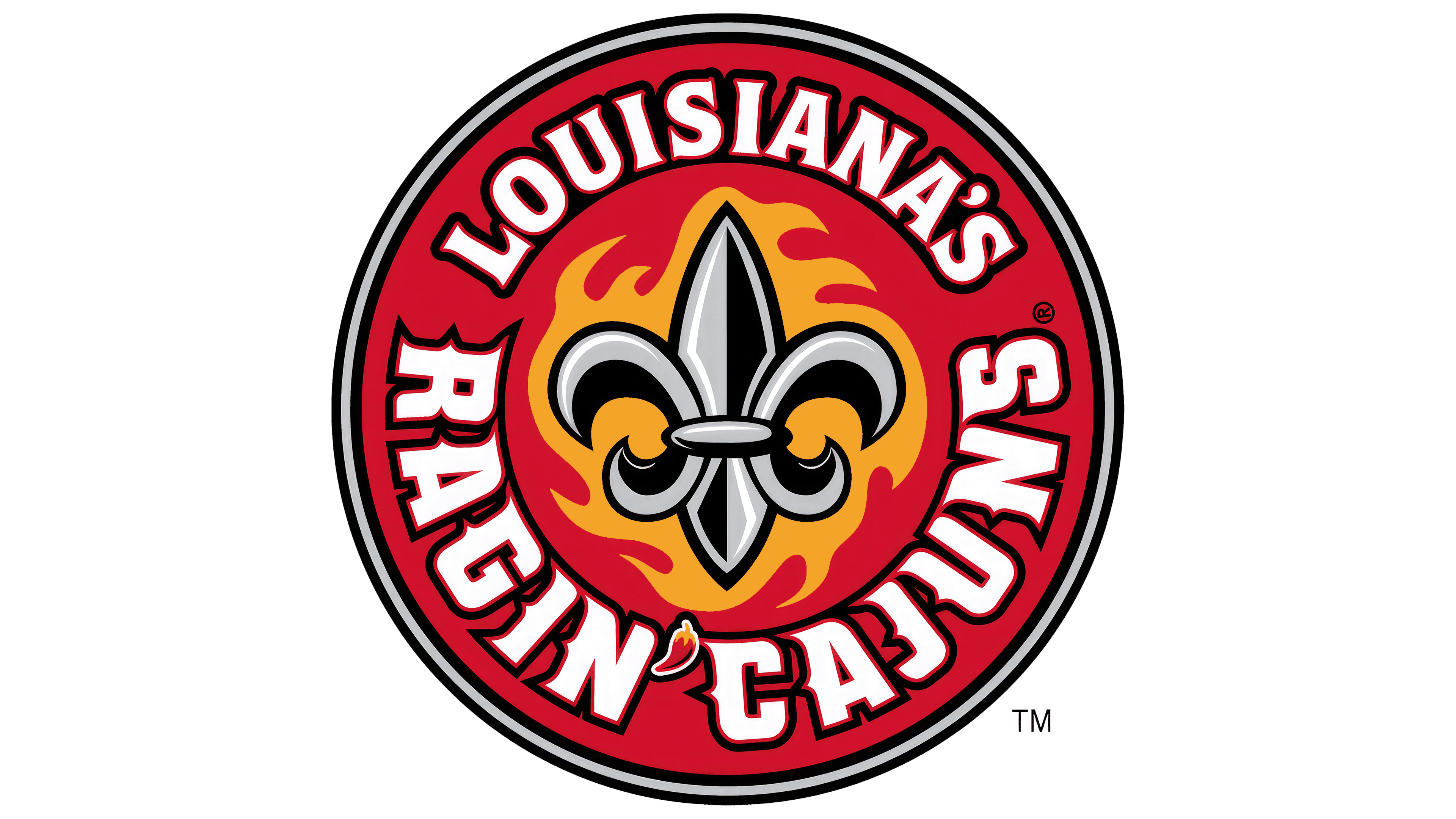
In 2006, the football team celebrated the opening of the new Leon Moncla Indoor Practice Facility, coinciding with a successful season that earned the team the maximum possible points. A redesigned logo was created to honor these achievements, reflecting a spirit of celebration and joy.
The design became more detailed and expressive. The team’s name is placed on a red circle border, with the word “Louisiana’s” highlighted in a smaller font. The serifs in the words “Ragin’ Cajuns” were modified to create a counterclockwise rotation effect combined with flames at the center. This element emphasizes using accumulated skills and experience as a foundation for progress.
The apostrophe in the word “Ragin'” was replaced with an image of a hot pepper, adding energy and emphasis to the design. This detail highlights the team’s character, conveying their uniqueness and dynamism.
The central part features an enlarged fleur-de-lis surrounded by flames. This element underscores the connection to historical heritage and reflects the strength of the ancestors’ spirit, inspiring the athletes.
2013 – 2018
The logo underwent minor changes that enhanced its meaning. The flame surrounding the central fleur-de-lis was changed to orange. This accent emphasizes the unity of students and players, reinforcing the idea of a shared goal.
The “Louisiana’s” inscription was replaced with “Louisiana,” highlighting the team’s territorial identity and openness to athletes from different regions. These updates add new dimensions to the visual perception, making it more universal.
2018 – today
The updated logo has been significantly simplified, removing the circular shape and elements associated with French symbolism. The main focus is the textual inscription, set against a rich red-and-black background.
The background curves and the font elements with sharp serifs enhance the dynamic composition. This design creates a sense of motion, reflecting the energy and swiftness of the players on the field. The impression is further complemented by a sense of interaction, as if the words symbolize athletes crossing paths during the game.