


 Seagate Logo PNG
The Seagate logo is cosmic and progressive. The emblem resembles an astronaut heading toward the stars. The symbol represents the company as ahead of its time, possessing new knowledge and technologies.
Seagate began in 1978 after Finis Conner suggested to Alan Shugart that a new company should build small, lower-cost hard drives for the emerging personal computer market. On November 1, 1978, Shugart and four partners registered Shugart Technology. The name was changed in 1979 to Seagate Technology to avoid a conflict with Shugart Associates. Xerox later acquired the earlier Shugart company.
In 1980, Seagate developed the ST-506, the world’s first 5.25-inch hard drive, with 5 MB of storage. Its size matched a standard 5.25-inch floppy drive bay, making it easier for computer makers to install. In 1981, the ST-412 doubled its capacity to 10 MB and improved head positioning. The interface used in these drives became an industry standard.
Seagate went public on NASDAQ in 1981. Its major break came in 1983, when IBM launched the PC XT, the first mass-market personal computer with a hard drive as standard equipment. Seagate became IBM’s main drive supplier, and by 1983, annual sales exceeded $100 million, with IBM accounting for more than 60% of revenue.
In 1989, Seagate bought Control Data Corporation’s Imprimis division, entering the enterprise drive market. In 1991, it launched Barracuda, the first hard drive with a 7200-rpm spindle speed, prompting Western Digital and others to adopt the same standard. Seagate reached 50 million total hard-drive shipments in 1993, bought Conner Peripherals in 1996, acquired Maxtor for $1.9 billion in 2005-2006, Samsung’s HDD business for $1.4 billion in 2011, and LaCie for $186 million in 2012.
Meaning and History
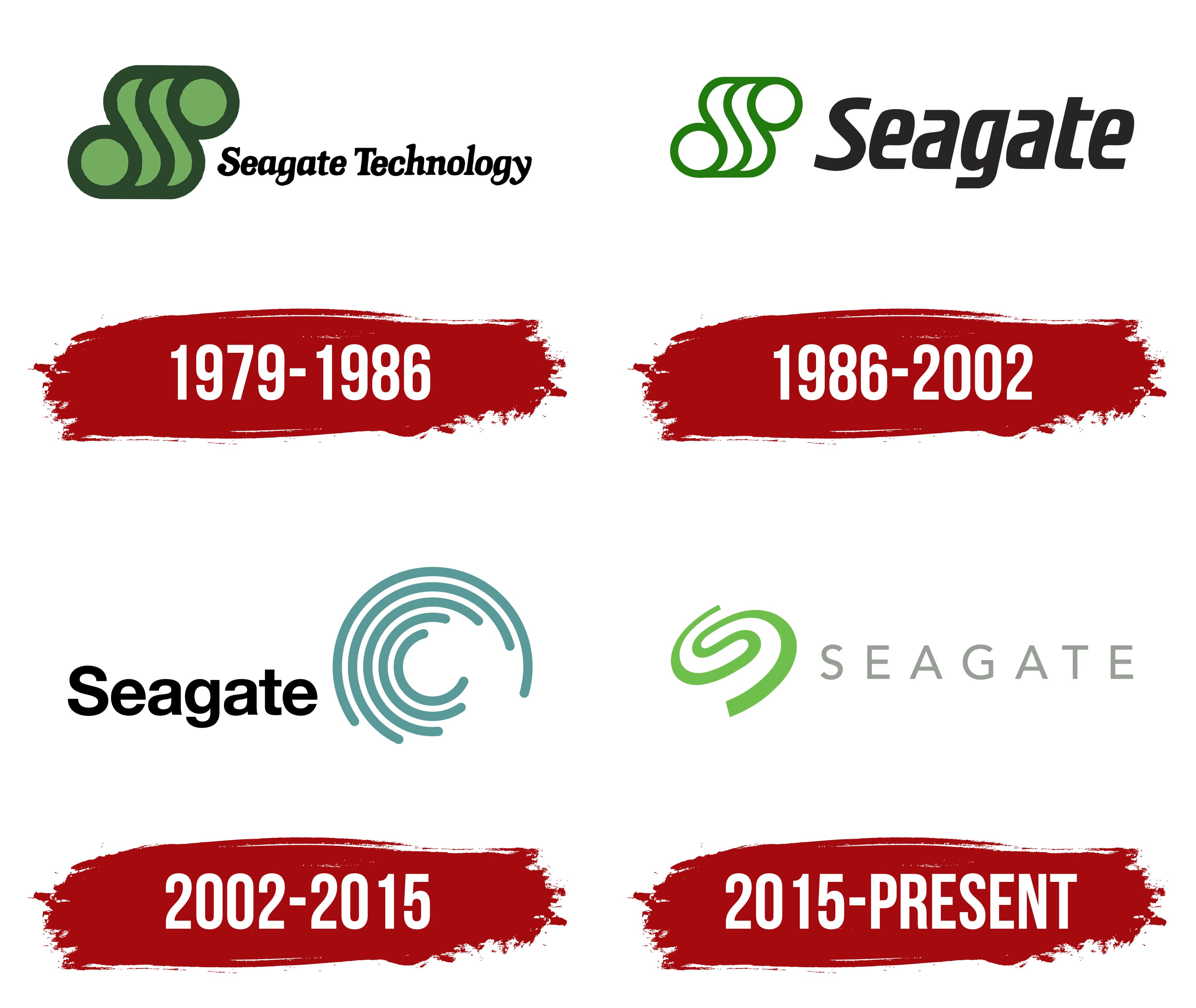
The corporation’s logos reflect the development path of data storage technology. From reels with tape, through floppy disks, to hard disks, and finally to SSDs. The latest emblems predict the connection between people and machines, the advent of artificial intelligence, and humanity’s expansion beyond its solar system. Each symbol shows a clear systematization that is the basis for creating storage devices. The logo demonstrates that thanks to companies like Seagate, the entire history of humanity can be recorded and preserved.
What is Seagate?
This is one of the largest manufacturers of data storage devices, with hard drives that store petabytes of information in data centers, personal computers, and gaming consoles worldwide. The product range includes compact external drives for personal use and reliable server solutions. A unique approach to different market segments distinguishes the IronWolf line: IronWolf, designed specifically for NAS; FireCuda, aimed at gamers; and BarraCuda, suited for everyday tasks. The sleek Backup Plus portable drive line is particularly popular, automatically backing up data from PCs and smartphones, combining high capacity with compact size.
1979 – 1986

The first emblem consists of a stylized letter S and the company name. The symbol significantly surpasses the size of the word. It resembles two disks that exchange information. In the first ST-506 systems, information was stored across several drives connected by cables. The emblem represents this system.
The color green symbolizes life, development, and growth. It demonstrates that the company’s technology is the future.
The name is written in lowercase letters in a script font, embodying the flow of information, the gradual extraction of data, and the connection between the disk and the computer.
1986 – 2002

2002 – 2015

2015 – today
In 2015, Seagate began partnering with IBM to develop data storage technologies, leveraging IBM Cloud, compatibility with IBM Power Systems, and Seagate’s disks. A new logo was developed to emphasize the key stages of development.
The emblem still consists of an image and an inscription. However, compared to the 2002 logo, they changed the order of placement. The symbol is placed ahead of the name.
The wavy green stripes resemble:
- A part of a fingerprint. The imprint is individual. It contains information about a person. The company’s products also store personal information.
- Tracks on the disk. Information on the disk is stored as magnetic pulses arranged into tracks.
- A galaxy. Earth is located in the Milky Way Galaxy, which is spiral-shaped. The association points to the storage of information for future generations. The disks contain encrypted data that will exist for millennia. This form was created to demonstrate the company’s participation in NASA experiments. In 2015, the disks were prepared to record information about Mars as part of the Mars Curiosity Rover program.
The name is written in thin light-gray letters. This technique creates an impression of airiness and flight. Overall, the symbol looks cosmic and marks a new stage in the company’s life, as it expands into space. The word Seagate seems to lead the planet. The company defines the industry’s further development by developing new technologies that transform information storage systems for humanity.
Font and Colors
The green color is integral to all of the manufacturer’s emblems. The shades incorporate the profitability and potential of new systems. Light green represents discoveries, beginnings, and far-reaching partnerships with technology companies. The color reflects the youth of our planetary system. It is at the beginning of its journey, and many discoveries await. Seagate dreams of participating in upcoming developments and innovations.
The inscription style is simple, with its letters resembling many common fonts. It indicates the universality of digital systems and the ease of communication between separate modules from different firms. The spacing between characters is increased, symbolizing the ability to store large amounts of data. Each letter is like a separate information cell. The technique gives the symbol airiness and a sense of flight.