


 Tums Logo PNG
The Tums logo emphasizes the product’s speed and simplicity in rapidly relieving post-meal discomfort. The brand gained popularity for its effective, immediate formula.
Tums began in St. Louis in 1928, when pharmacist James Howe developed a calcium carbonate antacid for his wife, who suffered from indigestion. His small, chewable tablets provided rapid heartburn relief without water, an uncommon format for medicines at the time. In 1930, demand led Howe to establish the Lewis-Howe Company. The tablets were made for regular home use.
The brand name came from a radio contest. A nurse won with the phrase “Tums for the Tummy,” and Tums became the product name. National radio and television advertising during the 1950s moved the medicine beyond its regional market. Rolaids, introduced in 1954 with a related carbonate formula, became a long-term rival in the U.S. antacid category.
Revlon acquired Lewis-Howe in 1978, giving Tums access to broader marketing and distribution while production remained in St. Louis. British pharmaceutical group Beecham bought the brand in 1986. Later corporate mergers placed Tums in GlaxoSmithKline’s consumer healthcare portfolio, formed in 2000.
During the 1990s and 2000s, the range expanded beyond classic tablets with Chewy Bites, Naturals, and Cooling Sensation products. Tums faced newer medicines, including proton pump inhibitors designed for longer relief, while retaining its calcium carbonate formula and rapid-action position. In 2022, GSK separated its consumer healthcare division as the public company Haleon. Tums moved into the new business, and manufacturing continued at its historic St. Louis plant.
Meaning and History
What is Tums?
It is an American medication used to relieve heartburn and stomach discomfort. Its active ingredient is calcium carbonate, providing rapid neutralization of stomach acid. It is sold as chewable tablets with fruit and mint flavors. The effect is fast-acting but short-lasting.
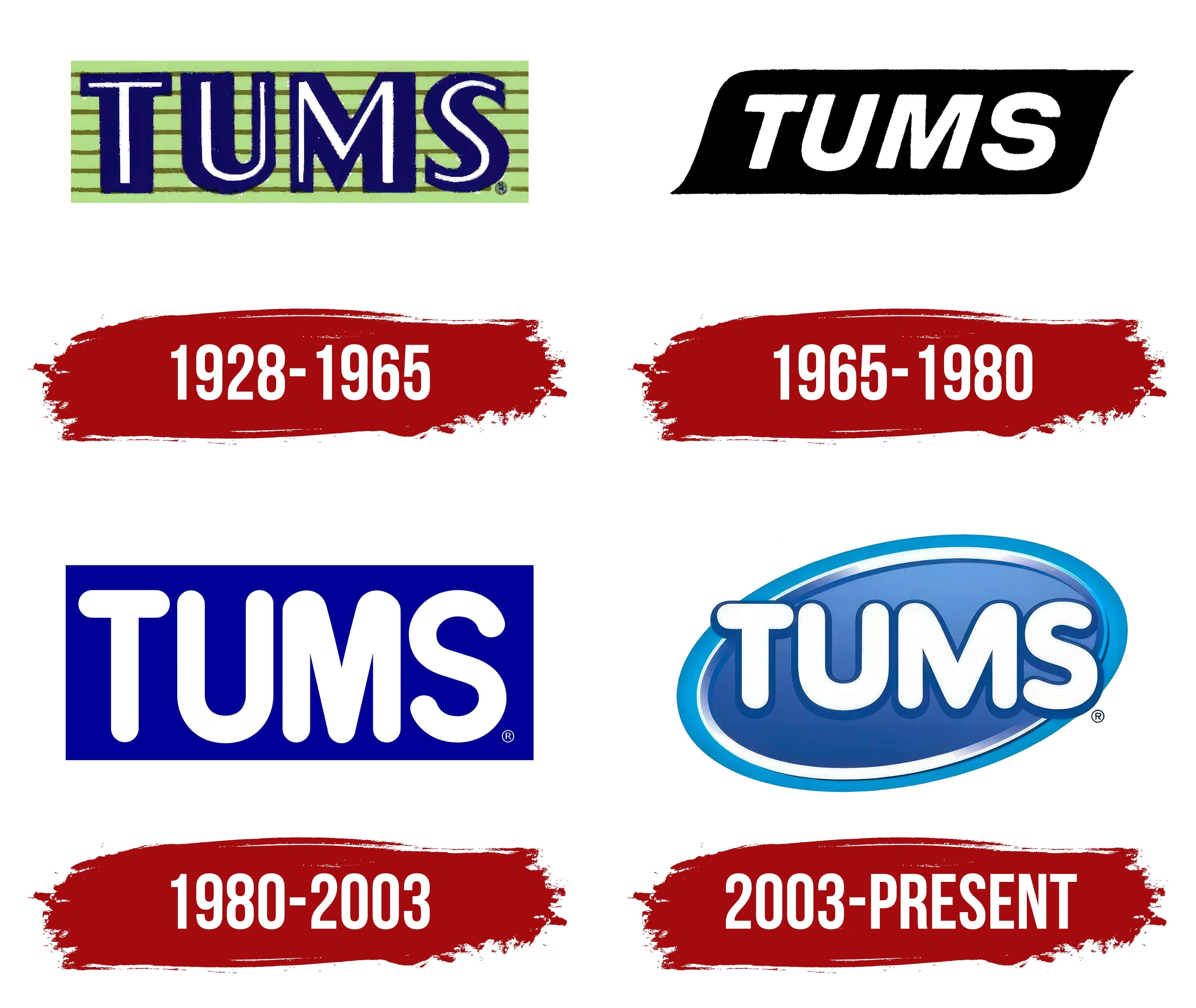
1928 – 1965

The first logo reflected the era when medicines became popular among Americans. The original emblem was created by Lewis-Howe, who developed Tums as a remedy for heartburn.
The geometric font featured thick blue letters with distinctive white inner lines resembling hollow cores. The color used was Cobalt Blue, symbolizing reliability, calmness, and medical professionalism.
The green background with thin brown stripes was unusual for pharmaceutical packaging at the time. The stripes hinted at digestive comfort, regularity, and balance, differentiating the product in the 1930s and 1940s.
1965 – 1980

In 1965, Tums updated its visual identity to align with pharmaceutical design trends. Lewis-Howe simplified the graphics to emphasize visual clarity.
The new logo featured italicized, rounded letters that suggested quick relief from heartburn.
The color scheme shifted to a simple contrast: white letters on a black background, highlighting product accessibility without complex medical associations.
1980 – 2003

In 1980, the logo evolved toward simplicity, clearly reflecting the product’s functionality.
The font, Helvetica Rounded Bold, was smooth and rounded, visually conveying a soothing sense of relief.
The minimalist color scheme featured a dark blue background and white lettering. Blue symbolized stability and calmness, typical of pharmaceuticals of that time.
2003 – today
The Tums brand image update in the early 2000s was part of GlaxoSmithKline’s broader effort to rethink its consumer communication. The company aimed to present the medication in a more accessible and friendly form, emphasizing ease of perception.
The key symbol of the new style became an oval shape resembling a tablet. It points to the product’s primary function and fits naturally within the category of medical remedies. The creation of the logo was entrusted to the agency Interbrand, which had experience working with pharmaceutical companies and understood the industry’s specifics.
For the name, the VAG Rounded Bold typeface was used, which Volkswagen has used since the late 1970s. The rounded lines and even strokes conveyed the antacid’s gentle action, emphasizing the product’s accessibility.
The logo color scheme is presented through a combination of blue and white shades. The primary tone became Brilliant Blue, reflecting the brand’s medical orientation and inspiring consumer trust. The glossy, smooth gradient from light to dark enhanced the impression of freshness and cleanliness of the medicinal products.
Font and Colors

The logo utilizes VAG Rounded Next Black, a rounded sans-serif font designed by GGK Düsseldorf for Volkswagen, which emphasizes care and attention.
Primary colors include vibrant azure (also known as Brilliant Blue) and white. Azure is a classic choice for medical branding; its stark white contrasts clearly, reinforcing the product’s effectiveness.
The oval’s gradient imitates a pill’s volume, strengthening associations with direct effectiveness and reliability.