


 Wimbledon Championships Logo PNG
The Wimbledon Championships logo reflects the tournament’s strict traditions. It’s a symbol of elegance and restraint, immediately associated with British style, precision, and respect for the sport.
Wimbledon began with a practical goal. The All England Croquet and Lawn Tennis Club, founded in 1868, organized a tournament to raise money for repairing a roller. On July 9, 1877, 22 amateurs entered the first official lawn tennis event. The final was played on July 19, when Spencer Gore defeated William Marshall 6:1, 6:2, 6:4 in 48 minutes before about 200 spectators and received a silver cup worth 25 guineas.
Women’s singles and men’s doubles were added in 1884, with Maud Watson becoming the first women’s champion. Women’s doubles and mixed doubles followed in 1913. Rising attendance pushed the club beyond Worple Road, and in 1922 Wimbledon moved to Church Road after spending about £140,000 on the new grounds. King George V attended the opening of “Centre Court”, while the Challenge Round system was abolished.
The tournament stopped during World War I (1915 to 1918) and World War II (1940 to 1945). A bombing raid in October 1940 destroyed 1,200 “Centre Court” seats, but play returned in 1946. In 1968, Wimbledon entered the Open Era and admitted professional players, with Rod Laver and Billie Jean King becoming the first champions of the period.
Later changes included a new No. 1 Court in 1997, equal prize money for men and women in 2007, and a retractable “Centre Court” roof in 2009. A final-set tiebreak arrived in 2018, the middle Sunday break ended in 2022, and electronic line calling replaced line judges in 2025. Wimbledon remains the only Grand Slam played on grass.
Meaning and History
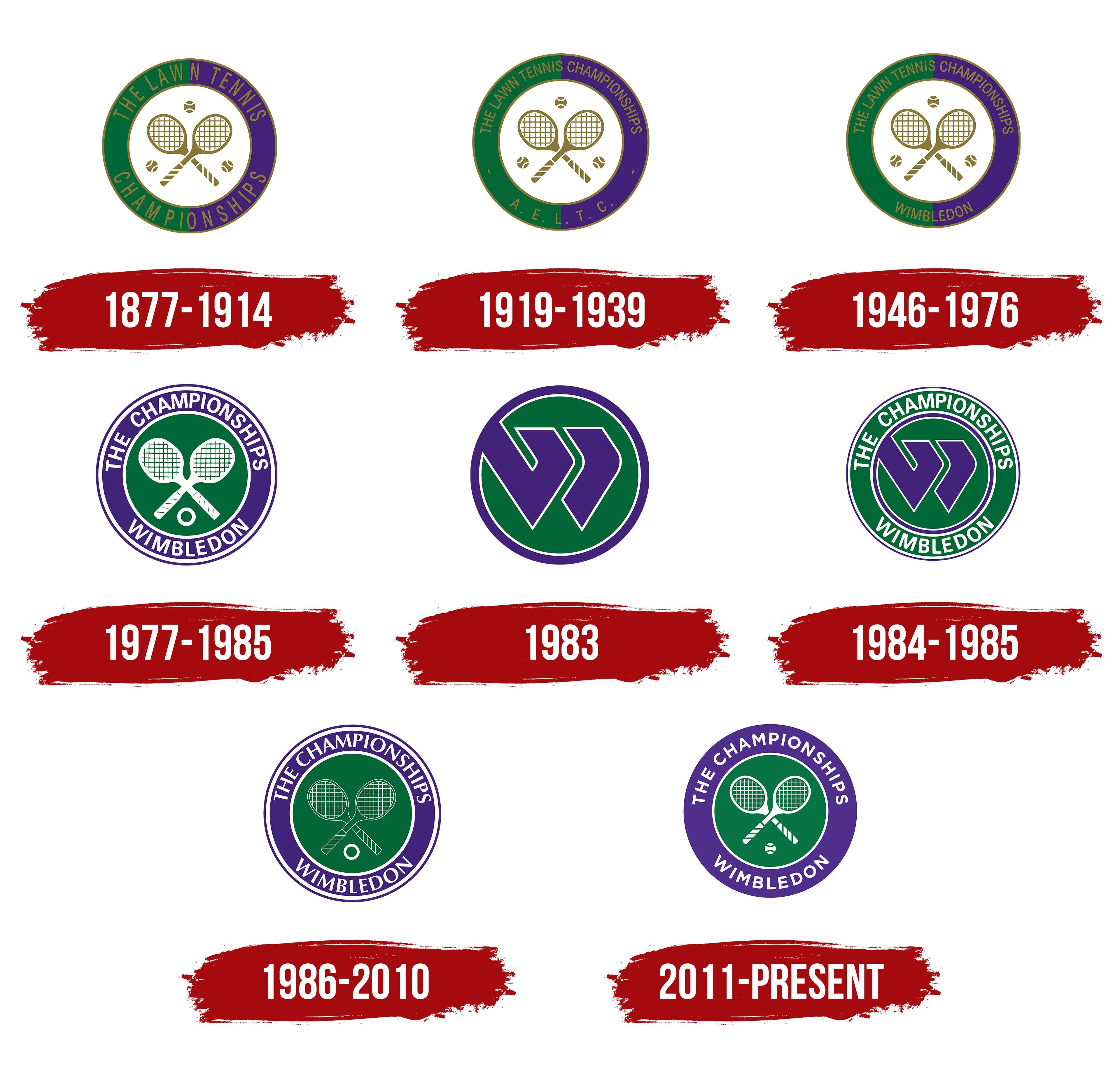
What is Wimbledon Championships?
The oldest and most prestigious tennis tournament is played on grass courts at a private club near London. The tournament observes strict traditions, including the mandatory wearing of white attire by athletes. A distinctive tradition is for spectators to eat strawberries with cream at the center court. The royal family has its honorary box. The grass surface speeds up the ball, emphasizing strong servers. Final matches do not use a tiebreaker, which can result in potentially unlimited game length. Winners receive prize money and permanent club membership with exclusive privileges.
1877 – 1914

The creation of Wimbledon’s first visual symbol coincided with tennis’s transition from a club game to an organized sport with a structured set of rules and international recognition. In this context, the first tournament logo was created, inspired by the late 19th-century Victorian aesthetic. The design reflected the era’s formality and the official nature of the 1877 competition, which marked the beginning of the grass court championship’s history.
The logo’s design centered on a circle with two crossed rackets. They had elegant, thin handles and finely detailed strings. Nearby were tennis balls representing the objects of competition and the tournament’s theme.
Along the outer ring was the name of the championship. The top part read “THE LAWN TENNIS” and the bottom part “CHAMPIONSHIPS.” The ring was visually divided into two halves. The left half was green, and the right was purple. The inscription was written in large, uppercase, gold letters without serifs, in a style similar to the Copperplate font. The color and lettering matched the event’s formal tone, emphasizing its ceremonial character.
The color scheme included green and deep purple. Over time, these became the official colors of the championship, expressing its traditions and prestige.
The first logo reflected the organizers’ intention to convey the ideas of order, honor, and tradition that underpinned the early tennis championships.
1919 – 1939
The interwar period marked a refinement of the tournament’s visual identity. The club management decided to strengthen recognition by moving the word “CHAMPIONSHIPS” from the bottom to the top. At the bottom, the abbreviation A.E.L.T.C. appeared, formed from the name “All England Lawn Tennis and Croquet Club.” It signified the emblem’s connection to the event’s organizer and emphasized its official status.
No other changes were made. The typography retained its copper-gold tone, close to the Copperplate font. Its strict proportions and classic appearance conveyed English tradition.
1946 – 1976

Postwar changes were also reflected in the logo. After the tournament resumed, the organizers decided to revise its design by simplifying the structure and reducing the amount of text. The abbreviation A.E.L.T.C., which appeared in the prewar version, was removed from the ring. Its place was taken by the word “Wimbledon,” placed in the lower segment.
The typeface remained classic, with the same proportions as before. The visual emphasis shifted from the club’s designation to the tournament name, reflecting its international importance and independent status in the sports world.
The color system remained unchanged. The combination of dark green and deep purple preserved the historical symbolism associated with British tennis. The colors became permanently established as the tournament’s signature palette.
The logo’s meaning was rooted in tradition and sport. The rackets and balls remained the game’s key elements, while the gold-and-purple-green combination conveyed the club’s heritage and the court’s atmosphere.
1977 – 1985

Designers from Minale Tattersfield led the next stage of updating the tournament’s identity. The team proposed a new logo structure emphasizing clean lines.
The main change was the use of a sans-serif typeface, Helvetica Bold. The new typography gave the inscription a functional look and matched the era’s aesthetics.
The center of the logo featured two crossed tennis rackets with an abstract ball placed below them. They represented the essence of the game and its athletic dynamics while maintaining balanced proportions.
The tournament colors were preserved but intensified. Purple Pantone 268 in the outer ring and green Pantone 349 in the inner part of the emblem were made richer. These shades became permanently associated with Wimbledon as a signature combination linked to its tradition and visual identity.
The updated logo marked a new stage in the tournament’s identity. The simple structure, modern typography, and clear color system reflected the spirit of the late 1970s and expressed Wimbledon’s transition to a new visual standard.
1983

The effort to update the tournament’s visual identity began with an initiative from the studio Minale Tattersfield, which had previously helped create Wimbledon’s official style. In 1983, the team presented an experimental version of the logo that differed from the previous structure. The project focused on modern design principles based on simplicity and abstraction.
The familiar circle and crossed tennis rackets were removed from the design. In their place appeared a stylized letter W. It referenced the name ‘Wimbledon’ and the word ‘World’, underscoring the tournament’s international scale. The visual logic was based on conciseness and structured form.
The colors remained unchanged. Green Pantone 349 and purple Pantone 268 were preserved, separated by a thin white line dividing the color zones. The minimalist project received mixed reactions from the public. This logo was used alongside the classic emblem but did not replace it, becoming a temporary stage in Wimbledon’s visual history.
1984 – 1985

The experimental period in Wimbledon’s visual style was closely linked to the work of the studio Minale Tattersfield. The project aimed to combine modern visual energy with the tournament’s traditional perception. The emblem featured a stylized “W” symbol enclosed in a circle, accompanied by the inscription “The Championships Wimbledon.” Their arrangement created a balance between modernist geometry and the classic form of a seal mark.
The typography used a bold sans-serif font rendered in white. The design preserved the Pantone shades 349 and 268, complemented by a thin white outline. The green and purple contrast with white accents, maintaining recognizability and aligning with the championship’s corporate colors.
The abstract “W” in the center of the circle conveyed a sense of innovation, while the circular shape symbolized continuity and the stability of sporting tradition.
The organizers aimed to modernize the tournament’s visual identity without losing its historical connection. However, the design was used for a short time and left a mark on Wimbledon’s branding development as an example of compromise between modernism and conservatism.
1986 – 2010
The tournament’s visual style was quickly reinterpreted and developed in a 1986 project by the British studio Minale Tattersfield. The work marked a return to the classic structure and reaffirmed the elements traditionally associated with Wimbledon.
In the center, the crossed tennis rackets reappeared, with a ball stylized as a circle. The outlines of the images became simpler. Around the graphic block was a purple ring bearing the inscription “The Championships Wimbledon” in white Gill Sans Bold. The typography emphasized the discipline and character of the English tournament.
The color palette remained unchanged, with the shades Pantone 349 (green) and Pantone 268 (purple) retained.
The logo proved long-lasting. It was used for almost 25 years, becoming a symbol of the tournament’s visual identity and a mark that tennis fans worldwide associated with Wimbledon.
2011 – today
The studio Hat-Trick Design marked the final stage in updating Wimbledon’s visual system. In 2011, the designers presented a modern reinterpretation of the logo, preserving the historical structure while carefully simplifying the form.
The main elements were retained but adjusted in proportion. The tennis rackets became larger and stood out more clearly against the green background. The ball regained its recognizable texture and increased in size.
The typography was updated. The Gill Sans Bold font was replaced with Gotham Bold. The new version created a denser and more balanced text rhythm, giving the inscription a modern character.
The color system remained the same. Traditional shades of green (Pantone 349) and purple (Pantone 268) were used. Decorative outlines around the rings were removed, resulting in a cleaner, more cohesive overall appearance.
Through the updated logo, the designers expressed respect for the tournament’s heritage and aesthetics, preserving historical continuity while transitioning to a contemporary style.
