


 Metro Atlantic Athletic Conference Logo PNG
The Metro Atlantic Athletic Conference logo is associated with one of the oldest collegiate conferences on the East Coast of the United States. The conference unites private universities with strong academic foundations and well-developed athletic programs, located within the dense urban corridor stretching from New York to the Mid-Atlantic region.
The Metro Atlantic Athletic Conference was formed in 1980 by six small northeastern institutions in the United States. Army, Fairfield, Fordham, Iona, Manhattan and Siena shared limited budgets and little interest in the costly top level of college football. Most had Catholic roots, while the new league gave their athletic programs a place in Division I competition.
The NCAA recognized the MAAC in 1981, and basketball soon became its leading sport. A compact regional footprint encouraged regular rivalries, while the men’s conference tournament provided access to March Madness. Holy Cross joined in 1984, but both it and Army left in 1989 as their athletic priorities changed.
Canisius, Niagara and La Salle entered in 1989, extending the league from Buffalo to Philadelphia. Loyola University Maryland followed in 1992, while Rider and Marist joined in 1997. By the end of the decade, the MAAC had 11 members and operated championships in basketball, baseball, rowing, lacrosse and other sports. Its headquarters moved to Fairfield, Connecticut, in 2003, followed by an ESPN3 broadcasting agreement across several platforms in 2008.
Loyola Maryland departed for the Patriot League in 2012. Quinnipiac and Monmouth arrived in 2013, restoring membership to ten schools. After Monmouth announced its exit in 2019, Mount St. Mary’s filled the vacancy in 2020. In 2021, Marist women’s basketball received an automatic tournament berth and represented the conference on the national stage.
Meaning and History

What is Metro Atlantic Athletic Conference?
It is an association of eleven colleges that compete in NCAA Division I and represent private institutions in the Northeast and New York City. The league stands out for its strong focus on basketball, with the annual tournament one of the most exciting regional college sports events, known for intense local rivalries and compelling underdog stories.
1980 – 1983

The Metro Atlantic Athletic Conference logo was introduced with the creation of a new NCAA Division I athletic structure that united private colleges in the northeastern United States. The visual was intended to emphasize the seriousness of the conference’s educational mission and its organizational integrity, combining academic prestige with a competitive spirit.
The emblem is circular, representing a three-level structure. The outer ring is painted a rich blue and includes the organization’s full name, “Metro Atlantic Athletic Conference.” The inscription is executed in a neat geometric font with thin lines. The golden letters contrast with the blue background, adding a sense of formality.
The inner space of the circle is set against a bright yellow background, on which a red form resembling the letter “C” is placed. Inside, it is the abbreviation “MAC,” rendered in a sans-serif typeface with straight lines and minimal curves. The typeface’s structure indicates a custom design and an orientation toward industrial aesthetics.
Around the inner circle’s perimeter is a stylized laurel wreath executed in a simplified geometric form. It connects the central part with the outer ring, creating a visual link between sports symbolism and academic tradition. The wreath, borrowed from ancient heritage, symbolizes achievement, success, and recognition, evoking victory and athletic excellence.
The red in the logo symbolizes energy and competitiveness, reflecting the conference’s active nature. Blue conveys academic foundations and official status. Yellow is associated with success and intellectual potential. The color palette creates a balanced image of an organization that unites athletic ambition with an educational mission.
1983 – 1987
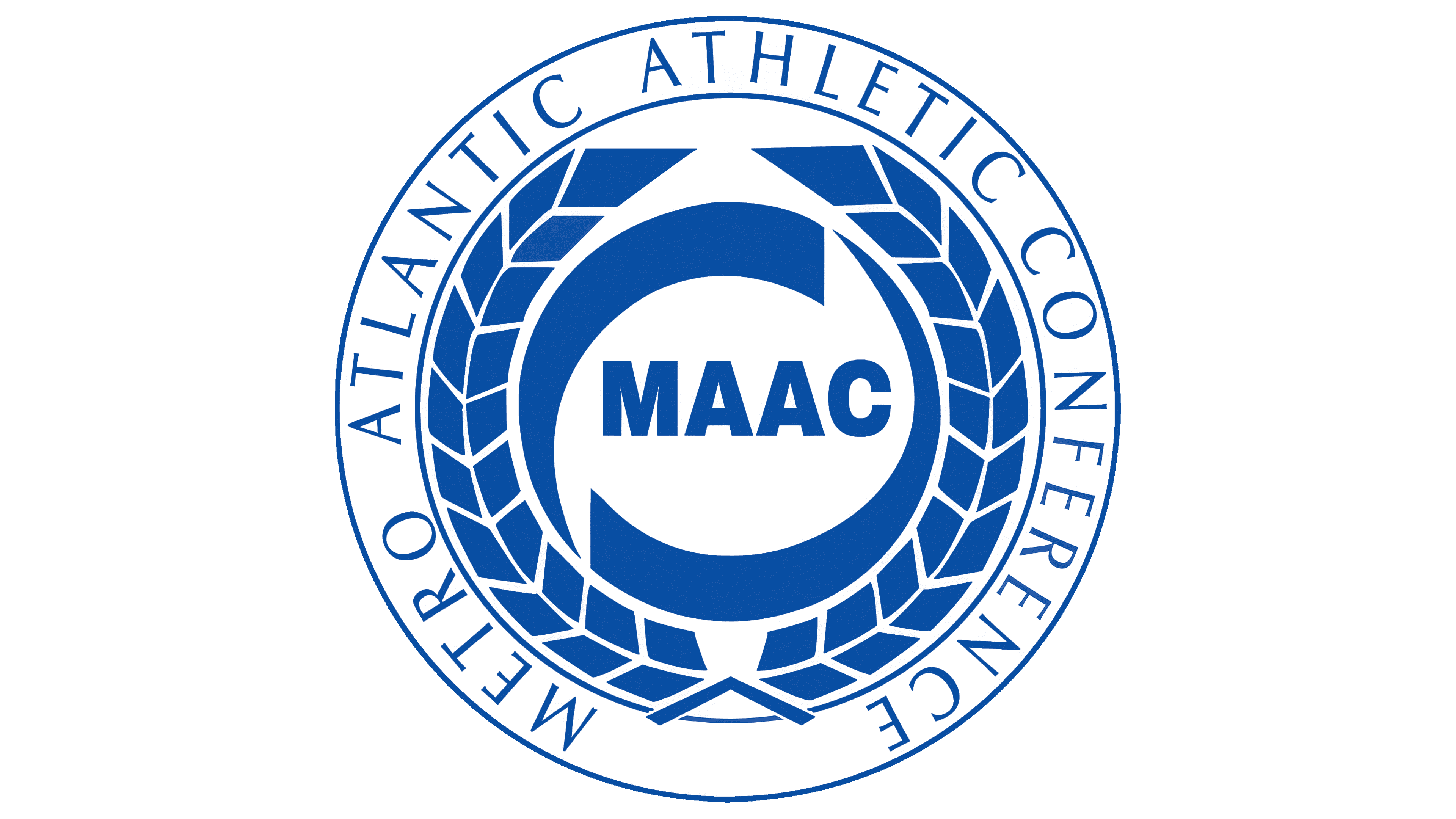
The expansion of athletic programs and the increase in membership required an update of the visual system to reflect the organization’s new scale. The redesign aimed to achieve greater formality and functionality.
The new version retained the previous logo but featured a revised visual system. Instead of a three-color scheme, a monochrome palette dominated by blue and white was used.
The typographic part of the design was modernized while maintaining continuity. In the center of the circle, the previous abbreviation MAC was replaced by MAAC. The inscription was executed in a sans-serif typeface stylistically close to geometric fonts such as Eurostile and Futura Bold.
The updated Metro Atlantic Athletic Conference emblem preserves its link to the original while adopting a more functional, professional appearance.
1987 – 1995

The key change in the development of the conference’s visual system was refining the logo’s structure and proportions to improve precision and order. Compared to the previous version, the circular text was redesigned to achieve a more even distribution. The stylized capital letter C forming a ring around the abbreviation MAAC, as well as the laurel wreath, were retained. The main change concerned the alignment of the inscription METRO ATLANTIC ATHLETIC CONFERENCE along the arc with increased letter spacing, making it easier to read.
The abbreviation “MAAC” in the center remained bold and sans-serif, maintaining its geometric form. The color scheme remained monochrome, with deep blue and white tones.
1995 – 2003

The new Metro Atlantic Athletic Conference logo reflected the organization’s transition to a modern media format of American collegiate sports. The circular form and academic symbolism of earlier emblems were replaced by a dynamic composition centered on the diagonal abbreviation MAAC.
The inscription was executed in a sans-serif athletic-style typeface with thick strokes and a slant similar to Impact or Athletic Block. The diagonal contours and slight curvature create a sense of motion, while the black shadow adds volume and visual density.
The background consists of a red ring partially overlapped by the large MAAC letters. Inside it is the full name, Metro Atlantic Athletic Conference, set in white type.
This version represented a transition from an academic visual style to an athletic aesthetic focused on brightness and recognizability. The logo reflected MAAC’s growth and its positioning as an independent brand in the sports landscape of the 1990s.
2003 – today

The redesign of the Metro Atlantic Athletic Conference emblem was undertaken in response to the NCAA’s growing presence in the media landscape and its expanded partnership with ESPN. The goal was to update the visual system to align with professional league standards and reflect the modern landscape of collegiate athletics.
The new version retained the MAAC abbreviation as its foundation but became more compact and structurally stronger. The letter strokes were thickened, and the proportions were balanced. Volume was achieved through multilayered outlines in white, gray, and black. These added visual weight and depth to the mark compared to the flatter, lighter design of previous years.
Visually, the new emblem appears denser and more dynamic than before. It lost its academic character and acquired a distinctly athletic identity.