


 MLS (Major League Soccer) Logo PNG
The best teams stand apart from the rest of the league; the MLS logo signals that. The squad consists of players who love their job, train extensively, and are genuine football stars. Beginners will have to train hard to reach higher levels; the emblem says.
Major League Soccer began with a promise to FIFA. In 1988, the U.S. Soccer Federation agreed to create a top professional league as part of the country’s bid to host the 1994 World Cup. On December 17, 1993, Alan Rothenberg announced the formation of MLS, and in 1995, the league was formally registered as an LLC. Its first media deal came with ABC Sports and ESPN.
The first match was played on April 6, 1996, when San Jose Clash beat “D.C. United” at Spartan Stadium in front of 31,000 fans. That season opened with ten clubs, including D.C. United, the Los Angeles Galaxy, the Columbus Crew, the New England Revolution, and the NY/NJ MetroStars. D.C. United won the first MLS Cup on October 20, 1996, defeating the Los Angeles Galaxy 3:2.
Early finances were tight. Player salaries were modest, TV ratings were weak, and soccer still competed with the NFL, NBA, and MLB for attention. MLS avoided NASL’s mistakes by using a salary cap and a single-entity structure, with the league controlling player contracts. In 1998, expansion added the Chicago Fire and the Miami Fusion. Still, the Tampa Bay Mutiny and the Miami Fusion folded in 2002. Investors Lamar Hunt and Philip Anschutz helped keep the league alive.
The major shift came in 2007 with the Designated Player Rule. David Beckham joined the Los Angeles Galaxy from Manchester United and Real Madrid, giving the MLS global visibility and opening the door for stars such as Thierry Henry and Rafael Márquez. Toronto FC debuted the same year, followed by Seattle Sounders FC in 2009 and Portland Timbers in 2011. Soccer-specific stadiums then helped raise attendance, which passed 20,000 per game by the mid-2010s.
Meaning and History

MLS comprises 27 teams, each of which can include up to 30 athletes. The league is divided into two Conferences: Western and Eastern. The league debuted in 1996. The Los Angeles Galaxy is the most successful franchise. Its players have won the MLS Cup five times and received the Supporters’ Shield award the same number of times.
The organization’s logos deserve special attention. They have been changed several times to keep up with current trends. The last redesign took place in 2014, shortly after Major League Soccer’s 20th anniversary.
1990 – 2007
MLS was formed in 1993 and officially launched in 1996. Before its first season, it adopted a logo depicting a single black-and-white boot (probably on the right foot) kicking a ball in a white circle with black pentagons of different shapes. Both elements are enclosed in a rectangle with rounded corners, with one side painted turquoise and the other blue.
The black abbreviation “MLS” is written on the bottom, and the blue phrase “MAJOR LEAGUE SOCCER” is written even lower. By experimenting with letter size, the developers ensured that both names (abbreviated and full) matched the line width.
2007 – 2014
Designers made the logo three-dimensional by adding colored elements. The ball had black outlines and highlights in three shades: gray, blue, and turquoise. The white part of the boot became gray, and a blue stripe was added at the edge. Meanwhile, the pattern and lettering are set within an additional white rectangle with rounded corners, encircled by a wide black line.
2014 – today
In late 2014, MLS unveiled a new version of the logo with a triangular shield at the MLS Next event. The modern, simple design was meant to showcase the marketing changes and unite the league’s fans in both stadium and virtual spaces.
All the soccer-related images were gone. However, a heraldic shield remained, resembling a classic sports coat of arms. It was an attempt to abandon an outdated design without betraying soccer traditions. The interior space is divided into two parts by a diagonal blue gradient line. It extends beyond the shield on the left side. The same band serves as the outer frame. The upper half of the logo is red, with a smooth transition from darker to lighter shades. There are three five-pointed stars and the abbreviation “MLS.” The bottom is white. The designers left the space empty so that fans could use it as they wanted: for example, to display their hometown’s name or the symbol of their favorite team.
Font and Colors
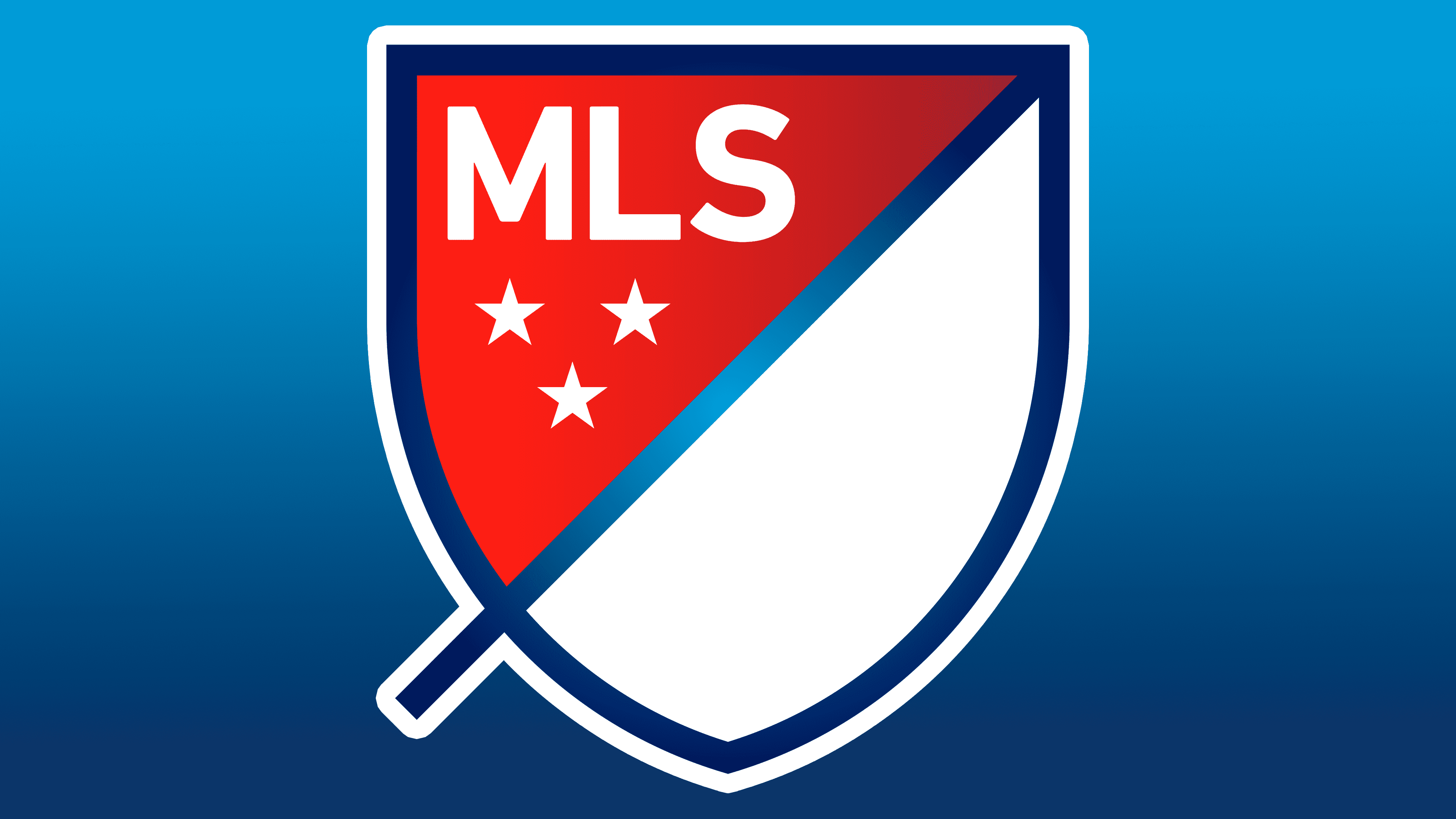
The diagonal line drawn across the shield at a 45-degree angle symbolizes the league’s unchanging trajectory and, at the same time, represents the players’ increasing energy and speed. The blue frame is the boundary of the playing field. The three stars represent the interconnectedness of MLS, its fan base, and the United States as a whole.
The font used for the lettering falls into the bold grotesque category. All letters are capitalized and have slightly rounded corners. In the basic version, the league’s name, the three stars, and the lower half of the shield are white; the upper part is red; and the outlines and diagonal stripe are blue. The red and blue elements have a gradient.
At the same time, the development team created a unique color scheme for each team’s MLS logo. This is the identity’s main feature, making the design adaptive and versatile.