


 ABA Logo PNG
The ABA logo symbolizes vibrant and entertaining basketball, blending sports and entertainment. It marks an era when the game was emotional, and arenas were filled with energy, excitement, and spontaneity.
The American Basketball Association was founded in 1967 by Dennis Murphy and Gary Davidson, who saw professional markets and overlooked players outside the established league. The plan targeted cities denied expansion teams. Former star center George Mikan became commissioner. Its first season featured 11 clubs, including the Anaheim Amigos and Indiana Pacers.
The league used a red, white, and blue ball that looked distinctive on television, alongside fast-paced play and the three-point line. Frequent dunks and individual stars shaped its public image. Pittsburgh Pipers won the first championship over the New Orleans Buccaneers in 1968. A professional dunk contest followed in 1969. The rival NBA adopted the three-point shot in 1979-80.
Julius “Dr. J” Erving became its leading attraction through aerial play, while Moses Malone entered directly from high school. Dan Issel, David Thompson, and Bob Netolicky joined a deep player pool. Yet weak television revenue caused repeated moves and failures. Pittsburgh became Minnesota, then returned as the Condors, while Anaheim relocated as Los Angeles Stars and later Utah Stars.
By the mid-1970s, seven of the original 11 teams remained. An agreement in June 1976 ended the association and admitted four clubs to the older league for $3.2 million each. Along with the Pacers, the New York Nets, Denver Nuggets, and San Antonio Spurs were admitted. Spirits of St. Louis, Kentucky Colonels, and Virginia Squires received compensation and closed.
Meaning and History

What is ABA?
A professional basketball league known for its innovative approach and entertainment value. It introduced the three-point line and a multicolored ball, replacing the classic one. Games featured high scoring, an emphasis on individual skills, and flashy slam dunks. The league was the first to organize slam-dunk contests. Its unconventional rules attracted young talent. After financial difficulties, several top teams joined the leading US basketball league.
1967 – 1976

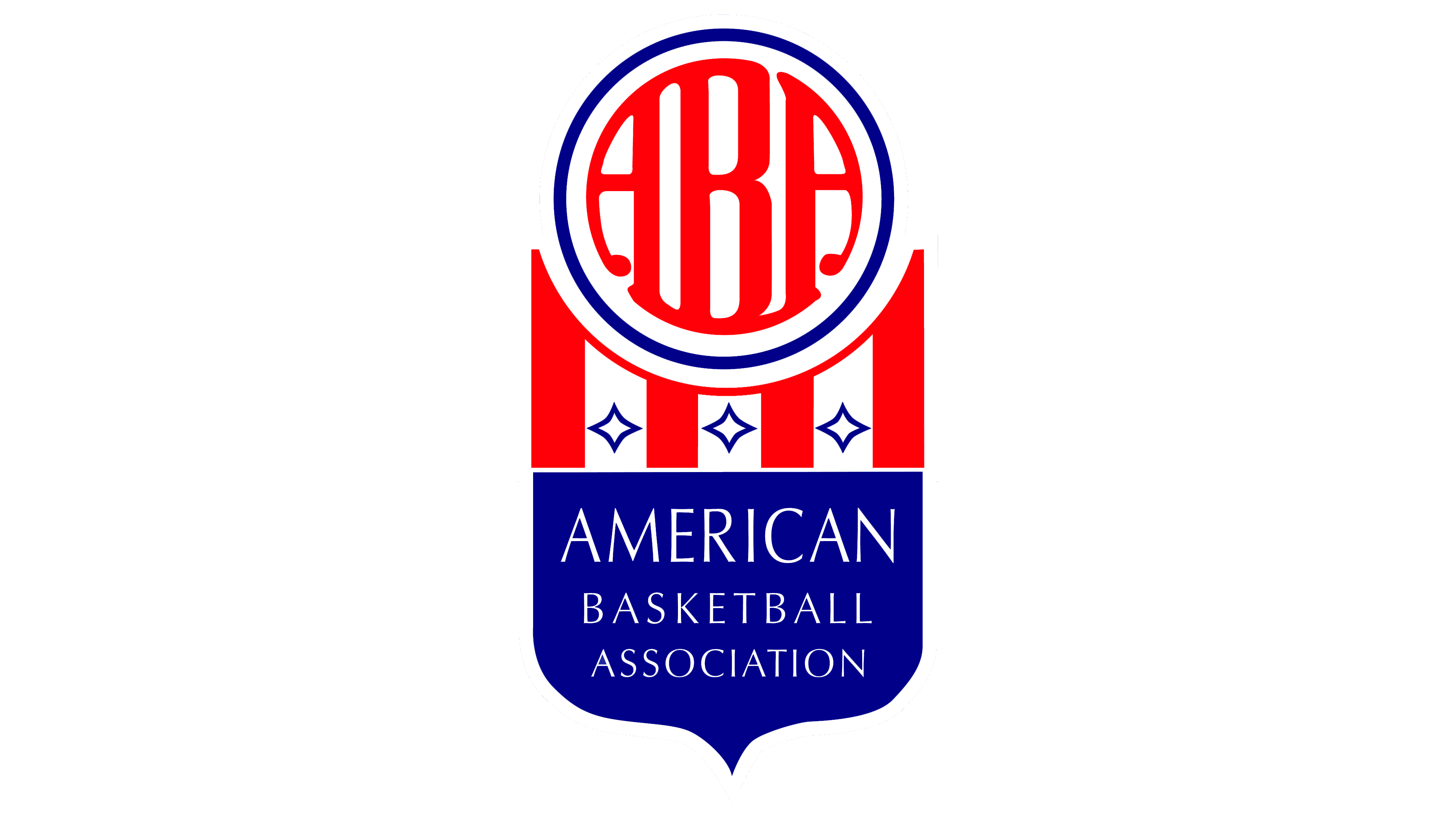
The logo of the American Basketball Association, used from 1967 to 1976, combines athletic energy with national symbolism. The entire design is shaped like a tall vertical shield with a pointed lower part, conventionally divided into three areas.
At the top, there is a blue-outlined circle resembling a basketball, with a red ABA monogram inside. The letters are elongated and styled to create the visual effect of another circle while keeping the inscription clear. The middle area of the shield features vertical red stripes on a white background, with three blue four-pointed stars (diamond shapes) placed between them. The stars emphasize the connection to American national symbolism and complete the graphic structure.
In the lower area appears the name of the association, AMERICAN BASKETBALL ASSOCIATION. The inscription is in white on a dark blue background, arranged in three lines with text sizes gradually decreasing. The word AMERICAN at the top is larger than the two below and set in a neat serif typeface, giving the composition an official, representative-athletic look.
The blue, white, and red combination that forms the basis of the logo reflects the United States’ national palette. It embodies the spirit of American sports and unity. The logo’s elements combine athletic and patriotic themes. Their combination created an image of the organization that became part of basketball history.
Font and Colors

The circular part of the ABA logo features a unique red font. Letters are softly elongated, with decorative tails on the ends of the letter “A.” The lettering appears playful, custom-made for this basketball association.
The lower text contrasts stylistically, using a font similar to Optima Pro Bold. Its lines are slightly narrowed, and letters are even and strict. The white text contrasts clearly against the blue background.
Colors reference traditional American symbols. The red letters convey energy, fitting ABA’s reputation for exciting games. Blue symbolizes reliability. The red, white, and blue combination is standard for US sports leagues.
Different fonts are used. The circular letters reflect the organization’s creative spirit. The lower inscription highlights the league’s official status. Design elements combine into a complete logo.