


 Akzonobel Logo PNG
A company that produces both paints and pharmaceutical products should have a universal emblem, not tied to a specific activity. The AkzoNobel logo features an abstract image that is fresh, open, and friendly. It looks friendly and elevated, symbolizing a commitment to continuous development.
AkzoNobel was formed in 1994, but its roots go back through several older European companies. One line began in 1792, when Dutch painter Wiert Willem Sikkens opened a small paint-and-varnish business in Holland. Another came from Vereinigte Glanzstoff-Fabriken, founded in Germany in 1899 as a maker of viscose and dyes. In 1929, it merged with Nederlandsche Kunstzijdefabriek to create AKU.
A separate Dutch branch developed through Koninklijke Zout-Organon NV, or KZO, with salt and pharmaceutical operations. In 1969, AKU and KZO merged into Akzo NV, a major European chemicals group active in synthetic fibers, paints, pharmaceuticals, and industrial chemicals. During the 1970s, pressure from East Asian fiber producers, oil shocks, and falling profits forced Akzo to cut capacity and shift its focus to paints and pharmaceuticals.
The Swedish side came through KemaNobel, founded in 1871, and Elektrokemiska Aktiebolaget, started by Alfred Nobel in 1895. In 1984, KemaNobel merged with Bofors to form Nobel Industries AB. The group later faced scandals, including the 1985 bankruptcy of Bofors Nobel Inc. in the U.S. and the 1987 revelation of illegal arms exports.
In 1994, Akzo NV merged with Nobel Industries AB to form Akzo Nobel NV. By 2000, it was the world’s largest paint producer, ahead of PPG Industries and BASF. In 2007, Schering-Plough bought Organon BioSciences for $14.4 billion. In 2008, AkzoNobel bought ICI, the owner of Dulux, for £9.1 billion and adopted the AkzoNobel spelling. After rejecting PPG’s offers in 2017, it spun off Nouryon in 2018 and focused on paints and coatings.
Meaning and History
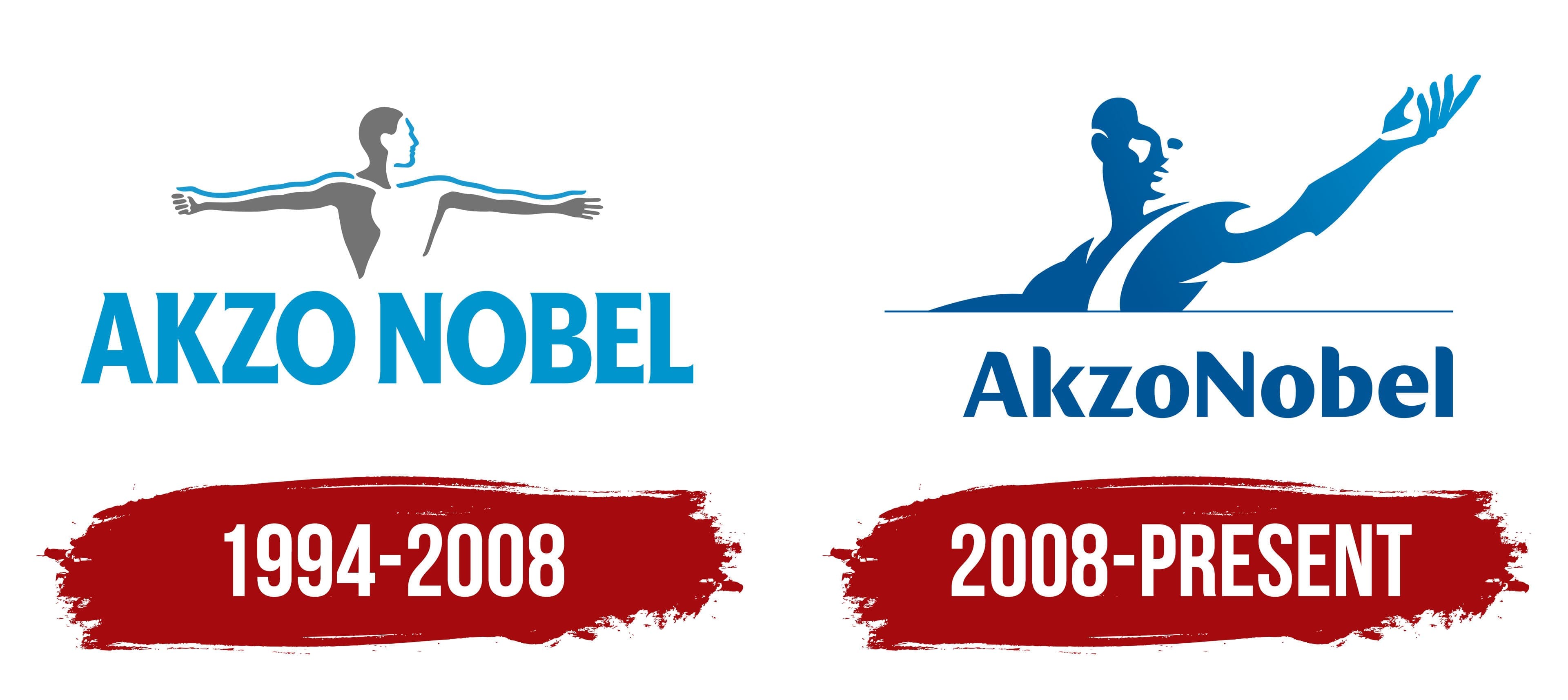
Throughout the company’s existence, only two versions of the logo were used. Both share the same basis: a sculptural figure of a man, with the corporation’s name beneath it. Only the figure’s appearance, its location relative to the viewer, and the color palette changed. Interestingly, the AkzoNobel logo has a prototype. It is a Greek bas-relief sculpture. Today, it is in Oxford, in the Ashmolean Museum.
What is AkzoNobel?
First and foremost, it is one of the world’s leading paint manufacturers. Sales in 2020 exceeded € 8 billion. The company also has subsidiaries in many countries worldwide.
1994 – 2008

The first version of the logo was presented immediately after the company’s foundation. The famous designer Wally Olins created it while working for Wolf Olins. The latter was unrelated to him, and the identical last names were a coincidence. That said, his success in creating visual brand identities led him to become chairman of Saffron Brand Consultants, a popular consulting firm.
For the AkzoNobel logo, Amsterdam-based illustrator Martin Rijven assisted him. He chose a male figure facing the viewer as the basis. His face faces left, and his arms are raised to shoulder level. The image is partially painted in gray, contrasting with the blue outlines that do not cover the entire figure. The face has no features, but one can easily tell it is a man. Both hands have five fingers each.
The brand’s name is set in a classic, bold sans-serif font in blue capital letters with a slightly rounded quality. There is a small space between the parts “Akzo” and “Nobel,” which separates the parts. Together, it looks modern and progressive.
2008 – today
The 2008 logo redesign is directly linked to AkzoNobel Corporation’s acquisition of the rights to the well-known chemical company ICI (Imperial Chemical Industries). The decision to change was driven by the fact that the acquired organization had a fairly modern logo. Therefore, AkzoNobel did not want to get lost in a subsidiary company’s visual identity.
At this stage, the emblem takes on more pronounced sculptural characteristics. The left hand is raised, while the right hand is partially closed at the bottom. This creates an association with scales. The man’s face also turns left, and the blue gradient and white create a sense of three-dimensionality. The corporation’s customers immediately see a reference to Greek sculptures. This choice aimed to showcase the company’s current achievements and future development aspirations.
Changes were also made to the verbal lettering. At this stage, there was no space between the parts of the name. At the same time, the capital letters “A” and “N” clearly indicate the two parts. The typeface was significantly redesigned. It uses a bold, modern sans-serif style with rounded corners. All of the letters look playful and friendly. Like the rest of the logo, the wordmark was navy blue rather than blue in the original version.
Saffron handled the redesign. The slogan “Tomorrow’s Answers Today” is the basis for this version of the logo. Interestingly, the day the new logo was released in April 2008 led to a significant increase in the stock price (by more than 3%).
Font and Colors

The designers chose a classic sans-serif font with rounded corners for the lettering. The name doesn’t get lost against the emblem’s background; it complements it.

The corporation did not choose the white-and-blue color palette by accident. It perfectly matched the style of the “sculpture” and clearly showed AkzoNobel’s customers the company’s prospects and growth.