


 Merck Logo PNG
The Merck logo reflects symmetry and harmony. A manufacturer of medical products needs to show a responsible attitude to work. In this case, the visually balanced emblem symbolizes the balance specialists observe in drug research and production.
Merck & Co. traces its roots to Germany in 1668, when Friedrich Jacob Merck bought a pharmacy in Darmstadt. In 1827, the Merck family business entered industrial drug production, beginning with the commercial production of morphine. The American company was founded on January 1, 1891, when 23-year-old George Merck and Theodore Weicker established Merck & Co. in New York with $200,000 from E. Merck.
The U.S. branch first traded chemical compounds and then expanded into pharmaceuticals. In 1898, it began selling the first commercial smallpox vaccine in the United States. In 1899, the first Merck Manual was published for doctors and pharmacists. World War I changed the company’s status: in 1917, Merck & Co. was seized by the U.S. government, and in 1919 George Merck bought it back at auction for $3.5 million.
Under George W. Merck, the company merged with Powers-Weightman-Rosengarten in 1927. It opened Merck Research Laboratory in Rahway, New Jersey, in 1933. During World War II, it joined government programs for penicillin and streptomycin. In 1953, Merck merged with Sharp & Dohme. In 1957, virologist Maurice Hilleman joined the company and later developed vaccines for measles, mumps, rubella, chickenpox, and hepatitis B.
In 1987, the FDA approved Mevacor, the first statin, putting Merck into direct competition with Pfizer in cardiovascular drugs. The Vioxx withdrawal in 2004 damaged its finances and reputation. In 2009, Merck completed a $41 billion merger with Schering-Plough, gaining pembrolizumab. Approved as Keytruda in 2014, it later became Merck’s main oncology product, competing with Bristol-Myers Squibb’s Opdivo.
Meaning and History
First, the apothecary Friedrich Jacob Merck set up a company in Germany. Then his descendant, Georg Merck, began expanding his business into foreign markets, establishing production sites, laboratories, and research centers. As a result of business negotiations, it was decided to open a branch of the Merck Group’s chemical and pharmaceutical plant in the United States. However, in 1917, the state confiscated the firm. Two years later, the owner bought back the shares and privatized the company again, but it became independent of the parent company. This time is considered the second founding date of Merck & Co.
Nationalization after the First World War had negative legal consequences. The parent organization, which previously included the American division, initiated litigation regarding the name. It was decided that Merck of Darmstadt (the original company) would own the rights to it in all countries except the United States and Canadian territory. It is known as EMD (abbreviation for Emanuel Merck, Darmstadt). However, this did not satisfy the founder’s requirements, and litigation still flares up.
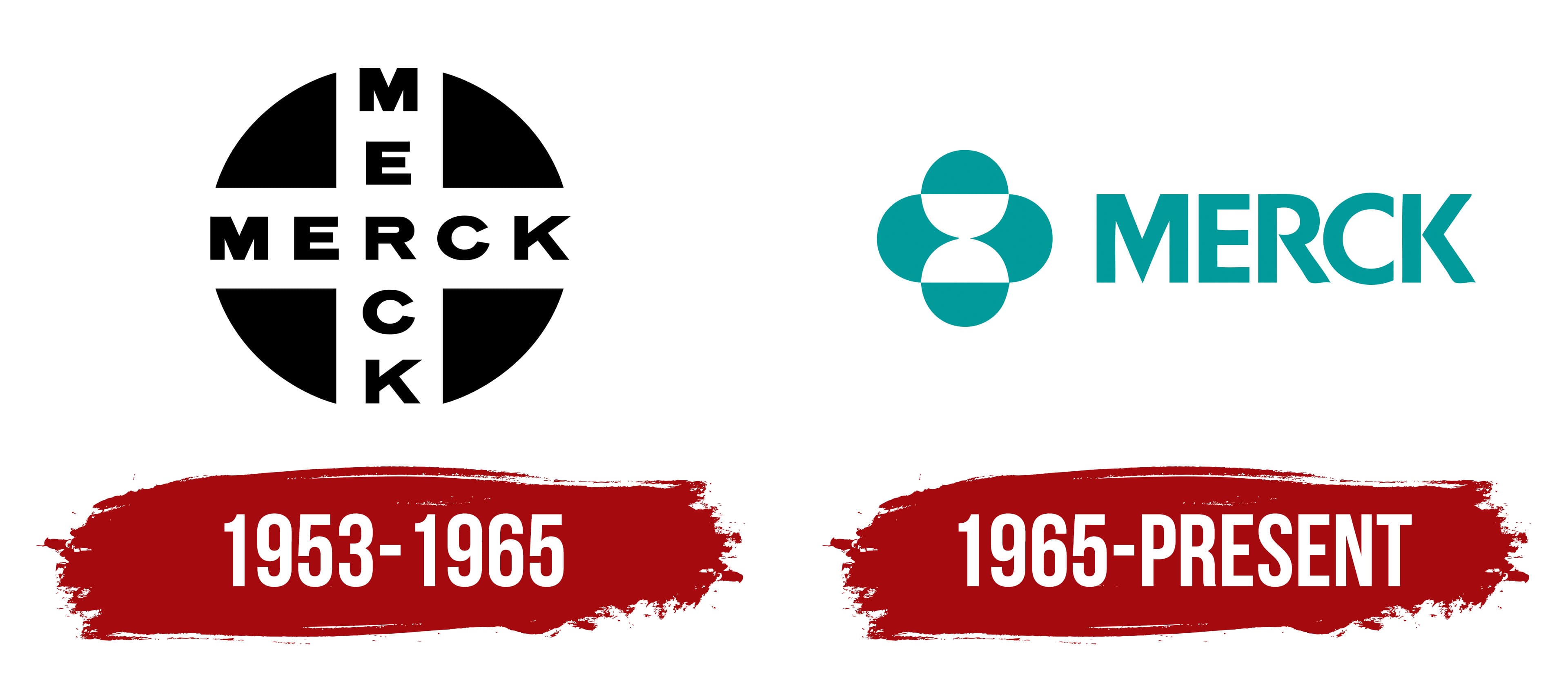
Naturally, problems with Merck’s ownership were reflected in the visual identity of the American successor, which became an independent structure. Its logo did not exist until 1953, signaling a complete break between the two companies. However, this did not prevent the newly created enterprise from using a German pharmacist’s name in its emblem. In general, a pharmaceutical company from the United States has two trademarks.
What is Merck & Co?
Merck & Co. is an American pharmaceutical and biochemical company engaged in the production of medicines, vaccines, biologicals, and animal health products. The year of its founding was 1891, when it was established as a foreign division of the German organization Merck Group. Its founders are Georg Merck and Theodore Weicker. The headquarters is located in Kenilworth, New Jersey.
1953 – 1965
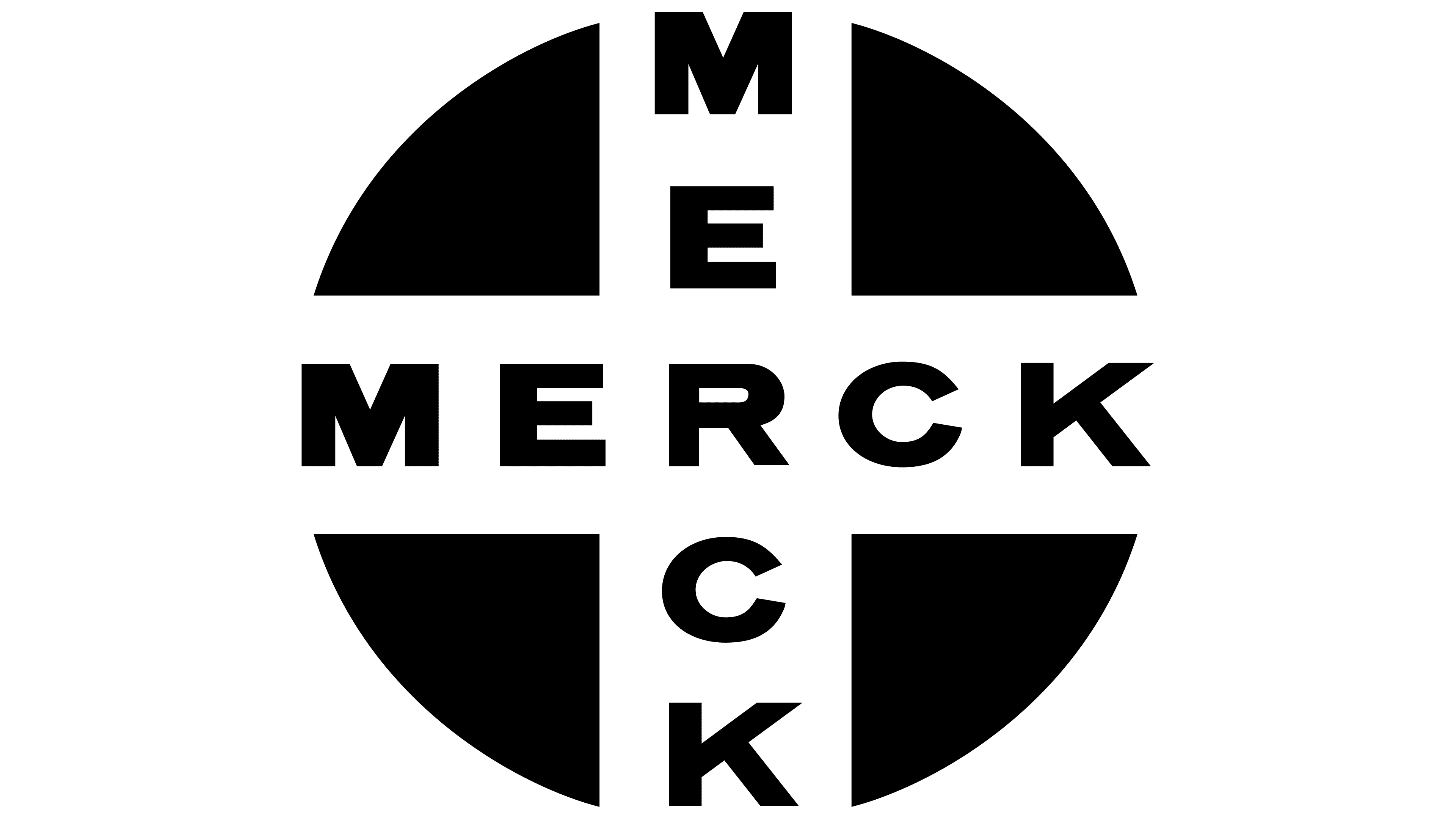
By that time, a simple circle-shaped logo was divided inside by two intersecting stripes of a contrasting color: the disk is black, and the lines are white. This combination made it possible to effectively highlight the negative space and create additional elements. For example, four triangles at the corners, between which two words “Merck” are harmoniously located. Both texts intersect and, in the central zone, are united by a common letter, “R.” Thus came the cross. All characters are capitalized, bold, and chopped.
1965 – today
After the redesign, Merck & Co. adopted a modernized, themed logo. The basic emphasis is on biochemical and pharmacological topics, so a geometric construction appeared next to the name, reminiscent of chemical and biological processes. For example, cell division under a microscope. For this, circles and hemispheres are used, located in a strictly defined order, one on each side. They are located at the top, bottom, right, and left, resembling a symbolic cross. Designers replaced the black color with emerald green. The style of the inscription has also changed: now the signs are elongated, with sharp intra-letter corners, as seen in the “M,” “R,” and “K.”
Font and Colors

The evolution of the Merck & Co logo has always been associated with disputes over the copyright in the authentic name it inherited from the parent company. However, at each stage of development, one can note the presence of large, chopped letters combined with simple geometric shapes: circles and triangles. The current version is the development of the studio Chermayeff & Geismar.

The designers chose grotesque to make the company’s name clear and easy to read. They made the text in both the first and second logos. The main emphasis is on the sharpness of the internal details: the connection between the right and left sides of the “R” and “K,” as well as the central element “M.” The palette of emblems is monosyllabic, consisting of black and white (in the first logo) and emerald and white (in the second logo).