


 Allstate Logo PNG
The Allstate logo offers help and protection. With a policy in place, clients will feel completely safe. The logo’s elements convey care, attention to user needs, calm, and confidence in the future.
Allstate began with a train conversation in 1930, when insurance broker Carl Odell suggested to Sears president Robert E. Wood that Sears could sell auto insurance by mail through its catalog. On April 17, 1931, Allstate Insurance Company entered the market. It took its name from Sears’ Allstate tire brand. The company started with 20 employees and sold 4,217 policies by the end of 1931, collecting $118,323 in premiums.
Its first claim was only $1.65 for a broken car door handle. After two unprofitable years, Allstate posted a $93,000 profit in 1933. At the 1933 Century of Progress fair in Chicago, agent Richard Roskam sold policies from a card table in the Sears pavilion. In 1934, Allstate opened its first permanent counter inside a Sears store. By 1936, premiums reached $1.8 million.
In 1939, Allstate introduced rates based on driver age, mileage, and car use, while State Farm and Farmers Insurance relied on traditional agent networks. In 1950, Davis Ellis created the slogan “You’re in good hands with Allstate.” The company later added liability, fire, homeowners, and life insurance. Allstate opened its first Canadian office in 1953 and had about 6,500 agents by 1970.
In the 1980s, Sears combined Allstate, Dean Witter, and Coldwell Banker under the Sears Financial Network, but the retail finance model struggled. Sears sold 19.8% of Allstate in a 1993 IPO worth $2.4 billion, then spun off the remaining shares in 1995. Allstate bought CNA’s personal insurance unit in 1999 and Esurance in 2011 for about $1 billion.
Meaning and History

The insurance company’s history dates back to 1925, when Sears department store management announced a contest for the best brand name for automobile tires. From over 2 million choices, Allstate was chosen and was incorporated the following year, securing the trademark. The tires were in high demand, so the name was on everyone’s lips.
Then Carl L. Odell, an insurance agent, proposed the concept of mail-order auto insurance to Robert E. Wood, head of Sears, Roebuck & Co. He, in turn, presented the idea to the board of directors, which approved it. Thus, Allstate Insurance Company was named after a tire brand. The idea was born almost by accident, during a train ride in 1930. The next year, the company began active operations. The first Allstate office opened in a Sears store in Chicago in 1934.
Then it began expanding the range of insurance services, adding more and more insured events to the package. In parallel, the company moved its offices several times as it expanded. In 1950, it adopted an excellent marketing motto that became the basis for its corporate style and was embodied in the emblem. Davis W. Ellis, general sales manager, wrote it. It said: “You are in good hands with Allstate.” The image of good hands became the emblem and the insurer’s primary symbol of trustworthiness. The organization has continually refined it, earning five insignia.
What is Allstate?
Allstate is an insurance, banking, and investment company. It is headquartered in the Chicago suburbs.
1931 – 1955
The first 20 years of the company are associated with its formation, as the concept emerged from the blue. During this time, the insurance service planned, laid the groundwork for future activities, and sold auto insurance through the post office (mostly at first). Its logo presumably consisted only of the name, written in strict, plain sans-serif lettering.
1955 – 1969

With the slogan “You are in good hands,” the designers focused on the image of caring hands. After a competition, the management settled on a version featuring outstretched palms depicting a private house on a plot of land. The hands were rendered in white and placed in a black oval. To its right was an unfolded inscription with the motto (above), the name (middle line), and the insurance organization’s legal status (below).
1969 – 2006
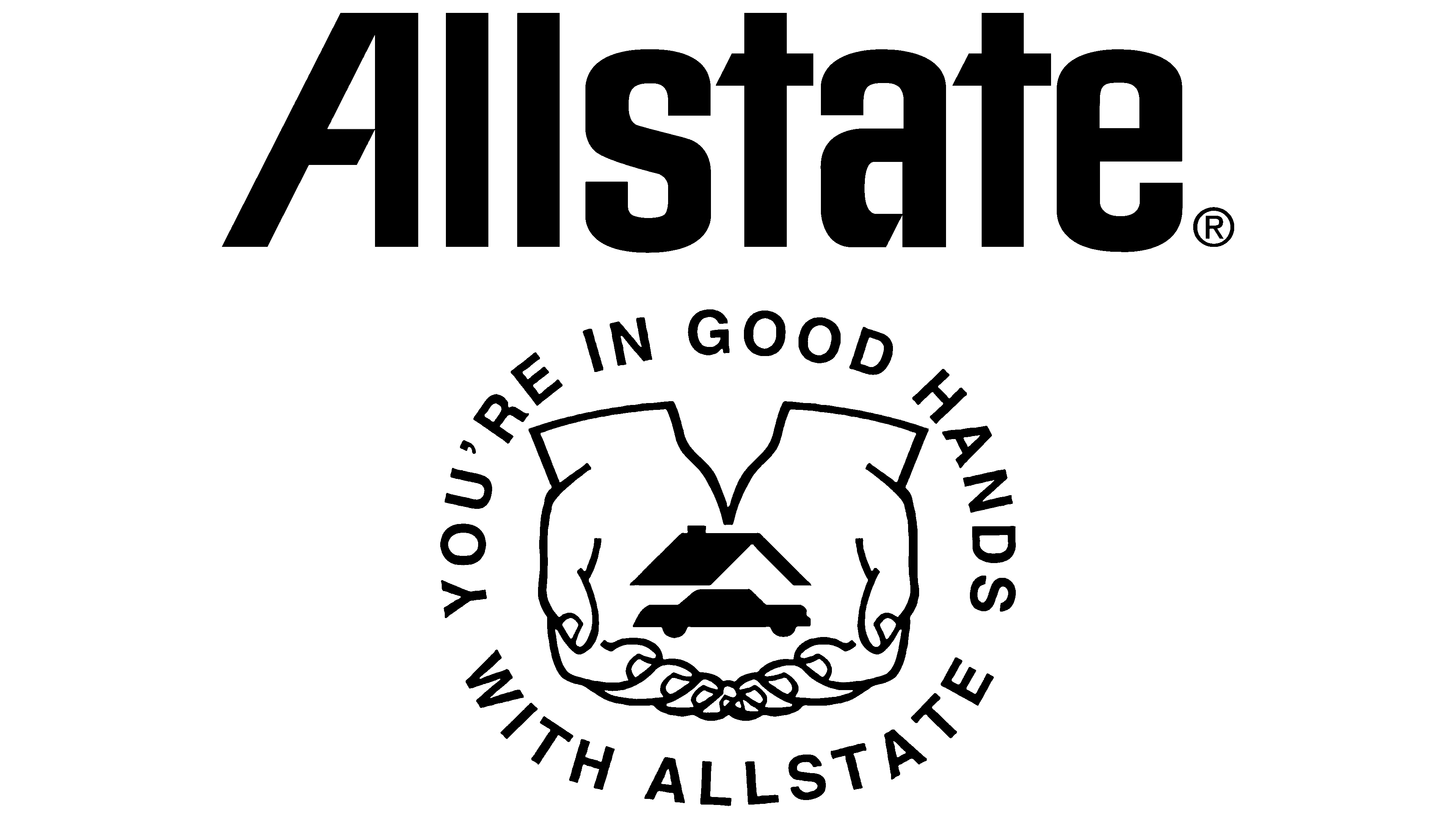
In the next version, the developers changed the text layout. They placed a hand holding a house roof and a car in the center and wrapped the phrase “You’re in Good Hands with Allstate” around it. All the graphic elements were drawn with black outlines and had no fill; they remained white except for the roof and the car. Above the pictogram was the company’s name, in a large, elongated font. In addition, the lettering received its own feature, a cut crossbar at the capital “A” and the same sharp angle at the bottom of the lowercase “a.”
1999 – 2006

As a result of the redesign, the logo changed slightly: the folded palms were placed in an oval and moved to the left of the insurer’s name. The roof and the car disappeared, so their hands appeared open, with the inner sides of their palms facing upwards, indicating the highest degree of trust towards clients. The logo’s color changed to blue for the first time.
2006 – today

After further modifications, the badge frame became slightly wider, and the inscription style changed slightly. One-third of the letters remained unchanged (“A” and two “l”), while the rest of the symbols received a new design (rounded and streamlined).
2017

For a brief period (May- September 2017), the company used a logo with a left-handed palm icon. It had a round shape. The hands had the previous design: strict and neat, with a clear image of each finger.
Font and Colors
The insurance agency’s employees, not specialists, designed the logo. On this occasion, Allstate announced a contest for the best logo. The winner was the variant proposed by Theodore Conterio, who received a $50 reward. According to a 2000 study by the Medill Graduate Department of Integrated Marketing Communications at Northwestern University, the original slogan and logo are the most credible.
The logo’s font is reminiscent of Whitney SemiBold, a humanistic sans serif typeface. Designer Tobias Frere-Jones created it, and Hoefler & Co. first published it.

The color palette is understated yet calm, as required by the insurance industry. At first, black dominated the corporate identity; dark blue later appeared and has been retained ever since.