


 Humana Logo PNG
The Humana logo has been updated frequently as the organization has experimented with its identity, bringing it closer to the principles of compassion and empathy. The logo is clean: it exudes calmness, reliability, and confidence, which is important in the health insurance industry.
Humana is an American home and health insurance company. Since its inception in 1961, it has been listed in the Fortune 500 in the United States, ranking 41st by annual revenue. The organization is also one of the top three health insurance providers in the country. Its founders are lawyers David A. Jones and Wendell Cherry. The company’s head office is in Louisville, Kentucky.
The insurance business was started by settling nursing homes. This is what the company was doing at the time of its inception. At that time, it was called Extendicare Inc. After a few years (in 1968), the organization became the largest in the United States in the nursing home service industry. In 1972, the partners decided to sell the network they had created and focus on hospitals.
They renamed the company specifically to emphasize its humanistic focus and to show that hospitals could and should provide high-quality patient care. By the early 1980s, the highly specialized firm had grown into a major specialty group through the absorption of American Medicorp Inc.
At the same time, Humana proposed a new model of hospital corridor layout and began constructing buildings with double rows of offices along the wards. This allowed it to provide quick and easy access for medical staff to bedridden patients. It introduced health insurance services later, when the U.S. healthcare system was modernized. At that time, the company lost its contract with a major organization and launched its own health insurance project.
Now, it is a large corporation that handles most medical-related issues. This includes hospitals, hospices, and home care services.
Meaning and History
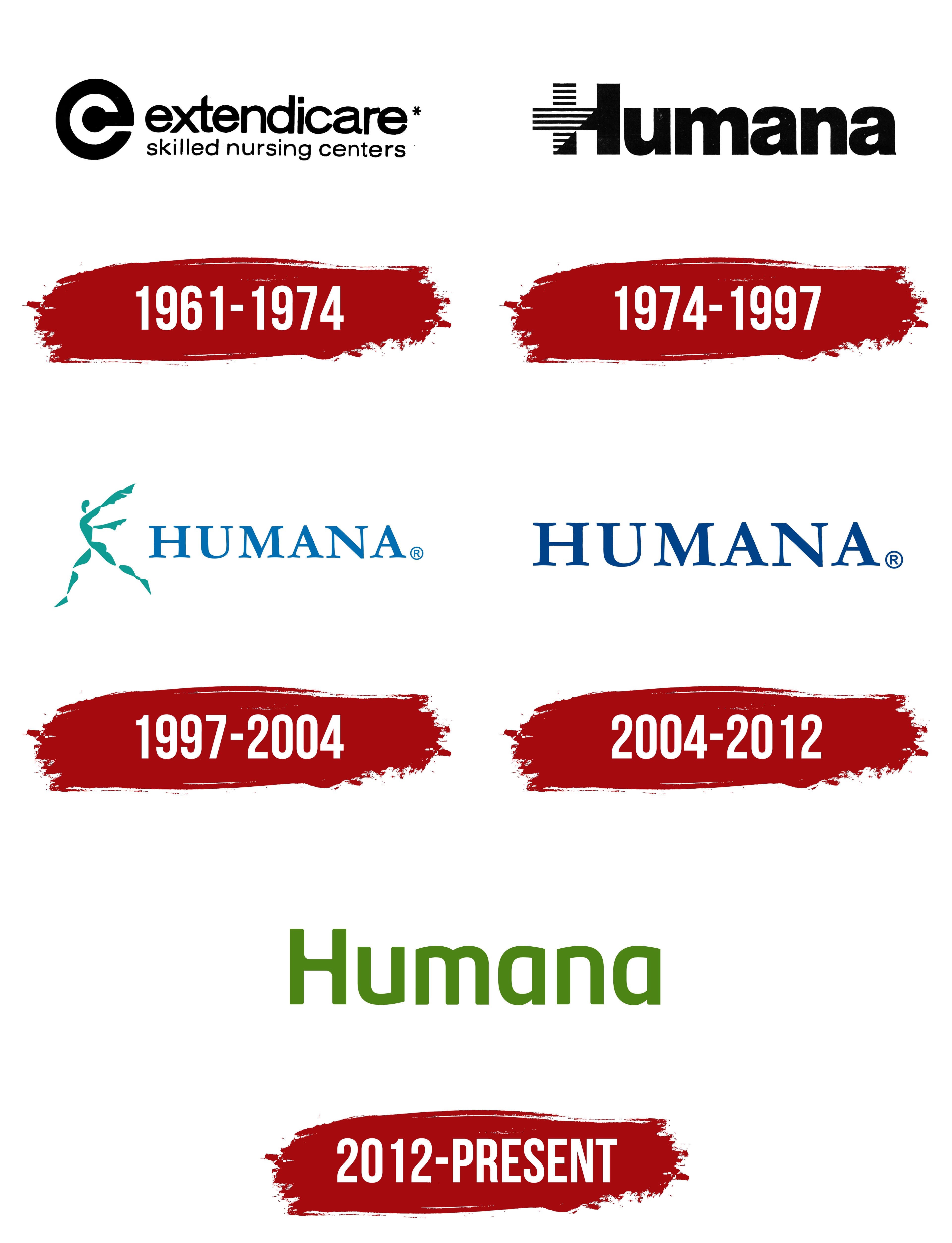
The history of the Humana logo dates back to 1961, when the Extendicare nursing home chain was founded. It later became a hospital company and was given a more “human” name to reflect care and humanity. These same qualities were embodied in the logo depicting a running man: the figure with outstretched arms symbolized care and help.
In the early 2000s, Humana had a simple wordmark with an inscription. The brand name, in Roman script with long, thin serifs, epitomized reliability, confidence, and resilience. In 2012, the health insurance company began using a different text logo- green, rounded sans-serif lettering. It is associated with safety, health, and optimism.
What is Humana?
Humana is an American company specializing in home health care, hospital construction, and health insurance. It is ranked among the most profitable organizations in the health insurance industry, ranking third in the United States. The firm came into existence in 1961, started by David A. Jones and Wendell Cherry. Its headquarters are located in Louisville, Kentucky.
1961 – 1974

The logo contains a stylized “e” in black, the first letter of the name Extendicare. It looks like an unfinished ring with a stripe leading to the center, where a thick dot sits. This design symbolizes cyclicality, care, and protection. The emblem can also be interpreted as a stylized copyright mark, as the negative white space is shaped like the letter “c.” Perhaps this similarity underscores the brand’s intellectual property and exclusivity. Or perhaps the “c” shaped figure is added for symmetry.
To the right of the stylized letter “e” is a two-level text written in lowercase sans-serif glyphs. In the upper part, the company name is typed in bold with narrow letter spacing. The second line is occupied by the phrase “skilled nursing centers,” Extendicare’s slogan.
1974 – 1997

The word “Humana” is typed in a font similar to ParaType’s “Pragmatica Condensed Black”. But the first letter “H” has a non-standard design: its horizontal stroke protrudes to the left. In addition, half of the letter “H” is not black but striped. It is stylized as a cross symbolizing health and medical services.
1997 – 2004

Then came the legendary emblem, which is very significant for an insurance medical organization, as it bears the name and a personal symbol. It is the personification of humanism, after which the company is named. To the left of the inscription is the figure of a man with widely spread arms resembling wings. The character is depicted in action – he is as if “snatched” from the frame at the moment of running, jumping, or taking off. The figure’s features are indistinct and jagged on the right side. Next to it is the word “Humana,” for which the designers changed the font, offering a broad antiqua instead of a bubbly grotesque. This time, all letters are typed in uppercase, and instead of bright cobalt, a pastel blue is used.
2004 – 2012

The logo created in 2004 contains the same lettering as before. The developers kept everything in the same style, font, and letter spacing. Only the text color has changed; it is now neutral blue. The image of a moving person has been removed.
2012 – today

During this period, the logo with an updated concept was used, as it had a different design. The letters are modernized: they have wide legs and sharp corners at the tops. In addition, the authors of the visual identity returned to lowercase, leaving only one capital letter: “H,” at the beginning of the company name Humana. In terms of its structure, it is very interesting: the crossbar lacks classic corners; instead, there are smoothly rounded transitions.
Font and Colors

The visual identity of this American company is completely built on its name. It is a textual sign indicating the seriousness of the services and business approach. The logo contains no superfluous elements; it consists only of verbal elements. In the latest version, the letters are designed as separate glyphs.
The earliest emblem used a grotesque, close to the bubble font Uniform Rounded Extra Condensed Black. The only difference between the two is that the letter “a” is a slightly different shape, with a more sloping transition of the center joint. A completely different lettering style is evident in the second and third logos. This Antiqua is the same as Adobe Kepler® Std Extended Caption Medium. For the modern version, an unparalleled typeface was chosen.

At first, the corporate palette was based on the traditionally “medical” color – blue. It was a very saturated shade of cobalt. Then there were two variants of blue: dusty and neutral. But over time, they were supplanted by green. All of them harmonize with white.