


 Mapfre Logo PNG
The Mapfre logo uses a three-leaf clover symbol, linked to the company’s insurance profile. The clover represents protection, well-being, and good luck, and reflects the work of an insurance company, which involves risk, safety, and customer support in difficult situations. The logo and symbol represent a balance among key insurance areas, long-term obligations, and a responsible attitude toward the client.
Mapfre was founded in May 1933 in Madrid as Mutualidad de Seguros Agropecuarios y de Accidentes, a mutual insurer focused on agricultural risks and worker accidents in a largely rural Spain.
Its early years coincided with the Spanish Civil War, which began in 1936, and with a long period of economic isolation that limited the development of the insurance market. Despite these conditions, the company survived and continued operating.
In 1955, Mapfre obtained a license to provide automobile insurance, entering a segment that later became central to its growth. The expansion of car ownership in the following decades supported this shift.
During the 1960s, under leadership reforms, Mapfre broadened its services beyond agriculture, offering products for individuals and businesses. In 1965, it created Mapfre Vida to enter the life insurance market, and in 1969, it established internal social structures for employees.
After Spain transitioned to democracy and joined the European Economic Community in 1986, competition intensified as companies such as AXA and Allianz entered the market. Mapfre responded by strengthening its distribution and its position in motor insurance.
In the 1980s, the company began expanding into Latin America, building operations in Brazil, Mexico, Argentina, and other countries, often using partnerships with local banks.
By 1999, Mapfre reorganized its structure into Corporación Mapfre and, in 2007, became Mapfre S.A., listed on the Madrid Stock Exchange while remaining controlled by Fundación Mapfre.
In the 2000s and 2010s, the company expanded into the United States and other regions, including a major 2011 joint venture with Banco do Brasil.
Meaning and History

The insurer’s corporate emblem appeared immediately, as it already had a full-fledged platform. However, the developers attempted to refine the symbolism, which, although not visually apparent, at least corresponded internally to the company’s activities.
Such unobtrusiveness proved successful, as the logo does not rely on aggressive advertising or active service promotion. This generated public trust and increased demand for services. The company’s logo features only one well-recognized graphic element, the name of the insurance organization, executed in an original style.
Under legislative requirements, neither the design nor the letters can be changed. They must remain as they were when Mapfre opened. This is related to the company’s visual identity and is intended for potential clients. Therefore, the fonts used on the website match those on the office facades. All versions preserve the emblem’s proportions, shape, and design to avoid discrepancies. This is emphasized in the company’s management requirements. Only the color can be changed.
For instance, a modified version appeared in 2004. It was based on its predecessor. It retained the same text and graphics, but presented the word “Mapfre” in a darker palette. Changes to the logo’s structure are allowed, but the original details must be preserved. Consequently, the logo can have a vertical structure (words arranged in a column, with the image at the top) or a horizontal structure (the name running along the line, with the trademark positioned on the left). However, the substrate’s shape is rectangular only.
Moreover, the word “Mapfre” is used exclusively in uppercase in all contexts. This is also enshrined in the company’s charter. The main reason is to ensure maximum stability, as the insurance sector must remain unchanged to demonstrate reliability and stability to the surrounding environment. Therefore, the company uses two main versions: white letters on a red background and red letters on a white background. The company also uses red-black and white-black logos.
What is Mapfre?
Mapfre is a Spanish company that offers a range of insurance services, including business, travel, health, life, property, and vehicle insurance. It helps manage assets and acts as a reliable financial consultant. The company’s history dates back to 1933, and it began expanding internationally in 1984.
1933
The debut logo featured the inscription “MSAPFRE” in a circular shape. The designers elongated the central letters and reduced the side ones to achieve this effect. As a result, it resembles a small sphere. At the same time, the glyphs are very close together, creating the impression of maximum space filling. The symbols are thin, grotesque, and individual.
1933 – 1934

In 1933, MAPFRE used a logo that reflected its ties to agriculture and to insuring agricultural risks. At that time, the brand was known as Mutua de Seguros Agrícolas and had a clearly defined agricultural focus.
Visually, the mark consisted of a typographic block combined with thematic icons representing the organization’s core areas of activity. The upper section featured symbols of agricultural labor and farming. One area showed a worker holding farming tools, emphasizing the manual nature of work in rural households. Other images included ears of wheat and a bunch of grapes, pointing to specific fields of activity such as crop cultivation, harvesting, and winemaking, which were especially important in southern Spain.
The typographic portion was set in uppercase letters using an elongated sans-serif typeface. The name MAPFRE was larger than the rest of the text and positioned at the bottom of the composition. The primary color was dark green.
1934 – 1940
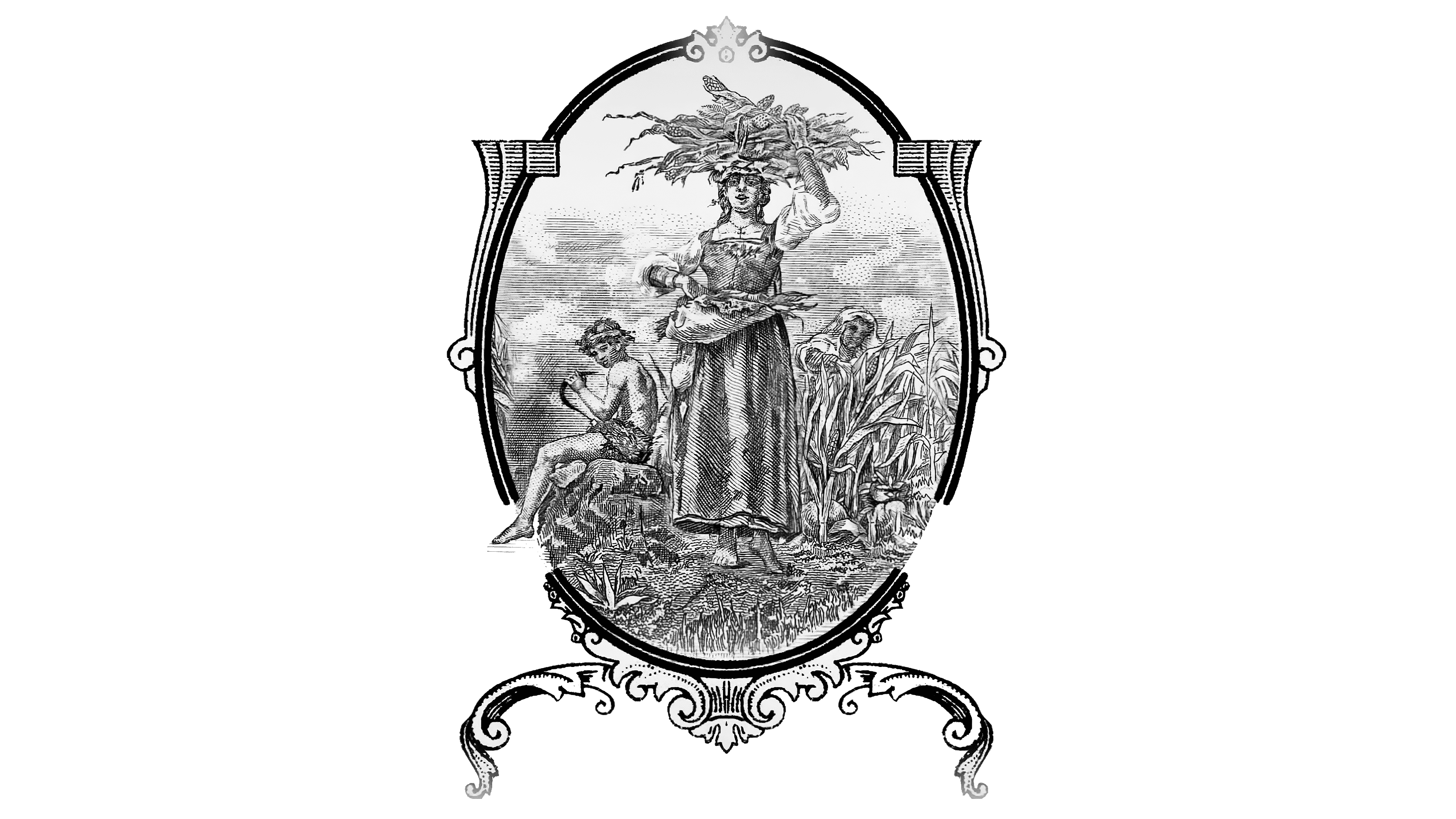
Then, a thematic logo was approved that reflects Mapfre’s sphere of insurance interests. Artists drew an emblem in a thematic style. It depicts three people in a cornfield. In the center stands a woman with a bunch of cobs on her head. Another rural woman stands among the stalks in the distance. A boy sits on the left. He holds a sickle. The logo is oval and oriented vertically. An elegant Rococo-style frame, emphasizing fine details, surrounds it. Strict symmetry and contrasting colors (black and white) emphasize the delicate interplay of lines. There are no inscriptions.
1940 – 1950s

To modernize the logo, the artists redrew it entirely. They presented a yellow field showing four tanned men wearing wide-brimmed hats working. In the background are several buildings that obviously belong to the farm. Further white clouds on a blue background. Below is the text, divided into four lines: “mutua,” “de seguros,” “agricolas,” and “M.A.P.F.F.R.E.” All letters are painted brown and outlined in blue.
1950s – 1955

The next modernization of visual identification brought a more contemporary interpretation. It was associated with increased insurance payouts. Thus, the logo depicted a man wearing a wide-brimmed hat, a traditional garment often associated with farmers. Behind him is a factory with tall chimneys from which thick smoke billows. The focus shifted from agriculture to industry, as shown by the frame, which features half an ear of corn and a gear. Unlike the previous version, this emblem is round rather than square.
1955 – 1960s

This emblem is a graphic and textual design that harmoniously combines both visual and textual elements. The key element is still the chosen drawing. It depicts a circle with a “crown” at the top, with a car and people inside. The background is a wide red-and-yellow stripe. They are enclosed in a ring consisting of the phrase “Mutua de seguros agricolas e industiales.” The upper part features the inscription “M.A.P.F.F.R.E.” The text uses black serif letters.
1960s – 1969

MAPFRE has unveiled a new logo and now identifies itself through a ring with contrasting color zones. A dark line outlines the lighter outer section, while the inner area is black.
At the center of the circle is a capital letter M, designed in a strict geometric style. The symbol’s form is simple and minimalist. Heavy sans-serif lettering surrounds the composition. The name MAPFRE occupies the upper arc of the ring, while the slogan MUTUALIDAD DE SEGUROS completes the lower part.
1969 – 1985
In 1969, a clover leaf appeared in the logo. It is white, outlined along the entire perimeter by a red raspberry line. The stripe is wide, so it outlines the leaf image well. The text from the emblem has completely disappeared.
1985 – 1998

The next version of the emblem is a miniature clover leaf in a square with rounded corners. It is so streamlined that it looks more like a straightened circle. Below is the insurance company’s name, but without dots after each letter. The symbols are bold and geometrically proportional.
1998 – 2004
The updated logo retained the same details as before. Only the font has changed. Now, the letters are shorter, but their height remains the same.
2004 – 2026

The insurance company Mapfre now uses a circular Raspberry logo instead of a square one. And the designers modernized the font. They increased the space between the letters, narrowed the serifs and crossbars, and sharpened the middle element of “M.”
2026 – today

Mapfre has refreshed its brand, unveiling a new visual style to the public. The update reflects internal changes within the company and its intention to build a closer connection with its audience. The move marks an important milestone for a business that has been actively evolving in recent years in response to market challenges, social trends, and new technologies.
Key elements of the new style preserve the traditions of a company with more than 90 years of history, while adding brightness and contemporary relevance. Mapfre’s iconic red has been revitalized, becoming richer and more saturated. The company’s clover-based logo has also been updated. Its revised silhouette feels lighter and more modern. Using a lowercase typeface helps the brand appear more approachable and accessible to customers.
The main goal of the rebrand was to support and strengthen relationships with clients and partners. The new visual language conveys closeness and simplicity.
The rollout of the new identity will take around three years. It will be implemented in stages, covering all regions where the company operates and taking local specifics and needs into account. Key offices will be updated first, followed by all Mapfre locations worldwide, and then by digital channels and corporate platforms. The changes will also extend to Mapfre’s subsidiaries, including its reinsurance and risk management divisions.
Font and Colors
In addition to the letter part, the company’s symbolism includes a graphic element: a clover leaf. It is a key factor in the image and a distinctive sign of high status. It consists of three proportional segments. Positioned in the center, above the name, between “P” and “F.” Initially, it was simple and monochromatic. After the 2004 logo redesign, small changes were made, which have been preserved to this day.
Another symbol closely associated with the company’s symbolism is the “bridge” (in the form of a circle). It has become a powerful communication tool. It is used alongside the inscription and the clover to symbolize cooperation.
Mapfre’s color palette is more loyal and has undergone repeated changes. However, it mainly uses the Pantone 485 range. Together with the logo, it forms a unique set. It also includes white.