


 State Farm Logo PNG
The State Farm logo represents protection against dangerous situations. The emblem reflects the theme of setting aside cash savings. You can look to the future with confidence because you have solid financial backing.
State Farm grew out of George Jacob Mecherle’s experience as a farmer who became an insurance agent. He believed it was unfair to charge rural drivers the same rates as city drivers, since farmers drove less and incurred fewer losses. His employer rejected his proposal to adjust the rates, so on June 7, 1922, Mecherle founded a company in Bloomington, Illinois. The name referred to its first customers, the state’s farmers. Policyholders owned the company, and paying premiums every six months helped ease the strain on family budgets.
State Farm reached rural customers through local agents before expanding into cities. Customers who bought auto insurance also needed life and property coverage, prompting the company to broaden its offerings. It weathered the Great Depression and became the largest auto insurer in the United States by 1942. Rising claims payouts after World War II led to losses and overwhelmed the home office. Management responded by shifting responsibilities among divisions and expanding the regional office network.
Homeowners insurance became the company’s next major line of business. State Farm combined coverage for several risks in a single policy, introduced monthly payments, and established a team to serve areas hit by natural disasters. The group later expanded into deposit accounts, mortgages, and auto loans. Over time, some operations moved to partners. Desjardins acquired its Canadian businesses, while State Farm began offering banking services through an agreement with U.S. Bank. By the end of 2025, the group served nearly 97 million policies and accounts.
Meaning and History
Starting as a small insurance project, State Farm has grown into a profitable business spanning many countries. In 2014, the company sold its Canadian operations to Desjardins Group, which had used the original name until 2018. It was then officially spun off from the parent organization and renamed Desjardins Insurance, while the U.S. division retained the former name. The final transition was completed only recently, in 2019.
The company kept the old logo, which had become widely popular. The red icon with three ovals is legendary; it has been in use since the 1940s. It was first updated in 1953. And for 60 years, this trademark has played an important role in maintaining the brand image.
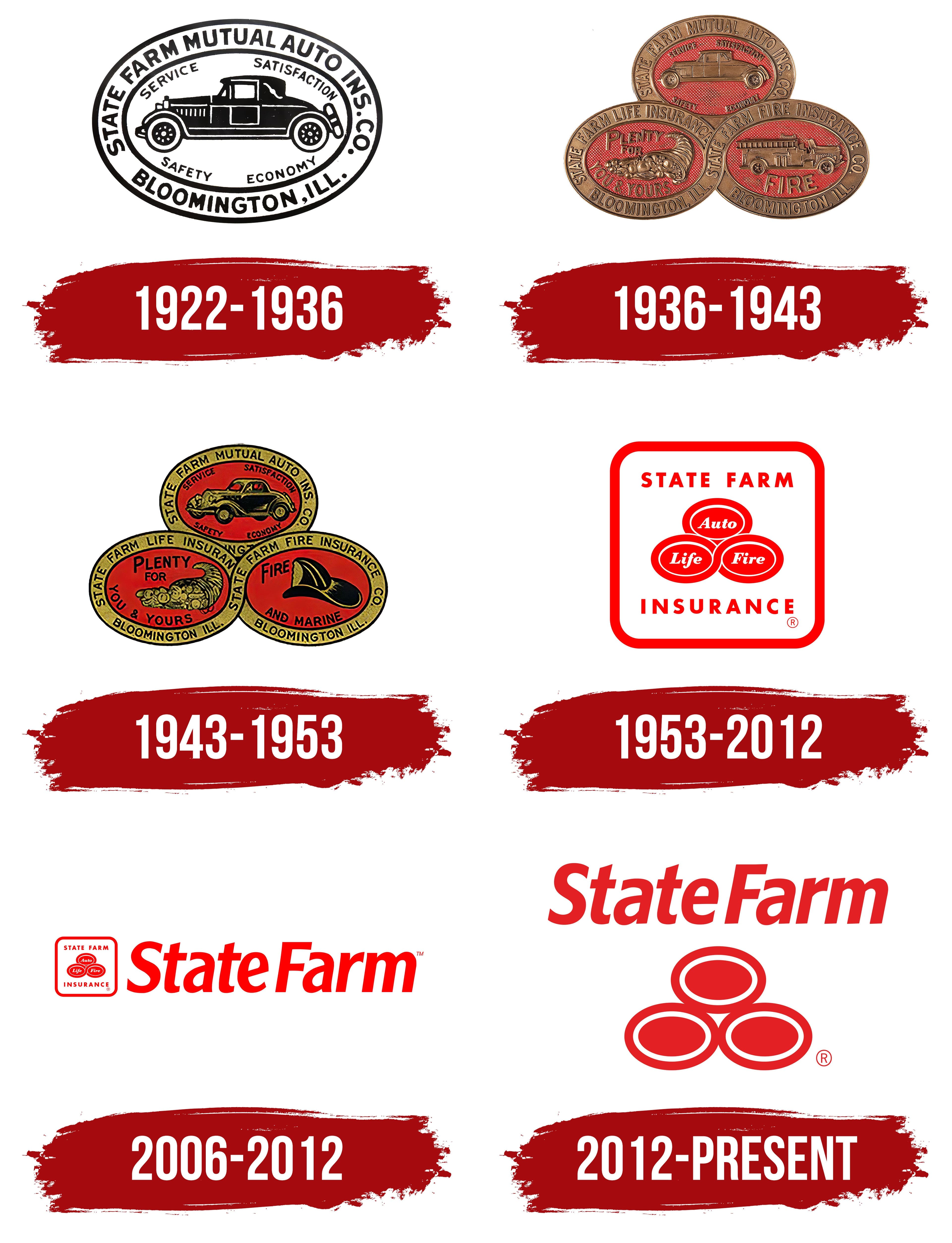
At the end of 2011, the company fully modernized its visual style, turning the three-oval emblem into a modern logo. This change was meant to promote its core insurance services. State Farm approved the new identity in early 2012, at its 90th anniversary. According to the vice president of marketing, this measure was necessary to make the organization more competitive in today’s digital world. The company has had six emblems in its history.
What is State Farm?
State Farm is a group of companies headquartered in Bloomington, Illinois. It was formed in 1922 to provide financial and insurance services. Since 1942, this organization has been the largest motor vehicle insurer in the United States.
1922 – 1936

The car in State Farm’s early emblem reflected the company’s original focus on affordable auto insurance for rural residents. Former farmer George Jacob Mecherle founded the business on June 7, 1922, in Bloomington, Illinois. As a mutual insurer, the company was owned by its policyholders.
The full name, State Farm Mutual Automobile Insurance Company, described the organization and its initial customer base. “State” and “Farm” referred to Illinois farmers, “Mutual” identified its ownership structure, and “Automobile Insurance” named the service it provided. As its audience grew and the company entered new lines of business, it retained the shorter State Farm name.
The early logo, documented in a 1927 example, was a horizontal oval with a double outline. A white band between the outlines carried the words “STATE FARM MUTUAL AUTO INS. CO.” Along the bottom, “BLOOMINGTON, ILL.” identified the city and state where the company was founded. Black uppercase lettering, a white background, and a heavy oval border gave the emblem a seal-like appearance.
Inside was a black car shown in profile, with detailed wheels, radiator, cabin, and door. Above it were the words “SERVICE SATISFACTION,” with “SAFETY ECONOMY” below. The four terms expressed the insurer’s promises of service, satisfaction, safety, and savings. The oval shape remained part of State Farm’s later identity.
1936 – 1943
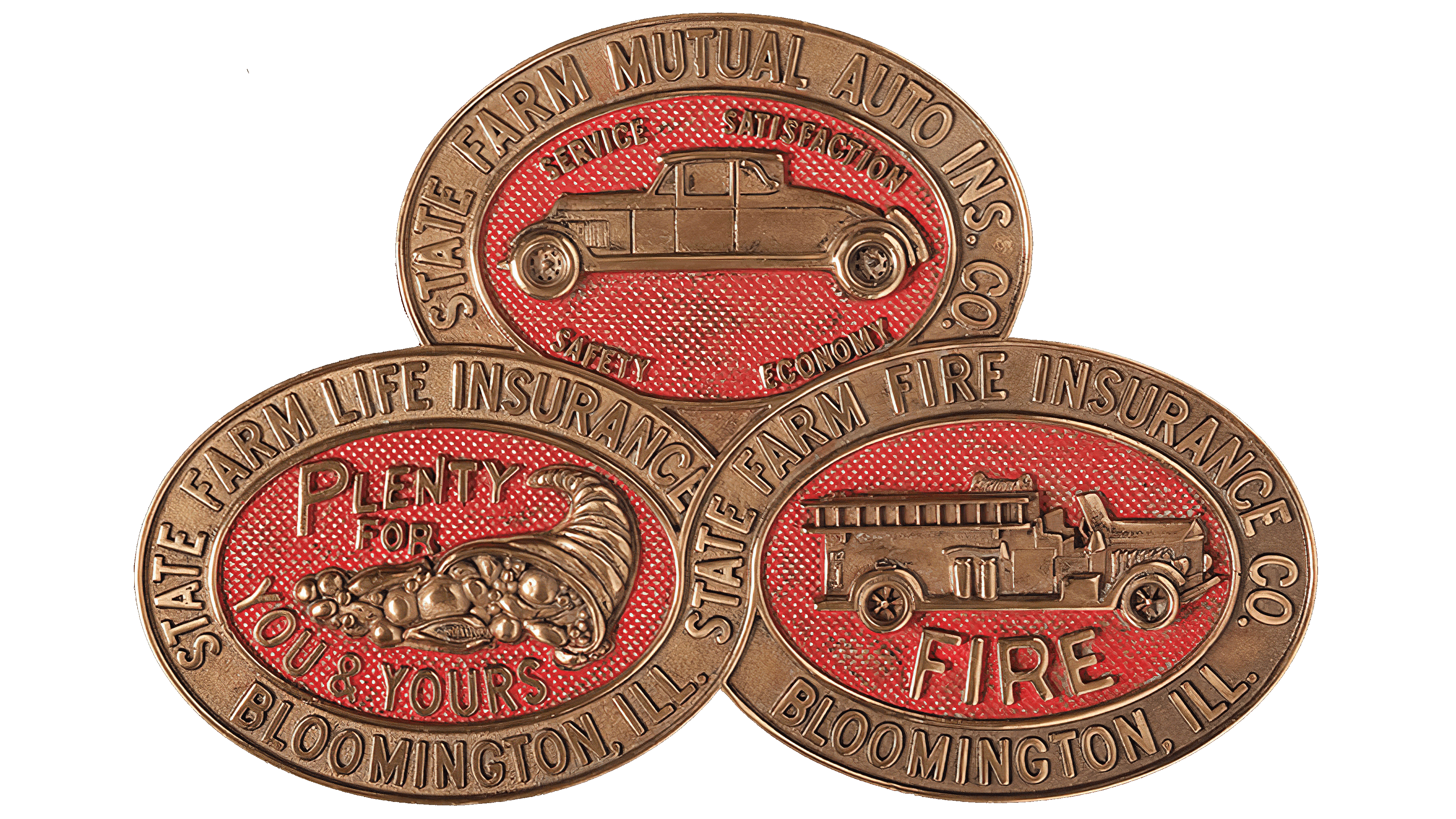
State Farm’s expansion beyond auto insurance led to an emblem composed of three ovals. State Farm Life Insurance Company began operating in 1929, with group founder Mecherle purchasing its first life insurance policy. State Farm Fire Insurance Company followed in 1935. By 1936, the three lines of business were represented in the “Tri-Oval” logo. The auto insurance emblem sat at the top, with the life and fire insurance emblems below, forming a triangle.
The bronze version brought together three horizontal ovals with red backgrounds. The outer rims, lettering, and illustrations were raised above the colored surfaces. The ovals partially overlapped but still resembled separate metal badges. The two interlocking lower ovals suggested a figure eight.
The upper oval retained the car and the insurer’s four earlier promises. At the lower left, a fruit-filled cornucopia represented life insurance. The words “PLENTY FOR YOU & YOURS” expressed a wish for prosperity for policyholders and their loved ones. At the same time, “State Farm Life Insurance Company” ran around the rim. The lower-right oval contained a fire truck and the word “FIRE.” The insurance company’s name and references to Bloomington filled nearly all the space around the borders.
1943 – 1953

State Farm retained the triangular arrangement of the three ovals while updating the images inside them. The car was angled to reveal its front end. In the left oval, the cornucopia shifted to the right, leaving the message of prosperity beside it. In the right oval, a firefighter’s helmet replaced the fire truck. “FIRE” appeared above the image, with “AND MARINE” below. The wording expanded the description of coverage to include marine risks alongside fire.
Gold bands with an olive tint and black lettering surrounded the red interiors. Detailed illustrations appeared alongside long company names and small explanatory text. The three ovals continued to represent the insurance lines.
The logo also appeared on automotive accessories. An enameled metal State Farm badge, dated to between 1940 and 1955, was designed to mount above the top edge of a license plate. It combined red, gold, and black with the insurer’s name and a reference to Bloomington. Displaying the badge identified the driver as a State Farm customer.
1953 – 2012

The State Farm emblem developed by Whitaker-Guernsey Studio in 1953 replaced the illustrations with service names. The three connected ovals contained “Auto,” “Life,” and “Fire,” identifying the company’s auto, life, and fire insurance businesses. The ovals retained their arrangement. Together with the company name, they were enclosed in a frame with rounded corners.
“STATE FARM” appeared above the ovals, with “INSURANCE” below. These outer inscriptions used Futura Bold, a heavy sans-serif typeface, in widely spaced uppercase letters. The service names inside the emblem were set in italic serif lettering. The contrasting typefaces distinguished the insurer’s name from its services.
The original version combined orange and black. A red-and-white version emerged while developing a reflective bumper sticker for policyholders. The sticker’s requirements determined a color combination that later became part of State Farm’s identity. White words appeared against the red ovals, with thin white outlines running along their inner edges.
The frame, three ovals, and brief service names remained in the logo until the 2012 update. In 2020, the 1953 version briefly returned in a SportsCenter commercial tied to the documentary “The Last Dance.”
2006 – 2012

In 2006, State Farm added a large wordmark to the right of its existing emblem. For a time, State Farm used the horizontal version alongside the square version. A smaller emblem remained on the left against a white background, retaining the frame, three ovals, and small “Auto,” “Life,” and “Fire” labels.
The State Farm name filled most of the logo. It appeared on a single line in red, slanted sans-serif lettering. Capital “S” and “F” letters marked the beginnings of the two words. At the same time, the narrow space between them brought the name together as a single wordmark.
2012 – today

State Farm’s expanding range of insurance and financial services called for a logo revision, but it still listed only “Auto,” “Life,” and “Fire.” Digital formats and mobile apps also drove the update. At small sizes, the frame, multiple lines of text, and labels inside the ovals became crowded. The redesign was announced on December 15, 2011, and the rollout began on January 1, 2012.
New York studio Chermayeff & Geismar retained the red color and triangular arrangement of the three ovals. The outer frame, the word “INSURANCE,” and the individual service names were removed. The proportions were adjusted for symmetry and easier reproduction. Thin white outlines remained inside the red shapes, and a small white triangular gap appeared between the upper oval and the two lower ones.
The State Farm name accompanied the emblem in horizontal and vertical arrangements. The wordmark used a modified version of Frutiger 76 Black Italic, retaining the heavy, slanted sans-serif lettering. Removing the service names allowed the emblem to represent the company’s broader range of offerings.
Wolff Olins refined the identity in 2020 as part of a project begun the previous year. James Moore served as design director, while Clinton Inselmann, State Farm’s head of brand design, oversaw the work. The three ovals remained, and the red became warmer. Supporting khaki, gold, and green drew on State Farm’s history. The team studied archival materials with the corporate archivist. CMOORE Sound developed the sonic identity.
Font and Colors
statefarm logo
The iconic State Farm mark is the oval. It was first single, then triple. The main logo is pyramidal, with two geometric shapes at the bottom and one at the top. This structure has been preserved to this day, although the drawings and inscriptions that once appeared on the oval have disappeared.
Several font types have been used over time. In the original versions, a font close to Whitney Bold Italic, designed by Tobias Frere-Jones, prevailed. The modern versions use Frutiger Bold Italic, designed by Adrian Frutiger and first published by Linotype.

The corporate palette has always been understated. The debut logo is in black and white. Over time, olive green and red became predominant.
FAQ
What do the three circles in the State Farm logo mean?
The three ovals in the State Farm logo represent the company’s insurance types: vehicles at the top and life and fire at the bottom. All the marks used to be signed, but now they’re drawn. They first appeared on the company’s emblem in 1936.
What does the State Farm emblem mean?
The modern State Farm logo has three simple graphic elements and one inscription. Under the name of the insurance group of companies is a pyramid of three ovals. They are identical in size and shape and neatly “stacked” on top of one another.
What does the State Farm slogan represent?
In 2016, State Farm, an insurance company based in Bloomington, Illinois, changed its slogan but kept the original logo. After a marketing rethink, it uses the slogan “Here to help life go right.”
What font is the State Farm logo in?
State Farm Insurance Company redesigned its logo in 2012. It changed the graphic and text elements and commissioned a custom typeface. The company has since renamed the logo State Farm News Gothic.