 Amgen Logo PNG
Serious business requires a serious approach. That’s why the Amgen logo is strict and businesslike, tolerating no “objections” from the outside, since it has few competitors in the industry. The corporation has an important mission: saving people from the most severe and often incurable diseases, which has shaped its serious emblem. It is impressive and inspiring, instilling trust and hope.
Amgen began on April 8, 1980, in Thousand Oaks, California, as Applied Molecular Genetics Inc., later shortened to AMGen and then Amgen. Venture investor William Bowes helped raise about $19 million in start-up capital. At the same time, UCLA molecular biologist Winston Salser built a scientific advisory board that included Norman Davidson, Leroy Hood, and other genetics specialists. In October 1980, George B. Rathmann, formerly of Abbott Laboratories, became the company’s first president and CEO.
In its early years, Amgen tested several uses of recombinant DNA technology before focusing on medical biotechnology. One early scientific result was cloning the luciferase gene, which appeared on the cover of Science in 1983. On June 17, 1983, the company held its IPO, raising about $40 million, and officially adopted the shorter Amgen name.
The breakthrough came with the cloning of the erythropoietin gene, which led to the development of Epogen. The FDA approved the drug on June 1, 1989, after patent disputes with Genetics Institute over commercialization rights. In 1985, Larry Souza and his team cloned the G-CSF gene, leading to the development of Neupogen, which the FDA approved in February 1991 for cancer patients receiving chemotherapy.
In 1984, Amgen partnered with Kirin Brewery to sell G-CSF in Japan, Korea, and Taiwan. By 1992, Epogen and Neupogen sales had passed $1 billion, and Amgen entered the S&P 500. Gordon Binder became CEO in 1988, the Puerto Rico plant opened in 1993, and Synergen was acquired in 1994. Later products and deals included Aranesp in 2001, Immunex and Enbrel in 2002, and Prolia and Xgeva in 2010. Key competitors included Genentech and Genetics Institute.
Meaning and History
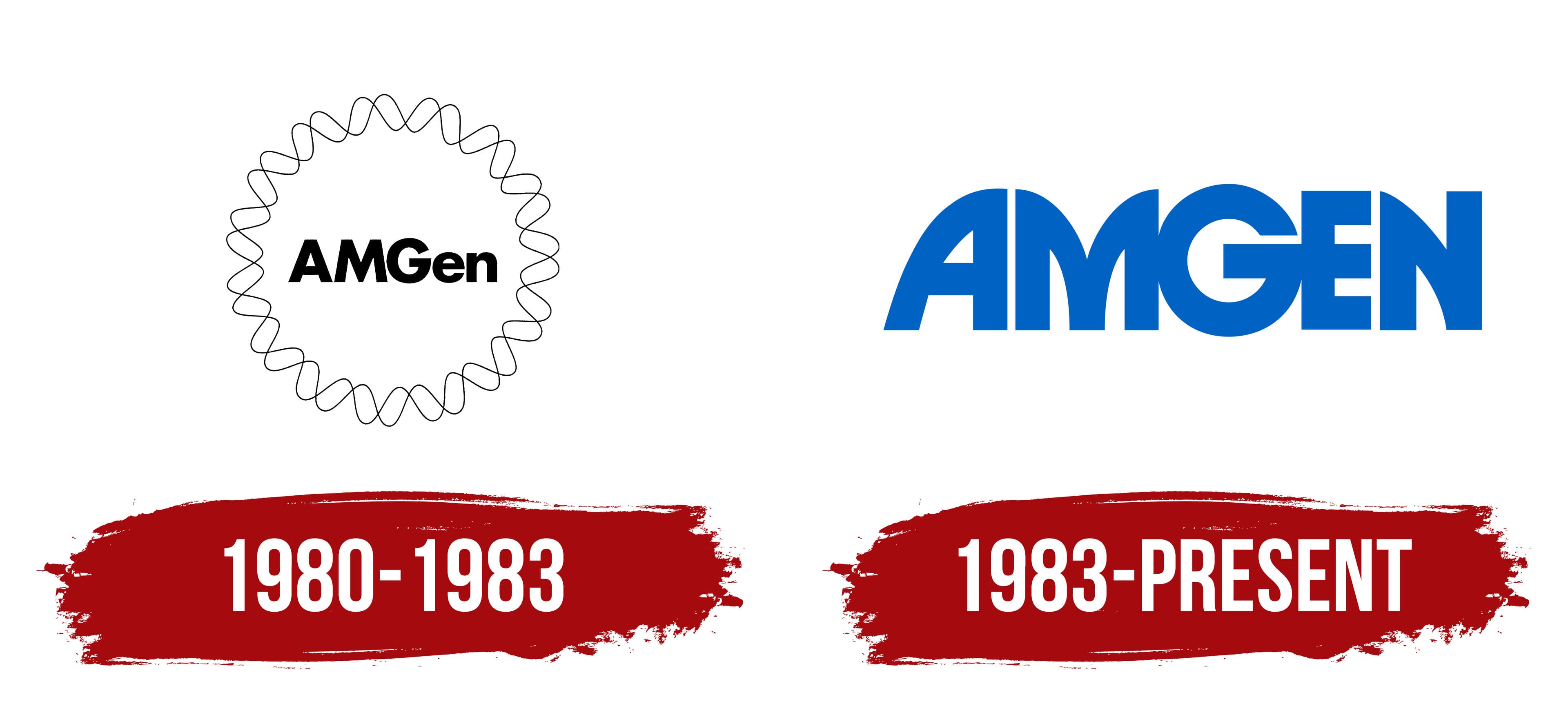
In 1980, entrepreneur William Bowes, who worked at Cetus Corporation, proposed that Winston Salser at UCLA assemble a group of scientists to conduct innovative research on producing advanced drugs at Amgen. The name was chosen accordingly – Applied Molecular Genetics, later shortened. Both versions are reflected in the corporate logos.
The company’s visual identity is built on the name so that interested parties can immediately recognize who it is, what it does, and what it produces. The logo is designed in a serious style, characterized by practicality, a business-like appearance, and minimalism. The color palette is optimistic and instills hope for improvement in clients. The emblem’s evolution addressed all aspects.
What is Amgen?
Amgen is a major player in the U.S. healthcare sector. It is the largest American pharmaceutical corporation, producing its own drugs based on advances in DNA research. A group of scientists established it in 1980, with support from William Bowes and Winston Salser. Its head office is located in the Californian city of Thousand Oaks.
1980 – 1983
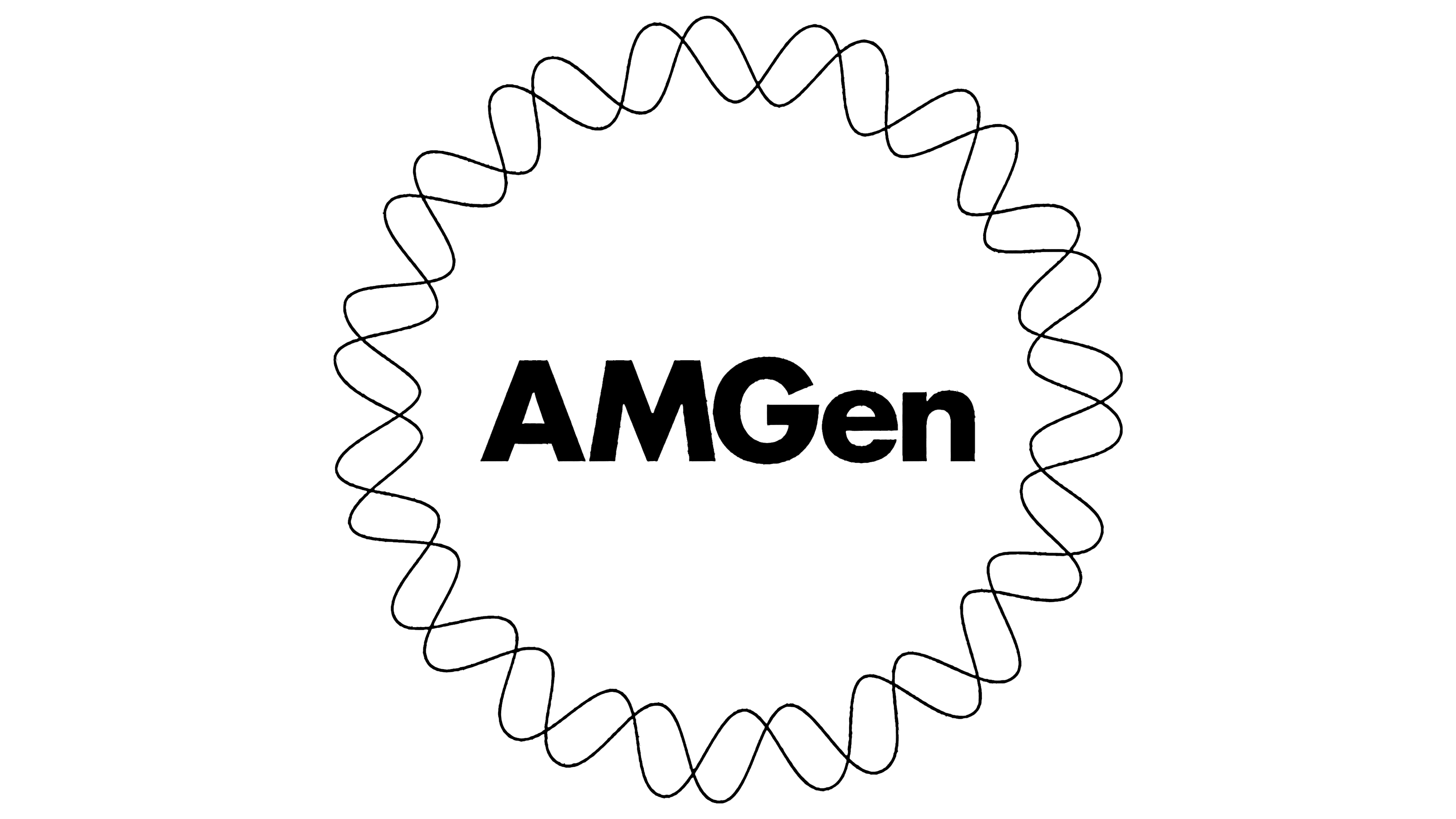
The Amgen logo was circular. It was shaped like a seal, with a double thin line along its edge. It represented human DNA, the basis of research and production technologies, and remains so. Placed in a circle, it looked like a strict ornament with repeating elements.
In the center was the name of the biopharmaceutical corporation. To emphasize that it was an abbreviation of the phrase Applied Molecular Genetics, the designers retained the three capital letters, one for each word. They shortened the company’s name to AMGen. The inscription was executed in bold, blocky font. The glyphs were positioned very close to each other; the inter-character spacing was minimal.
1983 – today
After the official transition to the abbreviated name, the biotechnology corporation redesigned its logo to make it more concise. The wavy double-line circle disappeared, leaving only the inscription. However, they modernized it with a distinct font. The designers focused on the glyphs, turning them into a contemporary visual identity element.
The letters became massive, large, blocky, and capitalized. In some places, the distance between them was reduced to the point that they almost merged. This is especially noticeable at the junctions of the characters “M,” “G,” and “N,” which transition harmoniously into one another.
Font and Colors
The main typeface used in the Amgen logo is a member of the Helvetica family. It is a smooth, bold, and even sans-serif font, reminiscent of Joya Sans Bold by Wiescher-Design. In another emblem, the inscription features unique glyphs created by individual order, making them hand-drawn elements. Three letters have peculiar elongations at the ends (“A,” “M,” “N”), while the remaining two (“G,” “E”) contain only straight bars of equal width.
The biopharmaceutical company’s corporate color palette is light blue. It has a corresponding name and expresses hope for the better: recovery and support for the body’s strength to fight disease. It is a color of faith, tranquility, and harmony. It reduces anxiety and balances the emotional background.