


 Anderlecht Logo PNG
The Anderlecht logo features numerous symbols linked to its origins and a history spanning more than a century. As a result, it includes many components that form a symmetrical pattern. It reflects the national pride of the Royal Sporting Club Anderlecht.
RSC Anderlecht’s history began on May 27, 1908, in a Brussels café, where Charles Roos gathered local players to form Sporting Club Anderlechtois. The team started on a modest field and entered official competitions in 1909.
By 1912, Anderlecht had reached the second division, and in 1917, moved to a new ground at Astridpark. The club first entered the top division in 1920–21 but spent years moving between tiers before stabilizing in 1935–36, where it has remained ever since.
In 1947, Anderlecht won its first Belgian title. Under coach Pierre Sinibaldi in the 1950s, the club secured five consecutive championships, with Jef Mermans becoming its top scorer.
The 1960s brought further dominance, including five straight titles from 1963 to 1968, led by Paul Van Himst. In Europe, Anderlecht won the Cup Winners’ Cup in 1976 against West Ham United and again in 1978 against Austria Vienna, as well as the UEFA Super Cup against Bayern Munich and Liverpool.
In 1983, the club reached the UEFA Cup final and defeated Benfica. Under president Constant Vanden Stock, Anderlecht dominated Belgian football through the 1980s and early 1990s, ahead of Standard Liège and Club Brugge.
The club adopted the modern name RSC Anderlecht in 1993. The club competed in early editions of the UEFA Champions League and had won 30 league titles by 2010.
In 2017, Marc Coucke acquired control. Vincent Kompany joined in 2019 as player-coach and later left for Burnley in 2022. The academy produced players like Romelu Lukaku.
Meaning and History

The football team’s emblem incorporates traditional symbols of Belgium and the commune of Anderlecht. It is multi-component, with each element intricately detailed and meaningful. The graphic symbol has changed several times, but its structure has remained the same since 1981.
What is Anderlecht?
Anderlecht (or RSCA) is an abbreviation for Belgium’s Royal Sporting Club Anderlecht. It is a professional football team in the First Division A, the country’s most successful club, with 5 European trophies, 9 Belgian Cups, 34 championship titles, and a record number of consecutive titles. The club was founded in 1908.
1933 – 1981

The SCA letters in Anderlecht’s emblem preserved the club’s original French name, Sporting Club Anderlechtois, meaning “Anderlecht Sporting Club.” The name referred to the Brussels municipality of Anderlecht, where the team was founded on May 27, 1908, at Café Concordia on Rue d’Aumale. Charles Roos, the club’s first president, was among the founders. The Belgian club began competing in official competitions in 1909.
The emblem gained a crown in 1933, when the club received royal status for its 25th anniversary. Its name became Royal Sporting Club Anderlecht. The addition of “Royal” reflected the honor, and the crown above the interlocking rings represented the new status.
The left ring was purple and the right ring white, preserving the club’s colors. Gold outlines edged both rings. Above their intersection sat a gold crown with red and green jewels and a small cross at the top. Thin “S,” “C,” and “A” letters appeared inside, crossed by a horizontal line. The initials of the original name remained part of the emblem even after the club’s full name changed.
1981 – 1989

Municipal heraldry and Belgian flags were added to Anderlecht’s emblem in 1981. The existing rings were placed on a white shield with a purple border, a nearly rectangular top, and a pointed base. A separate upper panel carried R.S.C. ANDERLECHT in two lines of black, uppercase, sans-serif letters.
Beneath the name were the crown and 2 Belgian flags with black, yellow, and red stripes, identifying the team’s country. A long club banner with folded ends ran behind the other components. A white vertical stripe sat between 2 purple stripes. The interlocking rings were smaller, and the SCA initials inside them were set in a dark serif typeface.
A white ribbon beneath the rings carried the Latin motto “Mens sana in corpore sano,” meaning “A healthy mind in a healthy body.” A small blue shield at the bottom depicted Saint Guidon, Anderlecht’s patron saint. His image came from the local coat of arms, preserving the club’s connection to municipal symbolism. Two gold wheat stalks rose from the bottom along either side of the inner design.
1989 – 2001

After Anderlecht changed the shield’s shape, the club’s name moved to the bottom of the emblem. A concave line between raised corners replaced the flat top, and the sides acquired gentle curves. The upper panel containing the name was removed. R.S.C. ANDERLECHT appeared beneath the wheat stalks in gold uppercase letters with dark outlines. The inner design was reduced, leaving open white space around it.
The shield’s border became light magenta, while the purple areas turned blue. The crown was reworked with a red interior. The municipal coat of arms was brought closer to its heraldic model, depicting the saint in gold against a blue shield. The rings, SCA initials, flags, and Latin motto remained part of the emblem.
2001 – 2010

With the outer shield and full name removed, wheat stalks framed Anderlecht’s emblem. They met at the bottom beneath the small shield depicting Saint Guidon. Purple-and-white banners, interlocking rings, and the municipal coat of arms dominated the design. The remaining text consisted of the SCA initials and the motto on a curved white ribbon.
The letter proportions were revised. The “C” was reduced in size and fitted between the intersecting rings, with its outline integrated into their lines. Magenta gave way to a rich, dark purple. Some black areas became white, lightening the design. Red details in the crown and flags, the shield’s blue background, and yellow-gold accents preserved the multicolored treatment.
2010 – 2023

Anderlecht’s 30th league championship, secured in April 2010, prompted the addition of 3 gold five-pointed stars to the emblem. Each star represented 10 Belgian league titles.
The stars formed a horizontal row above the crown. Beneath them, the existing combination of rings, flags, wheat stalks, and the municipal shield remained. The updated emblem was unveiled on the club’s uniforms in July 2010.
2023 – today

Anderlecht’s 2023 update revised its historic emblem and unified the identity of the first team, academy, women’s soccer, and other parts of the club. Base Design developed the project under the creative direction of Thierry Brunfaut and Koen Malfait, a longtime Anderlecht supporter. Lorenz Bungeneers, Sander Vermeulen, and Adam Sijkowski worked on the design alongside the club’s team, Tim Borguet and Brecht Waas.
The crest’s main symbols remained, but their shapes and color distribution changed. A single warm gold replaced several yellow-and-gold shades. The crown became an outline, with its small colored ornaments and red fill removed. The stars received a solid fill, and their previous light edging disappeared. Black outlines were removed from the wheat stalks, whose stems crossed beneath the municipal shield.
The small shield’s blue background became purple, while the saint remained gold. The SCA initials also became gold, and the interlocking rings received a lighter treatment. The motto remained on a white ribbon, set in narrow uppercase letters.
An RSCA wordmark was added to complement the historic emblem, and standalone versions of the crown and 3 stars were prepared. Purple, black, white, and gold became the identity’s primary colors. Commercial Type was commissioned to develop the typography.
Font and Colors
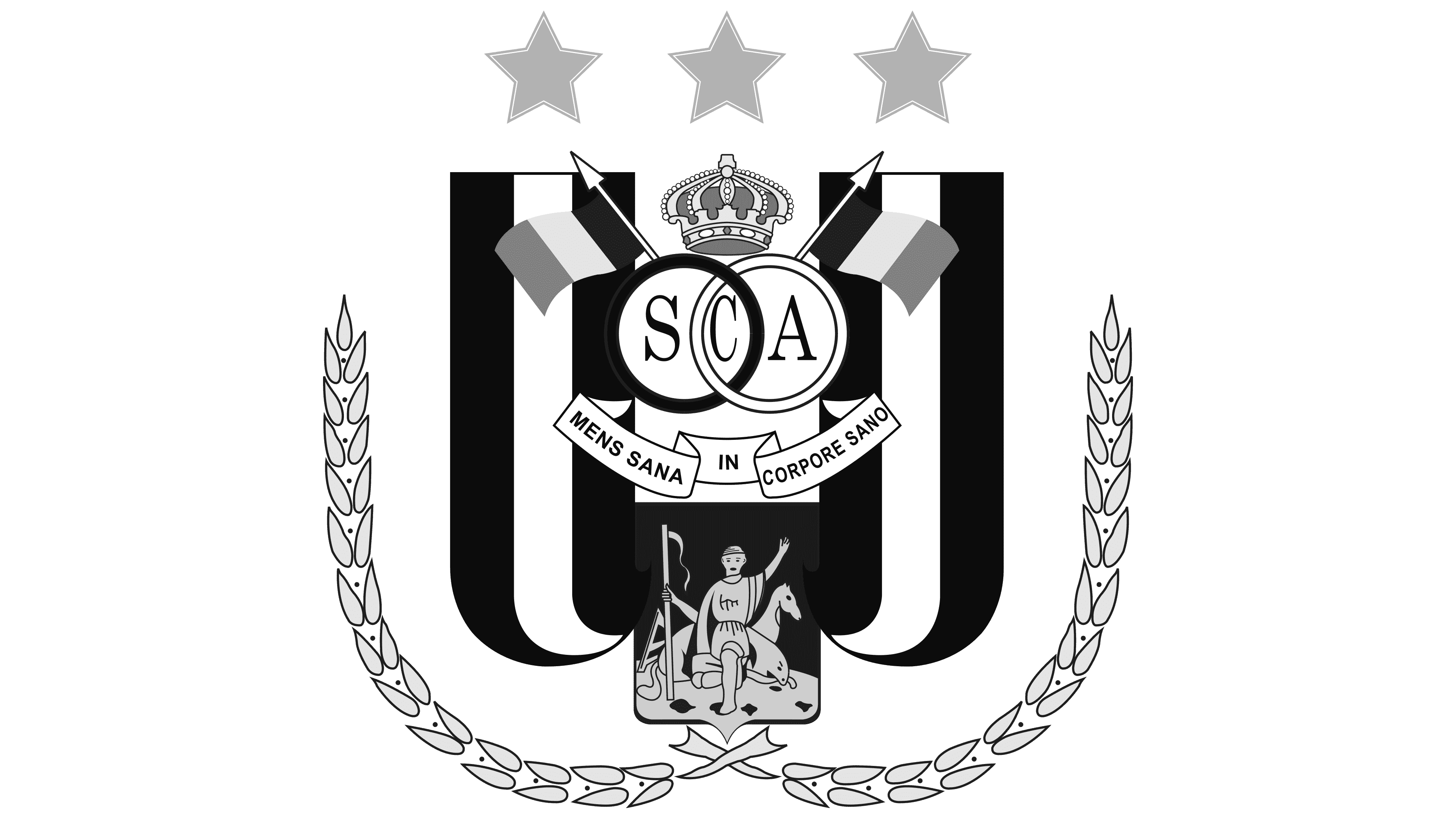
The Anderlecht emblem features four flags. Two belong to the club, and two resemble Belgian tricolors on flagpoles. The crown signifies the football team’s successes. Wheat sheaves symbolize prosperity, wealth, and well-being. The ribbon’s motto translates to “A healthy mind in a healthy body,” which fits the sports theme perfectly. The coat of arms of the Anderlecht commune is depicted with maximum accuracy.
The letters “SCA,” retained from Sporting Club Anderlecht, have large, acute serifs. The motto uses a completely different font and is written in a grotesque style.
The Belgian flags use three colors: Eerie Black (#18171A), Aureolin (#FCEC04), and Permanent Geranium Lake (#E92D2A). Aureolin also appears on the Anderlecht commune’s mini coat of arms, paired with rich electric blue (#0091D0). The three stars are mustard yellow (#E0AA00), while the left ring and the vertical stripes in the background are Spanish violet (#4C2484).