


 Liverpool Logo PNG
The Liverpool logo reflects conservatism and loyalty to tradition. The mythical griffin remains the club’s main symbol, embodying its spirit. The emblem also includes elements of the Hillsborough Memorial and the Anfield gates, which symbolize remembrance, respect, and connection to history.
Liverpool F.C. was founded in 1892 after a dispute with Everton F.C., which left Anfield over rising rent. John Houlding founded a new club on March 15, and the first team, largely composed of Scottish players, won its debut match 7:1.
Liverpool entered the Football League after one season and quickly won the Second Division, followed by top-flight titles in 1901 and 1906. The Spion Kop stand, built in 1906, became central to the club’s identity. Further titles followed in 1922 and 1923, before a long decline that culminated in relegation in 1954.
In 1959, manager Bill Shankly rebuilt the squad, introduced structural changes, and led the team to promotion in 1962. Titles followed in 1964 and 1966, along with the FA Cup in 1965 and the UEFA Cup in 1973. His successor, Bob Paisley, built on that success with six league titles and three European Cups between 1977 and 1981.
Joe Fagan added a treble in 1984, but 1985 brought the Heysel disaster during a final against Juventus, which led to a ban on English clubs from European competition. Under Kenny Dalglish, Liverpool won further titles in 1989 and 1990, though the Hillsborough tragedy in 1989 deeply affected the club.
After a long league title drought, Liverpool won the Champions League in 2005 against AC Milan. Under Jürgen Klopp, the club won another European title in 2019 against Tottenham Hotspur and secured the Premier League in 2020.
In 2024, Klopp left the club, and under Arne Slot, Liverpool won its twentieth league title in the following season.
Meaning and History
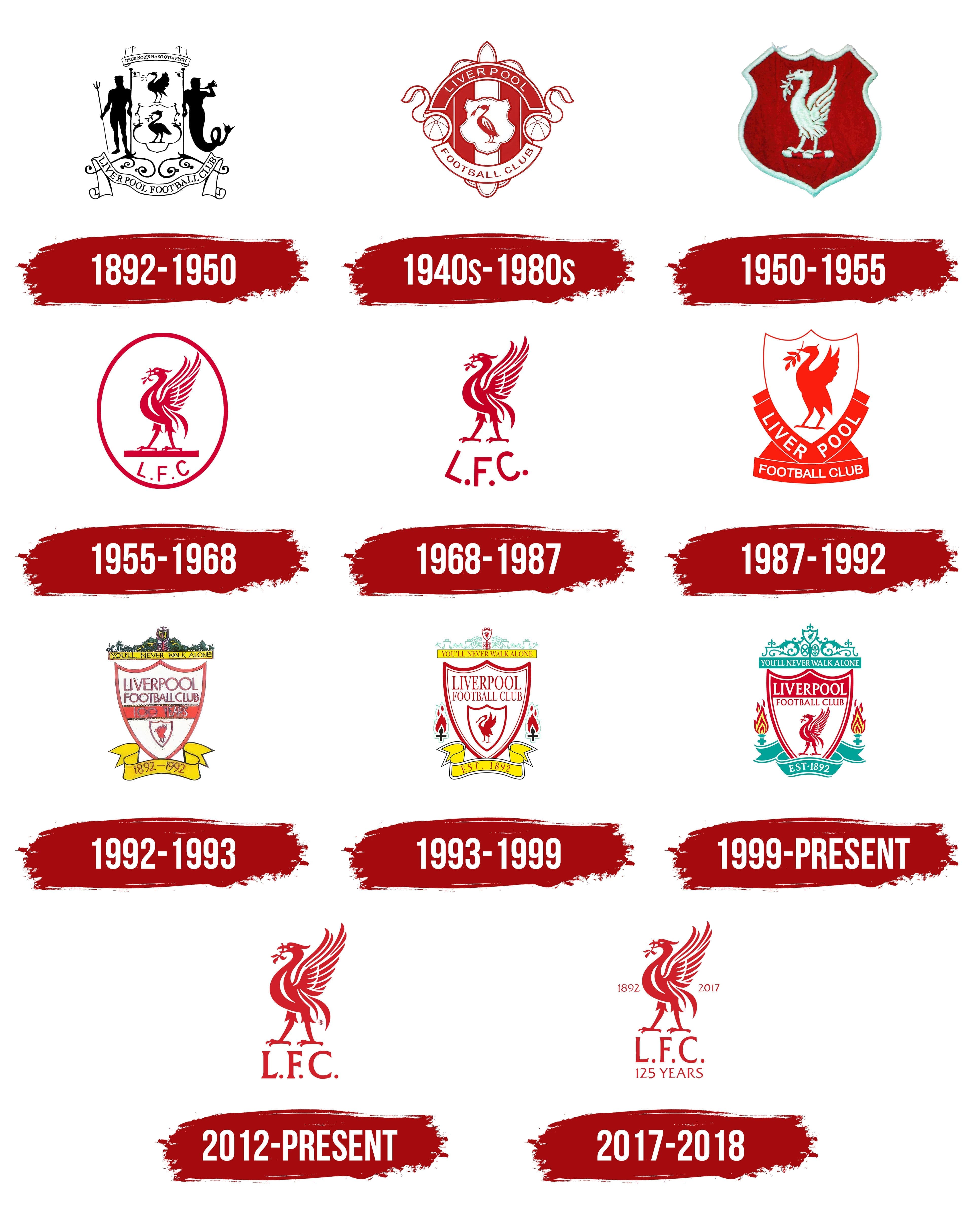
What is Liverpool?
It is a football club named after its hometown. Founded in 1892, it competes in the Premier League. The club has won dozens of championships and several prestigious international tournament titles. It earned the nickname “the Reds” for its bright uniform.
1892 – 1950
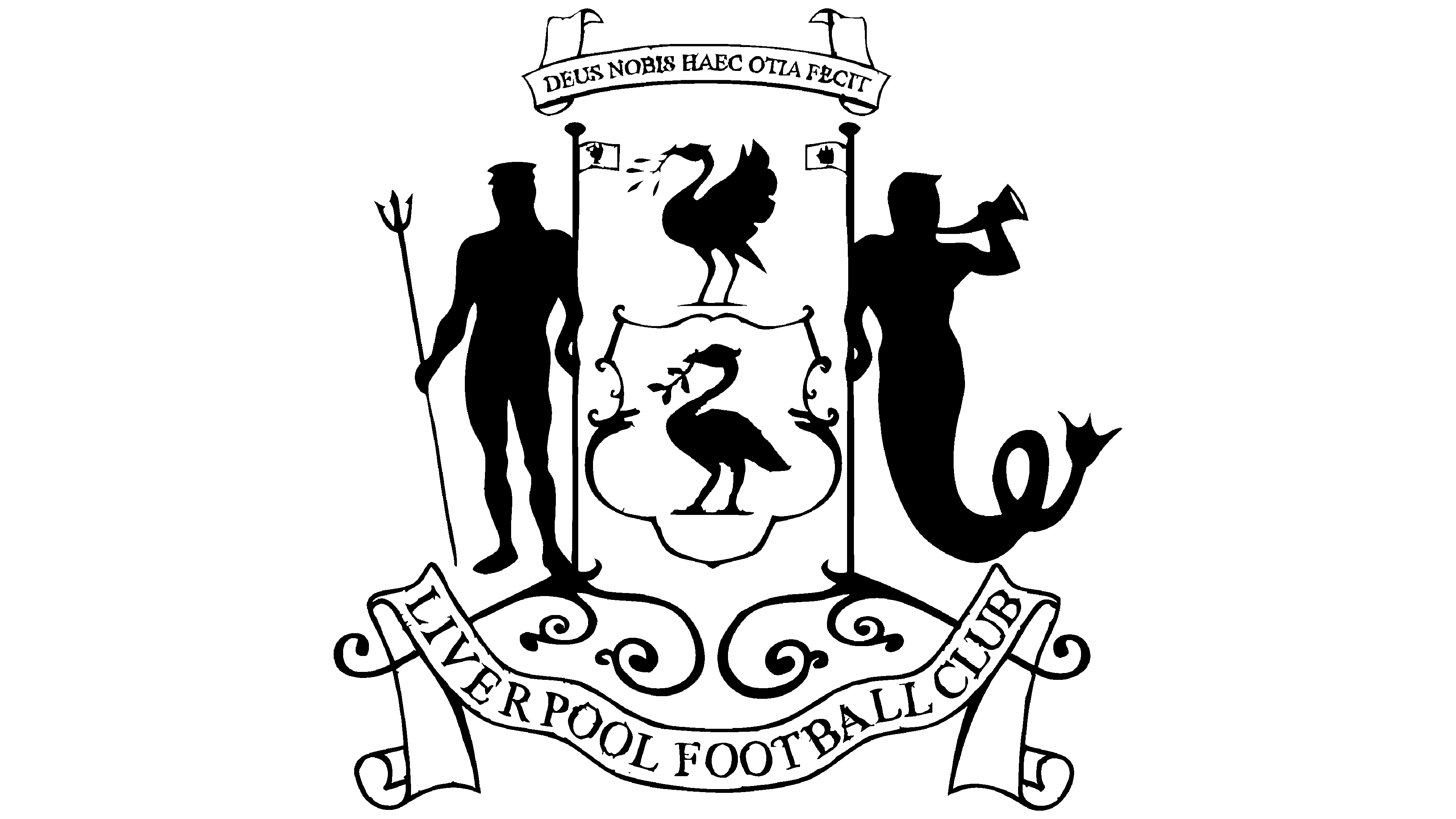
Liverpool Football Club’s debut logo reflects the city’s urban environment and maritime past. It is based on Liverpool’s historic coat of arms, with added imagery from ancient mythology. The entire structure conveys the connection between the football team, the city’s history, and its role as a port.
A large shield with smooth contours forms the composition. Inside is a bird with an elongated neck and long beak, holding a sprig of seaweed. The silhouette faces left and echoes the city’s heraldry. Above the shield is a second, smaller bird that repeats the seaweed motif.
On either side of the shield are figures from ancient Greek mythology associated with the sea and Liverpool’s port traditions. On the left is Neptune with a trident, rendered in the canons of classical art. On the right is Triton, with a human torso and the tail of a sea creature, raising a horn to his lips as if to announce the team’s achievements.
Across the upper part of the emblem runs a curved ribbon bearing the Latin inscription DEUS NOBIS HAEC OTIA FECIT, translated as ‘God has granted us this peace.’ The letters are set in uppercase.
A wide horizontal ribbon with the inscription LIVERPOOL FOOTBALL CLUB completes the lower part of the coat of arms. The typeface echoes the upper text and reinforces the logo’s sporting identity, linking historical symbolism to the football context.
Images of the sea, mythology, and sport are combined into a single system, forming a visual identity connected to Liverpool culture and football heritage.
1940s – 1980s
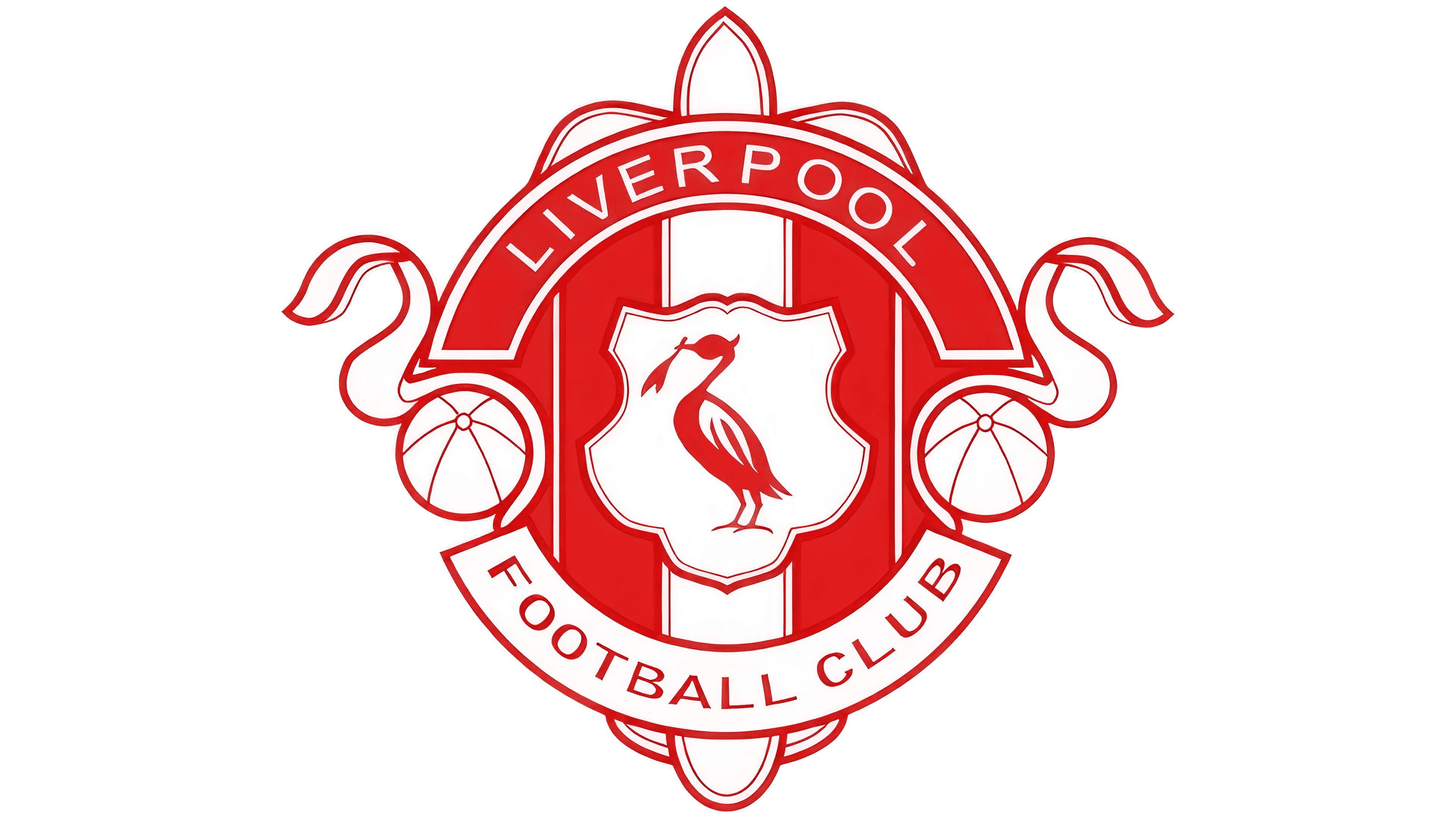
From the late 1940s until almost the end of the 1980s, Liverpool Football Club used an alternative logo alongside the main emblem. It was regularly applied to merchandise, match programs, club correspondence, and souvenirs, complementing the official symbolism and creating a distinct visual identity for the club.
Compared with the detailed coat of arms, this image was simpler. The Liver bird, a mythical figure and Liverpool’s city mascot, takes center stage, resembling a cormorant or heron in outline. The bird is shown in profile, with an elongated neck and long beak, holding a sprig of seaweed that alludes to the city’s port history.
The Liver bird is placed inside a small white shield with a red outline, set over a larger shield divided vertically into three parts. The central stripe is white, while the side stripes are red, the standard club colors. A circle frames the composition; along the upper arc, the word LIVERPOOL appears in white letters, and along the lower arc, FOOTBALL CLUB. The inscriptions use a strict sans-serif typeface, closely resembling Century Gothic or Futura.
On both sides of the shield, decorative ribbons extend symmetrically. Their ends finish in circles containing images of old-style footballs, assembled from radial-line segments. Small decorative shapes resembling architectural spires or petals are added to the top and bottom of the composition.
1950 – 1955

At the 1950 FA Cup final, a white bird appeared on Liverpool players’ shirts and later became the club’s main symbol. The image’s origins are linked to an ancient seal of King John of England. However, local folklore more often associates the bird with a cormorant, a familiar inhabitant of Liverpool’s shoreline and port waters.
The logo from this period features a restrained, simple design. The composition is enclosed within a shield shape. The top line has a soft, wave-like curve, while the bottom narrows to a sharp point.
The logo’s primary color is red. Against the rich background, a white bird figure has an elongated neck and a raised beak holding a small branch. One wing is lifted and spread, while the tail points downward.
The minimal level of detail helped the logo remain memorable for supporters. The bird image served as a linking motif between the club’s history and the urban environment, eventually becoming a symbol that unites the team and the city of Liverpool.
1955 – 1968

The oval outline in the Liverpool logo marks this period. A thin red line frames the shape, with a stylized bird inside.
The bird silhouette uses smooth line transitions. The figure faces left and stands on a rectangular platform. Its beak holds a branch that references Liverpool’s port history and maritime surroundings.
Below the bird image is the abbreviation L.F.C. The letters are set in a simple sans-serif typeface. The color scheme is limited to red and white.
The image remained clear and easily recognizable on players’ shirts and supporter merchandise.
1968 – 1987

LFC logo
During this period, the Liverpool logo became focused on its key elements. The platform and oval outline were removed, leaving only the bird and the L.F.C. abbreviation. The red background took on a deeper and denser tone. The bird itself underwent minimal changes. It is still facing left and holds a branch in its beak. The silhouette is elongated, with a simple outline.
Below the bird image is the club’s abbreviation, enlarged from earlier versions. The letters lack decorative elements, appearing strict and restrained.
1987 – 1992

During this period, the logo took on a form reminiscent of a championship trophy. The outlines and arrangement of elements evoke a winner’s cup, reinforcing the image’s sporting meaning.
In the upper area of the composition, a shield is outlined in a thin red line. Inside is a simplified red bird silhouette.
A wide, two-level red ribbon forms the lower part of the logo. Its shape visually echoes the base of a trophy. On the upper level, the word LIVERPOOL is placed along an arc, with FOOTBALL CLUB below it. The text is rendered in white letters. The typeface resembles DIN or Microgramma Bold.
The shield and heavy lower section evoke a trophy, shifting the emphasis toward sporting achievements and titles. The logo presents Liverpool as a club with a winning history, as reflected in the mark’s structure.
1992 – 1993
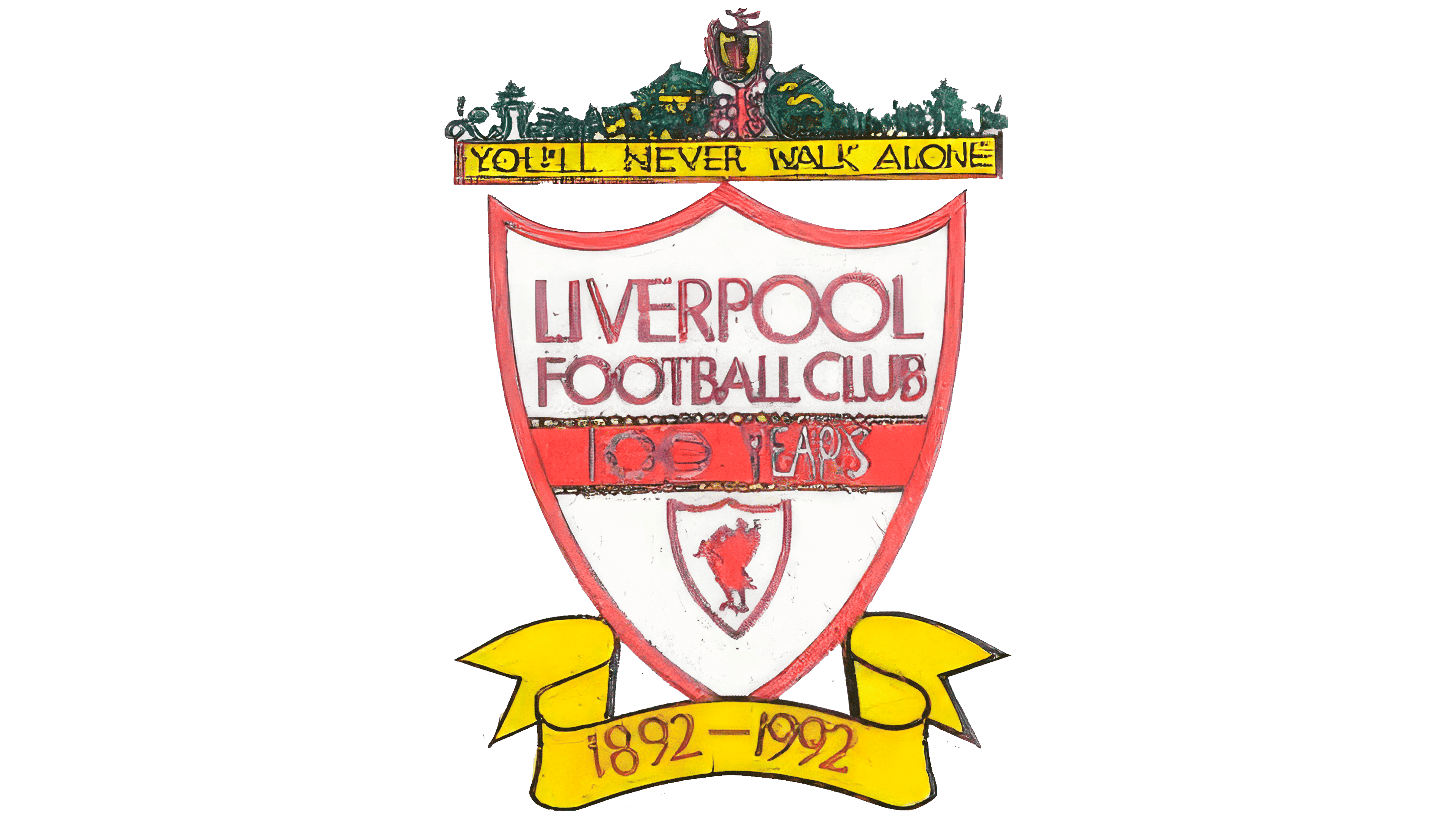
For Liverpool Football Club’s centennial anniversary, a commemorative emblem was created, rich in imagery and references to the team’s history and supporter culture. The logo was based on the famous Shankly Gates, dedicated to Bill Shankly, the manager whose name is associated with key victories and the formation of the club’s modern identity.
The composition follows the shape of a classic three-pointed shield. The upper zone features the club name in red uppercase letters across two lines. The word LIVERPOOL appears larger, with FOOTBALL CLUB placed below in a more compact form. Beneath this runs a horizontal band inscribed with 100 YEARS. Inside the shield is a reduced version of the Liverpool bird that has accompanied the team throughout its history.
The lower part of the shield is finished with a ribbon bearing the dates 1892-1992. The numerals are arranged symmetrically, and the ribbon edges curve gently. Above the shield is a green panel with a yellow inset carrying the club motto YOU’LL NEVER WALK ALONE. The phrase has long been associated with the atmosphere at Anfield and supporter culture, becoming part of club tradition as early as the first half of the 1960s.
A stylized depiction of the Shankly Gates arch complements the upper panel. The gates remind viewers of the manager’s decisive influence on Liverpool’s development. The entire anniversary emblem forms a visual narrative of the club’s hundred-year journey, its people, songs, and symbols that have accompanied the team over the past century.
1993 – 1999

After the anniversary period, the club emblem took on new meaning connected to the tragedy at Hillsborough Stadium. In April 1989, an FA Cup semifinal resulted in the deaths of 96 Liverpool supporters, with the official number later rising to 97. Among the dead was Steven Gerrard’s cousin, a future club legend. The events permanently changed the club’s relationship with its symbolism and how fans remember it.
The emblem introduced the motif of an eternal flame. Burning torches appeared on both sides of the shield, referencing the memorial installed in Sheffield. The date of the tragedy, April 15, 1989, became a point after which the flame image entered the club’s visual style and was regularly used in its identity.
The logo’s foundation is a shield with a top contour shaped like three peaks. The inner white field contains the inscription LIVERPOOL FOOTBALL CLUB, arranged on two lines and set in uppercase letters of a sans-serif typeface.
In the lower zone is a smaller shield with a red silhouette of the Liverpool bird. The figure faces left. The image is reduced to a smooth outline, losing fine detail.
The top of the emblem is designed as the structure of the Anfield stadium gates, known as the Shankly Gates. At the center of the arch is a small shield with the same bird, while symmetrical decorative elements in the form of green curls appear on the sides. Beneath the arch runs the inscription YOU’LL NEVER WALK ALONE, rendered in red letters on a yellow ribbon. The line refers to the club anthem, first heard at Anfield in 1963 and later becoming a symbol of supporter unity.
To the left and right of the main shield are torches constructed from black and red crosses with rounded bases. Three tongues of red flame rise from them, outlined in blue and highlighted in white. An unfurled yellow ribbon with the inscription EST completes the lower part of the composition. 1892, marking the year the football club was founded.
1999 – today
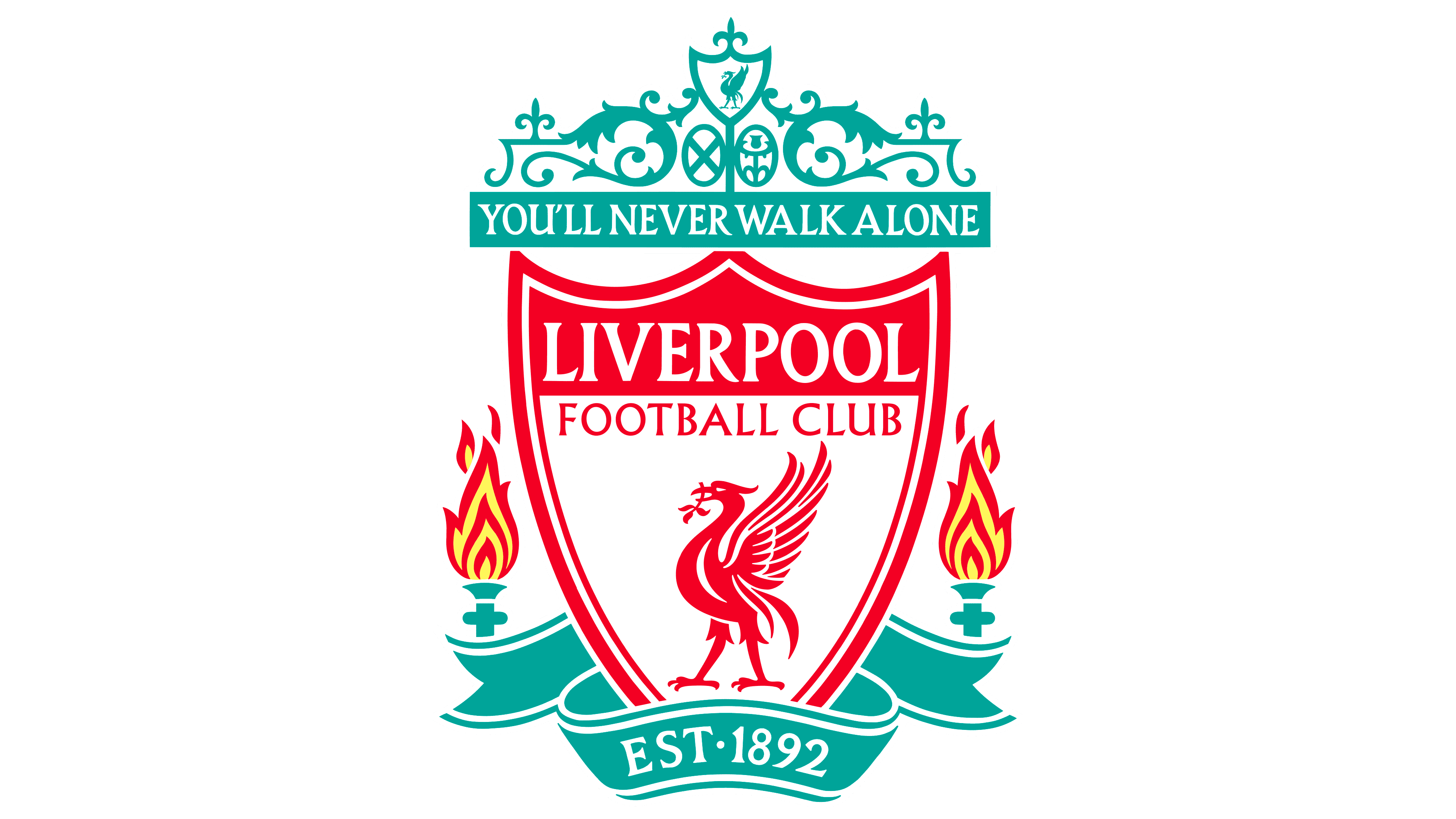
At the turn of the millennium, Liverpool Football Club changed its logo. The look became brighter and more modern, while it preserved the familiar imagery and symbolic accents supporters knew.
The color scheme shifted to green and red. Green appeared in the upper decorative arch and the lower heraldic ribbon, while red strengthened the shield. The arch was ornamented with references to wrought-iron gates, and above it, a small shield with the silhouette of the Liver bird was placed.
Below the arch is the inscription YOU’LL NEVER WALK ALONE, set in white letters on a turquoise background. The phrase is associated with Anfield and is perceived as both an anthem and a motto that unite the team and the stands.
At the center of the entire structure is the main red shield with a double outline. At the top is the name LIVERPOOL in white letters on a red background. Below it is the line FOOTBALL CLUB, rendered in red on white. Beneath the name is the silhouette of the Liver bird, colored red and holding a branch in its beak.
On either side of the shield are two torches in red and yellow tones, placed on turquoise bases shaped like crosses. The flames refer to the tragedy at Hillsborough Stadium, which holds a special place in the club’s and its supporters’ history.
A turquoise ribbon with the inscription EST.1892 completes the lower part of the composition.
2012 – today

In 2012, Liverpool introduced an updated emblem, and the supporters’ reaction was cautious. The simplified form removed several details, most notably the two torches that symbolized the Hillsborough tragedy. The club used the previous version alongside the new one until 2024, reinforcing a sense of mixed change.
The memorial reference to the tragedy took on a different meaning. Starting with the 2013/14 season, the number 96 with torches on either side appeared on the back collar of the shirt. In the 2022/23 season, the designation changed to 97, paying tribute to the final victim of those events.
The 2012 logo’s visual design is simplified. At the core of the composition is the Liver bird, an upward-stretched figure with a curved body. An open beak holds a branch. The wings are raised, the feathers arranged in layers, and three downward-pointing lobes form the tail.
Below the bird silhouette is the abbreviation L.F.C. A strict typeface is used, closely resembling Trajan.
The emblem update became an emotional moment for supporters. The memory of the past was preserved beyond the main mark, in the kit elements, reminding us of the value of history even during periods of change.
2017 – 2018

In 2017, Liverpool FC marked the club’s 125th anniversary. To mark the milestone, the club introduced a commemorative emblem based on the 2012 version and adapted for the anniversary year.
At the center of the composition is the silhouette of the famous Liver bird. Two dates flank the bird. On the left is the year 1892, indicating the club’s founding, and on the right is the anniversary year, 2017. Below the silhouette is the abbreviation L.F.C., set in a large typeface closely resembling Trajan. Beneath it is the inscription 125 YEARS, set in the same style but smaller.
The club’s entire history is framed between the two dates, while the bird remains the primary visual focus and has become inseparable from the club’s identity.
Font and Colors

The central image of the modern “Liverpool” logo is the mythical Liverpool bird. It’s a “distant relative” of the phoenix, something between an eagle and a cormorant. On the football club’s emblem, the Liverpool bird holds a branch in its beak, signaling its proximity to the sea.
Artists depicted the mythical creature on shields of various shapes before settling on the final version: a triangular heraldic shield with a figure at the top. The bird’s drawing changed several times, but did not affect the minimalist style.
The modern logo contains many inscriptions: the motto “YOU’LL NEVER WALK ALONE” on a blue rectangle, the full team name “LIVERPOOL FOOTBALL CLUB” at the top of the shield, and the phrase “EST. 1892” at the bottom on a ribbon. All words use serif letters. The Albertus MT font contains six styles. Its developer is Berthold Wolpe.
Most Liverpool emblems are red, and, according to the authors, this color should have a psychological effect: instilling fear and symbolizing power. However, in the current version of the logo, it is no longer red but blue or white. Yellow is also present, but in limited amounts. Meanwhile, the primary colors (red and blue) are represented in several shades, creating gradient transitions.