


 Manchester City Logo PNG
The Manchester City logo reflects the city’s coastal location and historical roots. The ship symbolizes Manchester’s trade and maritime connections. The emblem unites the city’s history with the club’s character, conveying a spirit of rivalry and its ambition to lead English football.
Manchester City began in 1880 as St. Mark’s, formed by church members to occupy local youth during the winter. The team lost its first match 1:2, later became Gorton AFC and Ardwick AFC, and, in 1894, due to debts, adopted the name Manchester City and the sky-blue kit.
In 1892, Ardwick joined the Football League Second Division. They were promoted in 1899, and their first major trophy came in 1904 with an FA Cup win over Bolton Wanderers. A financial scandal soon led to player suspensions, and Billy Meredith moved to Manchester United.
After a stadium fire in 1920, the club moved to Maine Road in 1923. In 1934, City won the FA Cup again and, in 1937, secured its first league title. The late 1960s brought a strong period under Joe Mercer and Malcolm Allison, with a league title in 1968, an FA Cup in 1969, and a European Cup Winners’ Cup in 1970 against Górnik Zabrze.
The club then declined, with relegations in 1983 and again in 1998 to the third tier. The club returned to the top division by 2002. A major shift came in 2008 when Sheik Mansour acquired the club and funded large transfers, including Robinho from Real Madrid.
Success followed with the FA Cup in 2011 and a league title in 2012, decided by Sergio Agüero’s late goal. Under Pep Guardiola from 2016, City reached 100 points in 2018, won a domestic treble in 2019, and secured the Champions League in 2023 against Inter Milan. In 2024, the club won a fourth consecutive Premier League title.
Meaning and History

What is Manchester City?
It is a football club that took its current name in 1894. Previously, it was known as Ardwick Association F.C. and St. Mark’s (West Gorton). The club plays in the Premier League and hosts home matches at the Etihad Stadium. Founded in 1880, the club won its first Football Association Challenge Cup 24 years later.
1880 – 1887

The emblem of the football club St. Mark’s, from Manchester’s West Gorton district, creates a strict, restrained impression. Today, many see in its details the origins of modern Manchester City’s symbolism, although it refers to a very different scale and era. The club’s history began in 1880 as an initiative of parishioners of the Anglican Church of St. Mark. The organizers sought to offer local men an alternative to alcohol and street conflicts. Over time, the team became more established, moved beyond amateur gatherings, and began competing in official competitions under a new name.
The mark of that period is executed in black and white and relies on simple forms. Its structure consists of two circles, one inside the other. A white cross sits in the center on a black background. In outline, it resembles a Teutonic or simplified Maltese type, with widening ends and soft rounding at the diagonal intersections.
The outer ring contains the club name arranged along the edge in an arc. The upper part reads ST. The lower part reads WEST GORTON. Between them are the numbers 18 and 80, indicating the year the team was formed. All typography is set in white sans-serif lettering, visually close to modern typefaces such as Gotham or Avenir.
1887 – 1894

Long before Manchester City appeared on England’s football map, a club with the unusual name Ardwick A.F.C. existed. It emerged after St. Mark’s was renamed West Gorton and, over time, almost disappeared from collective memory, even among those long immersed in English football. Yet Ardwick marks the next stage in the formation of modern Manchester football, as local initiatives and district teams set the tone for the game’s development in the city.
The Ardwick A.F.C. emblem draws attention through its form and structure. The shield has soft outlines, a curved top edge, and is divided into four equal sections. Two colors, white and deep purple, alternate to form a checkerboard-like pattern.
Each section contains one letter of the abbreviation AAFC. The reading follows a circular order, starting from the upper-left field. The two A’s sit at the top, with F and C at the bottom. The typeface is sans serif with rounded shapes, visually close to Helvetica Rounded. All strokes have equal thickness, without emphasis or complexity.
The club existed for only a short time, yet it laid the foundation for a future team whose name would later become known worldwide.
1894 – 2011

On April 16, 1894, the Ardwick team took on the new name Manchester City, and with it, the city coat of arms appeared on the playing kit. It accompanied the club for decades, remained relevant until the 1960s, returned to the shirts for the FA Cup final, and was used up until 2011. The mark linked the team, Manchester, its past, and the city’s way of life.
The Manchester coat of arms is built on a classic heraldic shield divided into two parts. The upper half is white. At the center is a three-masted sailing ship moving left across blue waves. The drawing is detailed. The masts, sails, and hull are visible. Behind the stern, the English flag with a red cross on a white field flies. The lower part of the shield is red and crossed by three gold diagonal bands.
Two heraldic animals accompany the shield. On the left is a silver creature with gold horns and mane, with a chain running along its body. A red Lancaster rose appears on its chest. On the right is a gold lion standing on its hind legs, with a red mural crown and the same rose on its chest. Both figures enhance the sense of protection and status.
Above the shield is a metal knight’s helmet facing left. Decorative red-and-gold flourishes resembling flames surround it. Above it sits a globe with an even grid of meridians and parallels. The globe’s surface is covered with numerous bees with yellow bodies and black stripes. For Manchester, bees symbolize industriousness, industrial growth, and collective labor, while the globe points to the city’s trading influence.
At the bottom of the composition is a green base resembling grass. The shield and animal figures rest on it. Beneath them is a silver ribbon with yellow edging. At the center of the ribbon is the Latin motto CONCILIO ET LABORE, translated as By counsel and labor. The inscription is set in uppercase sans-serif letters.
Manchester City has used this coat of arms for many years. The mark represented the city as a whole, reflecting its industrial strength, maritime connections, and culture of labor, as captured in the emblem’s images and symbols.
1960s

In the 1960s, Manchester City introduced an emblem that became the starting point for all subsequent club symbolism. At first, the mark served as a corporate identifier, and later appeared on the playing kit. The period coincided with changes in sports culture, when football clubs began to build their own visual identities.
The emblem is based on a classic circular form with a light blue field and a double black outline. Around the circumference is the club name MANCHESTER CITY F. C. The lettering is set in large black characters with proportions similar to those of Helvetica Bold.
Inside the circle is a shield with lines, projections at the top, and a pointed bottom. The outline is a thin black line with a yellow inner border. The shield’s surface is divided into two zones, each with a different color and content. The upper part is white and features a yellow image of a simplified three-masted ship. Detailing is reduced to the outlines of the hull and sails, without fine elements. The image refers to Manchester’s trading history and its connections to the outside world. The lower zone is orange, overlaid with three gold diagonal lines. The motif is linked to the Grelley family, who owned the lands on which the city later grew.
The symbols on the shield echo the city’s coat of arms but are simplified, without complex heraldic figures. For the 1960s, this style fit well with the new sporting aesthetic focused on clear forms and modern perception.
1970 – 1972

In 1970, Manchester City introduced an updated emblem that reinterpreted familiar motifs. The club maintained continuity of imagery, but the presentation changed.
The mark is circular in shape. Its base is a light blue ring with the inscription MANCHESTER CITY F.C. placed along the circumference. The letters are set in uppercase using a straight sans-serif typeface that closely matches Franklin Gothic or Impact. The text color is rich yellow with a thin black outline. Dots appear between the inscription elements in the lower part. A double border encloses the blue band.
Inside the circle is a classic shield shape with a pointed bottom and smooth projections at the top. In the upper zone is a yellow three-masted ship with a black outline. Beneath the vessel runs a broken horizontal line, interpreted as a stylized wave. It visually separates the upper part of the shield from the lower.
The lower segment is filled with diagonal pink and yellow stripes. The pink tone is close to coral, while the yellow repeats the shade used in the lettering and ship elements. The stripes echo motifs from Manchester’s coat of arms.
The 1970 version brought together familiar symbols in a more saturated and cohesive form.
1972 – 1976

In Manchester City’s history, emblem updates often coincided with important stages in the club’s development. Color schemes changed, new elements appeared, and certain details faded away. In this version, the circle’s center turned blue, the diagonal stripes disappeared, and the key symbol became the crimson Lancaster rose.
The mark retained its circular form. A wide white ring runs along the outer edge, bounded by thin black lines on the inside and outside. Within the ring is the team name MANCHESTER CITY F.C. The inscription is set in a dense black sans-serif typeface, visually close to grotesques such as Helvetica and Arial.
The inner area of the circle contains a shield with classic proportions, a softly curved top line, and a sharp base. The outline is built from three strokes. Two thin black lines frame a wide yellow band.
The shield is divided horizontally into two zones. The upper part is light blue and contains a yellow sailing ship with three masts. The sails have rounded contours, the hull is elongated, and a wave formed by smooth curves runs beneath it. The lower zone is white. At the center is a large red Lancaster rose with five petals and a dark star-shaped center. Small green leaves appear between the petals.
1981 – 1997

The next Manchester City emblem adjusted the color scheme while preserving the overall look and all key elements of the previous version. The changes affected the shades. The colors became richer, the visual emphasis increased, and the composition gained a brighter tone.
The mark remains circular in shape. The ring’s inner field is now filled with a more saturated light blue. The familiar shield sits at its center. The upper part of the shield received a new light blue gradient that gradually transitions to white from top to bottom. The lower part of the shield remains white.
The updated version maintained continuity with earlier designs while strengthening the color treatment and further developing the visual style associated with Manchester and regional traditions.
1997 – 2016

The Manchester City logo changed multiple times, sometimes under circumstances unrelated to on-field performance. One such change occurred when the club abandoned the previous emblem because of a copyright dispute. A new image replaced the old mark. It became a golden eagle rooted in Manchester’s historic heraldry.
At the center is an eagle with wings spread wide. Thin black lines draw the feathers, head, and neck for added detail. The head faces left, and the beak is open. A shield divided into three horizontal zones covers the bird’s chest.
The upper part of the shield is light blue. It features a gold three-masted ship moving across a stylized wave rendered with minimal strokes. The vessel image is reduced to basic outlines. The middle band is black and contains the gold abbreviation M.C.F.C. The serif letters are centered.
The lower segment of the shield is also light blue. Three white diagonal lines cross it from top to bottom. The motif links to Manchester’s three rivers: the Medlock, the Irk, and the Irwell.
Above the eagle are three stars. They are rendered in gold with a thin black outline and serve a decorative purpose, without reference to sporting titles.
A curved white ribbon completes the lower part of the composition and bears the motto Superbia In Proelio. The inscription is set in a black italic typeface with a soft slant, reminiscent of handwritten lettering. The Latin phrase, which translates as “Pride in battle,” gives the image a sense of completion.
The creators of the emblem sought to give the motto a tone of strength and pressure on opponents, although the inscription’s meaning is not clear to everyone. Nevertheless, the mark remained part of Manchester City’s visual history and reflected a specific stage in the club’s journey.
2016 – today

On December 26, 2015, on the eve of a match against Sunderland, Manchester City presented an updated emblem to supporters. The creation process began with a large-scale survey in which thousands of fans shared in detail how they wanted the club badge to look. Supporter input formed the basis of the final version and influenced its appearance.
The new emblem returned to a circular shape, referencing the club’s early history and the visual systems of partner teams within the City Football Group, including New York City FC and Melbourne City FC. The primary color pairing became blue and white. The first was supported by 94 percent of survey participants, the second by 68 percent. Supporters also defined the set of core symbols. These included the ship as an image of Manchester, the city’s three rivers, Irwell, Irk, and Medlock, and the red Lancashire rose.
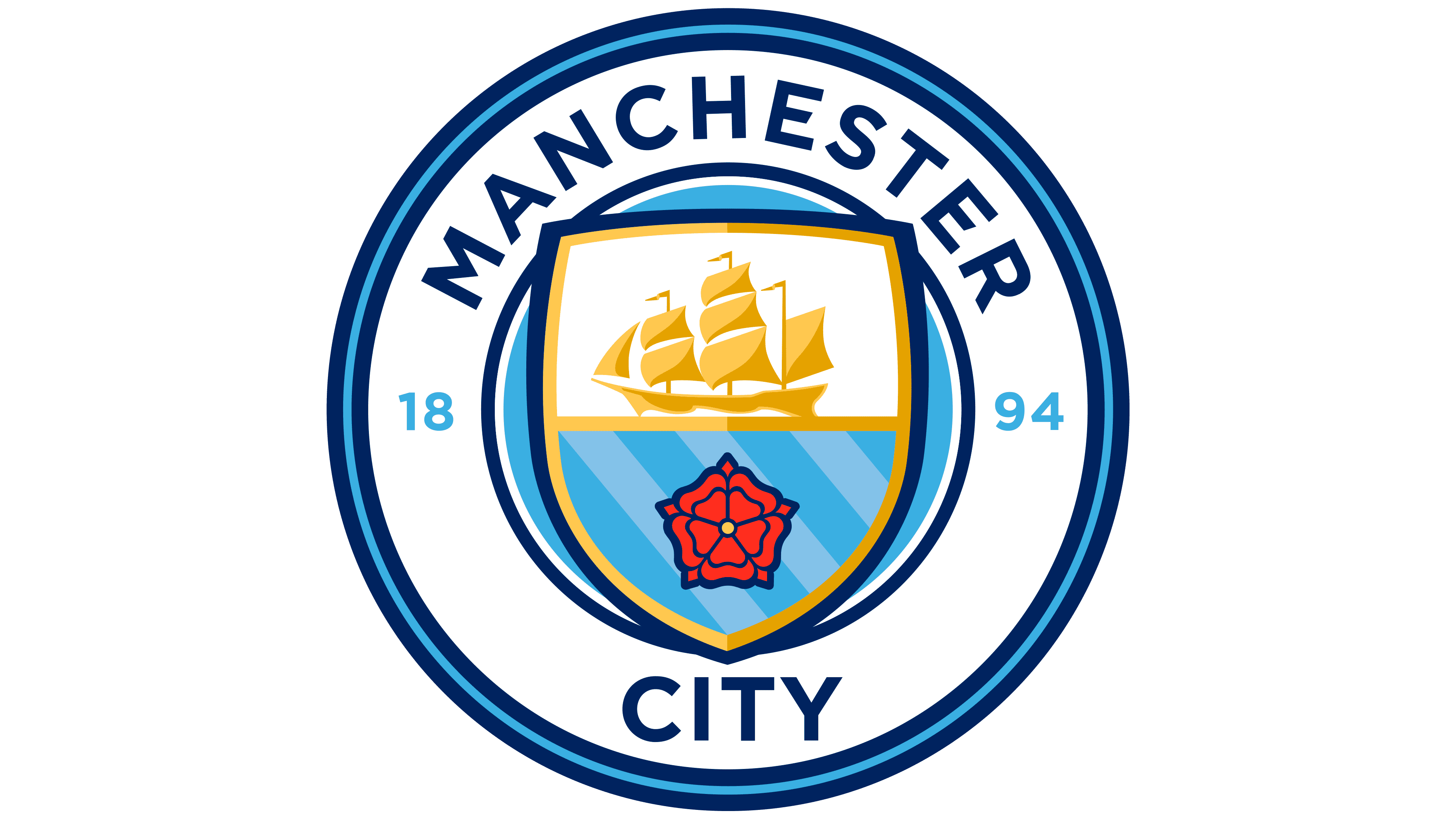
The entire composition is built around a shield placed inside a circle. The outer edge features a double outline of dark blue and light blue lines, with a wide white ring between them. At the top of the ring is the word MANCHESTER, and at the bottom the word CITY. Both are set in dark blue uppercase letters. The design uses a sans-serif typeface similar to Gotham Bold or Avenir Heavy. On the sides, separating the inscriptions, are the numbers 18 and 94 in light blue. They reference the year 1894.
The shield inside the circle is divided into two horizontal zones. The upper part is white and contains a gold ship with masts. The lower zone is filled with alternating stripes in two shades of blue. A red Lancashire rose sits over the stripes, outlined in dark blue.
The reduced details and ordered structure gave the emblem a modern look, reflecting the views and expectations of most Manchester City supporters.
Font and Colors
Until 2016, the text on the heraldic shield was set in the contrasting font Palatino Bold, created by Hermann Zapf. The new logo uses its complete opposite. The name “Manchester City” is written in bold, sans-serif letters, and all strokes have the same thickness. This version roughly resembles Metropolis Bold by Chris Simpson.
To make the football club’s symbol bright and easily noticeable, the designers combined several colors:
- Dark blue (for letters and most contours);
- Two shades of light blue (for the diagonal stripes inside the shield, numbers, and some details);
- Red (for the petals of the rose);
- Two variations of gold (for the ship and inner contours of the shield).
- White is used as a background for the inscriptions and the sailboat.