


 Assault Logo PNG
The Assault logo captures the energy of an arcade action game where speed meets tactical depth. The game won over players with its unique controls and well-designed combat, where quick reflexes and smart movement across the battlefield are key to victory.
Assault was developed by Namco in 1988, during the peak of arcade gaming’s popularity in Japan and the U.S. Known primarily for Pac-Man and Galaga, Namco introduced Assault as a vertical-scrolling shooter featuring unique mechanics for its time.
Players controlled a futuristic tank capable of transforming into an aircraft, enabling versatile gameplay and tactical variety. Powered by Namco’s advanced System 2 arcade hardware, Assault delivered smooth animations and detailed visuals that players appreciated upon its release.
Following success in Japanese arcades, Assault reached American audiences who favored its challenging gameplay and innovative transformation feature. In 1989, the game transitioned to home platforms, first appearing on the Sharp X68000 in Japan, and was praised for closely replicating the arcade experience.
In the early 1990s, Assault was adapted for various home computers, retaining its transformation mechanic despite hardware differences. By the mid-1990s, it had established its reputation as an influential arcade title, making notable contributions to the evolution of the scrolling shooter genre.
Today, Assault continues to appear in Namco’s classic compilations, serving as a testament to the company’s creative legacy in arcade game design.
Meaning and History
What is Assault?
This multiplayer first-person shooter features players battling across various maps using a range of weapons and tactical abilities. The game features team-based battles, capture points, and special missions, along with a class system that allows characters to have unique skills. Destructible environments, customizable weapons, and character modifications add depth to the gameplay. Progression through the ranking system unlocks additional content and enhances combat skills.
1988

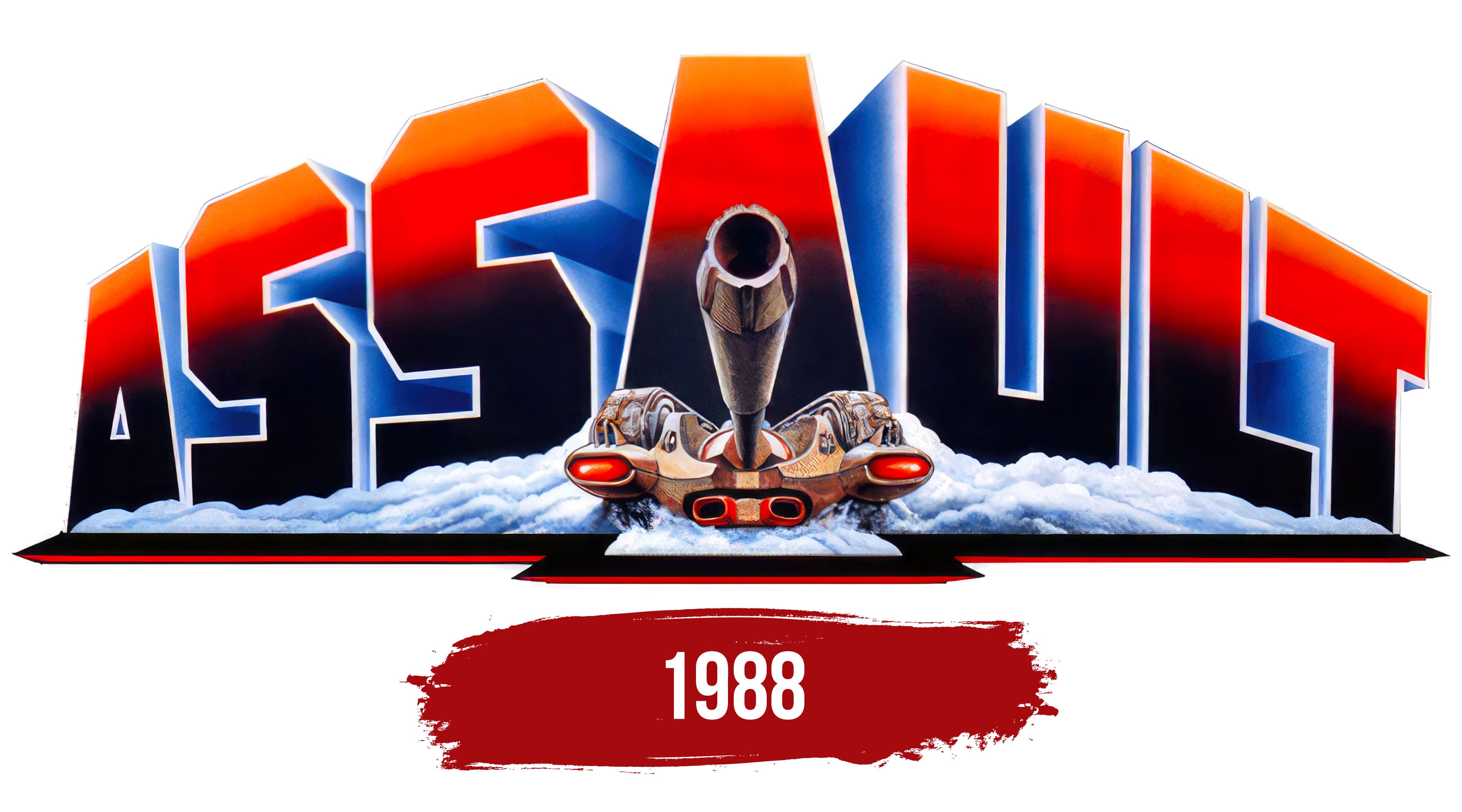
In 1988, Namco developed the logo for the arcade game Assault, with Kunio Okawara, a renowned designer of machinery and characters, serving as the lead designer of the project. The emblem was created for the game’s release in the Japanese market and was later adapted for North America by Atari Games. Later, the product received an updated version called Assault Plus, was included in the Namco Museum Vol. 4 collection, and became available on Wii Virtual Console.
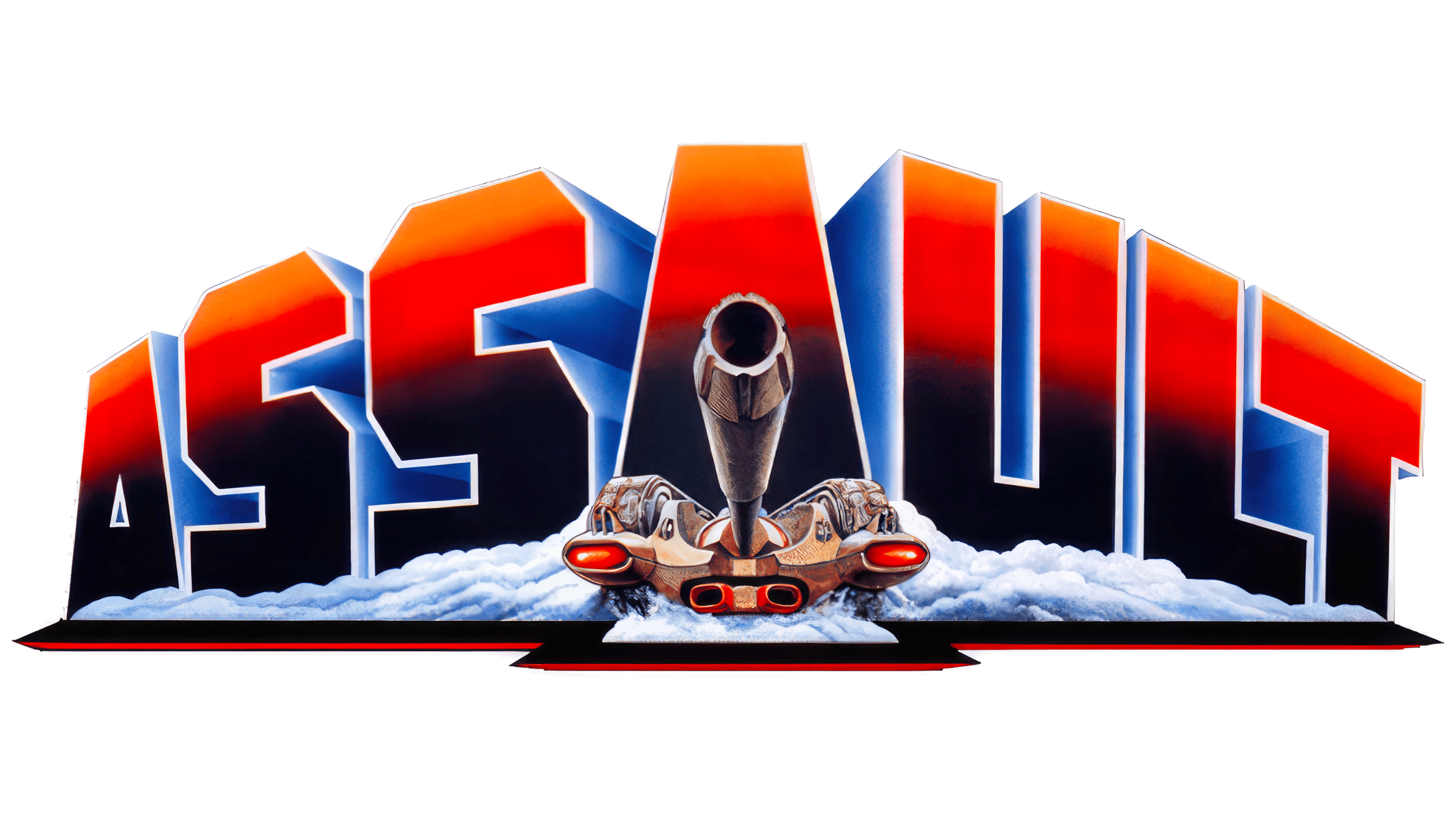
The appearance of the Assault emblem is built on a panoramic composition. The main element is a futuristic tank organically connected with the game’s title. The tank’s body and cannon are integrated into the base of the letter “A.” At the bottom is a horizontal platform with a dark shadow visually fixing the composition. On the body’s surface, there are multiple small details, and the chrome finish with red light accents creates a sense of technology. In the lower zone, smoky clouds enhance the illusion of an energy discharge.
The text arch is executed with perspective distortion. The letter “A” in the center of the arch is the largest, and the symbols on the edges decrease in size. The typeface consists of angular, massive glyphs without serifs. The volume of the letters is achieved by gradient fill and outline. The gradient transitions smoothly from saturated red-orange at the top to black at the bottom. A white contour and blue shadows evoke metallic surfaces.
The color system is based on the contrast of warm and cool shades. Red-orange gradients evoke heat and active motion, black creates depth, and blue in the shadows reinforces the image of solid metal. The white edging emphasizes the contrast and preserves clarity of perception even against a busy background.
The combination of the weapon and the text emphasizes aggression and power, aligning with the game’s military theme. The visual integration of machinery and title exemplifies the late 1980s approach, in which design was viewed as a tool to influence the audience and as a means of distinguishing the product from competitors.