


 AutoCAD Logo PNG
The AutoCAD logo emphasizes the product’s technological nature and evolution. Its form and structure convey precision and clarity, while the overall image evokes a modern tool designed for efficient, well-considered work.
Autodesk was founded in early 1982 by 13 programmers from Marin County, led by John Walker, who invested $59,000. They aimed to develop several PC applications, but one gained traction. At the time, CAD systems from Intergraph and Computervision were limited to expensive mainframe solutions.
AutoCAD’s core came from Interact, which Michael Riddle created. Walker adapted it into a commercial product and later bought full rights for $10 million. In December 1982, AutoCAD debuted at COMDEX, running on an IBM PC and priced at $1,000, far below existing systems.
Distribution relied on resellers, allowing expansion with limited direct costs. By March 1986, AutoCAD became the most widely used CAD software. That year, AutoLISP support was introduced, enabling customization and creating a third-party ecosystem. Autodesk went public in 1985 and, by 1986, had 255 employees and over $40 million in revenue.
In 1989, Release 10 expanded to UNIX via Xenix. In 1993, Release 12 brought Windows support, and AutoCAD LT launched at $495 for smaller users. By 1994, Autodesk ranked sixth among PC software companies.
AutoCAD 2000, released in 1999, was a complete rewrite. In 2002, Autodesk acquired Revit Technology Corporation, introducing BIM and competing with its own AutoCAD in the architecture market.
In the 2010s, the company shifted to a subscription model. By 2021, perpetual licenses ended, with AutoCAD moving to cloud tools and mobile apps. The DWG format, introduced in 1982, became an industry standard used alongside Bentley Systems software.
Meaning and History
What is AutoCAD?
It is an abbreviation for “Automatic Computer Aided Design.” It refers to software that enables the creation of 2D and 3D drawings, high-precision object modeling, and project analysis. The American company Autodesk created the commercial application for use in various fields, including electrical engineering, mechanical engineering, engineering design, and architecture.
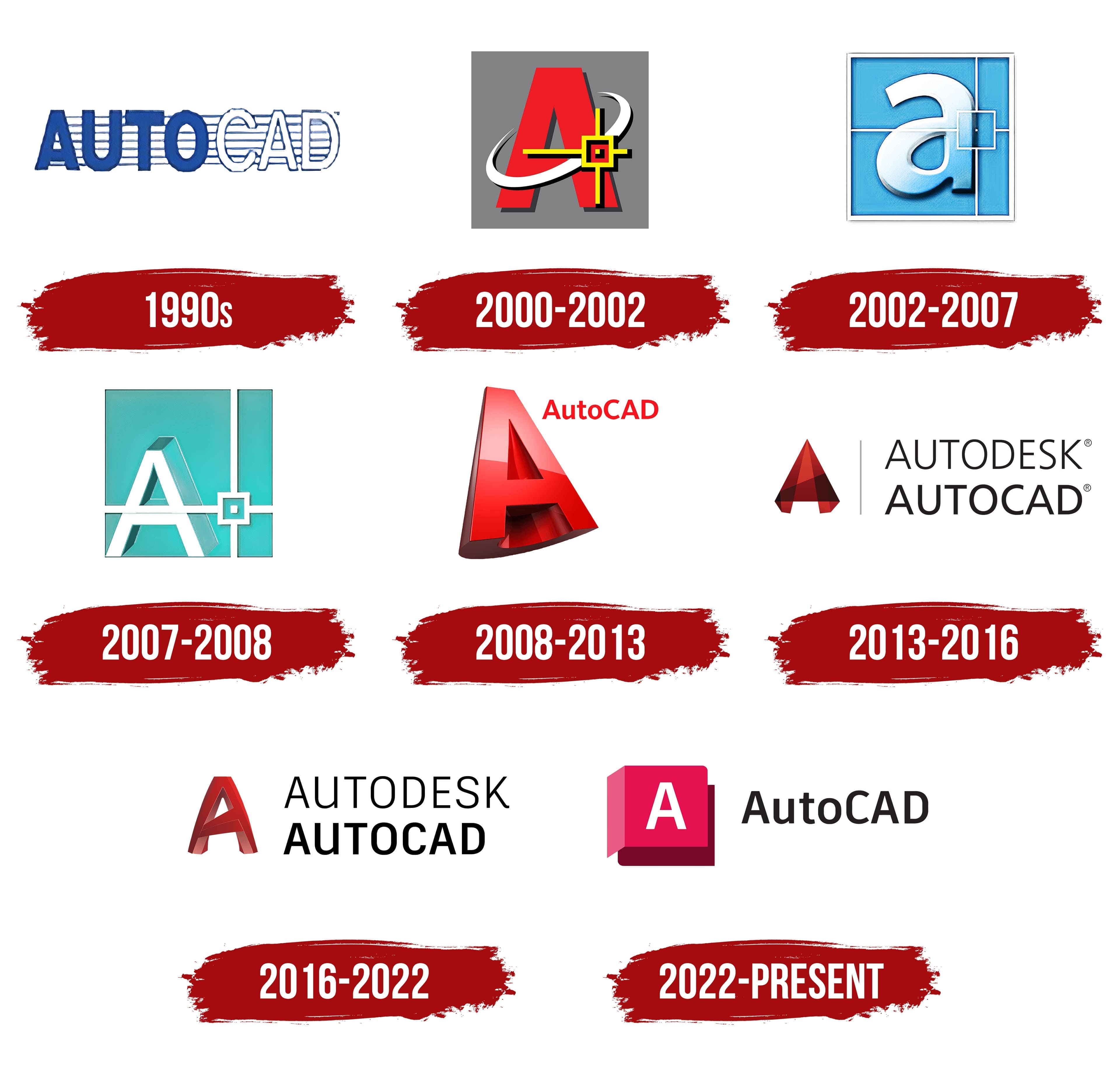
the 1990s

The debut emblem looked like a single inscription against a background of thin blue and wide white stripes. And it was blue and white. The first word, “Auto,” was in bold blue. The second, “CAD,” was written in white letters, outlined with a thin contour. The name consists of two parts and is used as a single unit, without breaking into separate fragments. This contrast makes the inscription easy to read, as each part is visible. At the same time, this connection underscores the program’s shared goal.
Autodesk employee Chuck Weickshn created the first AutoCAD logo. The logo was a word made of letters of the same size; “AUTO” was blue, and “CAD” was white in a black frame. The background consisted of seven blue stripes resembling a staff. A TM subscript appeared in the top-right corner.
2000 – 2002

Developers replaced the program’s full name with a single letter A. It was executed in red, around a white orbit in a slanted ellipse to the right, a yellow star stylized as a drawing. This emblem proved recognizable and drew additional attention to the product.
2002 – 2007

The logo design changed radically: the letter “a” was made lowercase, voluminous, and light blue with a gray contour. The square background also became blue, and the frame turned light gray. A stylized white cursor completed the design.
2007 – 2008

Again, the image changed: the square became blue-green, tilted toward green; the letter “A” was again uppercase, in thin white lines; the frame’s inner perimeter was outlined with a white stripe.
2008 – 2013

A new logo returning to red: a 3D image of the letter “A” tilted to the left. Thanks to the dark background, it appears three-dimensional.
2013 – 2016

The letter “A” was widened and stylized as a voluminous pyramid. It successfully reflected the design program’s functionality.
2016 – 2022

The final version, still relevant today, was adopted in 2016. The voluminous letter “A” is executed in an original design, with a color gradient from dark brown to pink. The program’s official name, AutoCAD (in this case, uppercase), is written in bright red letters on a white background.
2022 – today
Font and Colors

The changes to this brand’s logo reflect new software features. In addition, the authors have always strived for visual clarity and simplicity, and they have achieved this in the latest version. The current emblem is a 3D object with wide lines, well-distributed shadows, and clear edges. As a result, the letter “A” looks perfectly balanced despite the uneven stripes. The legs are slightly twisted at the bottom, so the inner parts are slightly turned outward. The crossbar is wider on the right and narrows to the left, which also emphasizes the volume.

Although the modern emblem includes a letter, it doesn’t include text to indicate its absence. The designers bet on a symbiosis between verbal and graphic symbols. At the same time, the inscription is used separately from the icon or on the label. Usually, it’s the TrueType format with a TTF or .ttf extension. SHX extension is used on Windows. The rest are special AutoCAD fonts. But the very first logo had text. It was a chopped font, smooth and without serifs. The brand palette evolved from blue and white to red and burgundy, with occasional pink accents.