


 Canva Logo PNG
The Canva logo looks like the work of this graphic service. At first glance, it seems simple, made up of standard elements. However, the designers used unusual decorative techniques that make the emblem feel festive and optimistic.
Canva began in 2007 in Perth, where 19-year-old Melanie Perkins taught students to use Adobe Photoshop and noticed that Adobe and Microsoft tools slowed beginners down. She developed a simpler online design platform.
With Cliff Obrecht, she launched Fusion Books, a service for creating school yearbooks. It provided early user feedback and shaped the future product.
Funding proved difficult. Perkins received over 100 rejections before investor Bill Tai met her and introduced her to Lars Rasmussen, co-founder of Google Maps. He later joined as an advisor and helped bring in Cameron Adams, a former Google designer.
In 2012, Canva raised $1.6 million plus a $1.4 million government grant. In 2013, Blackbird Ventures led a $3 million round, and the platform launched on August 26. By year’s end, it reached 750,000 users.
Canva raised a Series A in 2015, led by Blackbird Ventures and Matrix Partners, followed by a Series B in 2016. That year, Canva opened an office in the Philippines and launched Canva for Work. By 2017, it was profitable with 294,000 paying users, and in 2018, its valuation passed $1 billion.
In May 2019, a breach exposed data from about 139 million users, and in 2020, 4 million passwords were later leaked. By 2021, its valuation reached $40 billion, and 85% of Fortune 500 companies used Canva. By 2024, it had over 185 million monthly users and about $2.3 billion in revenue, competing directly with Adobe.
Meaning and History

Graphic designer Melanie Perkins founded the company in Sydney, Australia, on January 1, 2012. Over two years, 150,000 users regularly used the new possibilities of online graphic design to create logos, labels, and images for the internet. In 2014, Guy Kawasaki, a social media and technology culture expert, joined the project. By 2019, the service was valued at $1 billion, with fewer than 200 staff across three offices in Sydney, Milan, and Beijing.
Since 2019, the service has created avatars for Instagram and other social networks using your photos.
According to founder Melanie Perkins, the company started with an idea. The second step was to create a logo that would stand out, be memorable, and carry deep meaning.
The name Canva is French and means “the basis of something.” In Russian, ‘kanva’ is embroidery fabric stretched over a round hoop.
The sign idea came naturally: a bright turquoise base, a perfect circle, with the name Canva embroidered in white. The round shape also denotes perfection and emphasizes the company’s core values: accessibility, loyalty, honesty, and creativity.
What is Canva?
Canva is a cross-platform graphic design service. It’s a workspace where you can create logos by dragging and dropping. It uses interchangeable templates and fonts. The service has been operating since 2012.
2013 – 2021
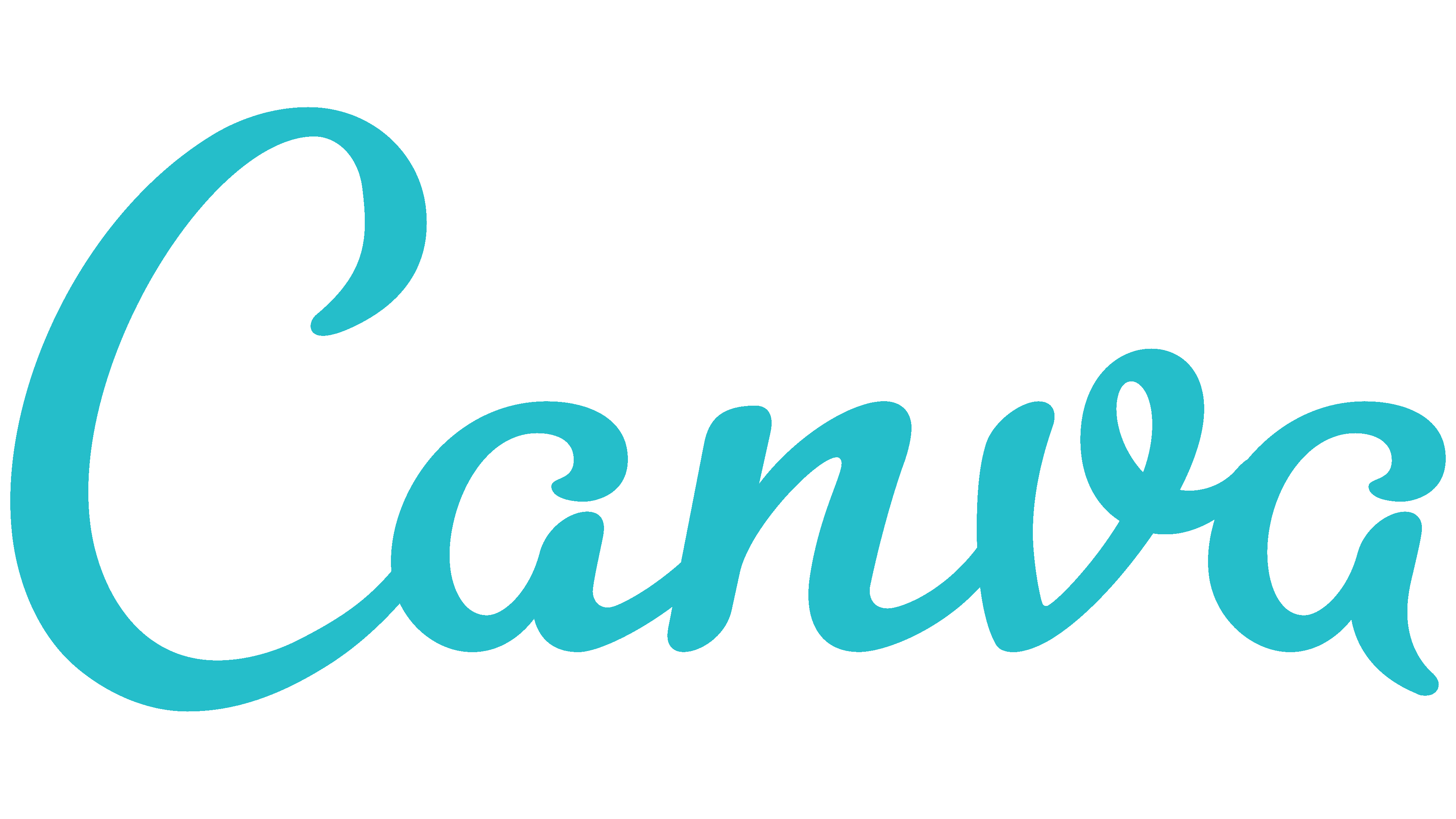
The Australian online platform for creating graphics was launched in 2013. It was called Canva and featured a logo with the same inscription. It was a blue-green handwritten wordmark. The designers created elegant letters by connecting them. Only the first “C” was in uppercase, slightly shifted downward and protruding beyond the conventional border. The same shift appeared in the last “a”: its tail pointed toward the lower-left corner. The developers tried to balance the asymmetry by making both sides symmetrical.
Despite the rather wide lines, the logo looked refined. And all thanks to decorative elements adorning the glyphs. This includes the teardrop loop on the lowercase “v” and an unusual twisted stroke at the top of both “a”s.
2021 – today
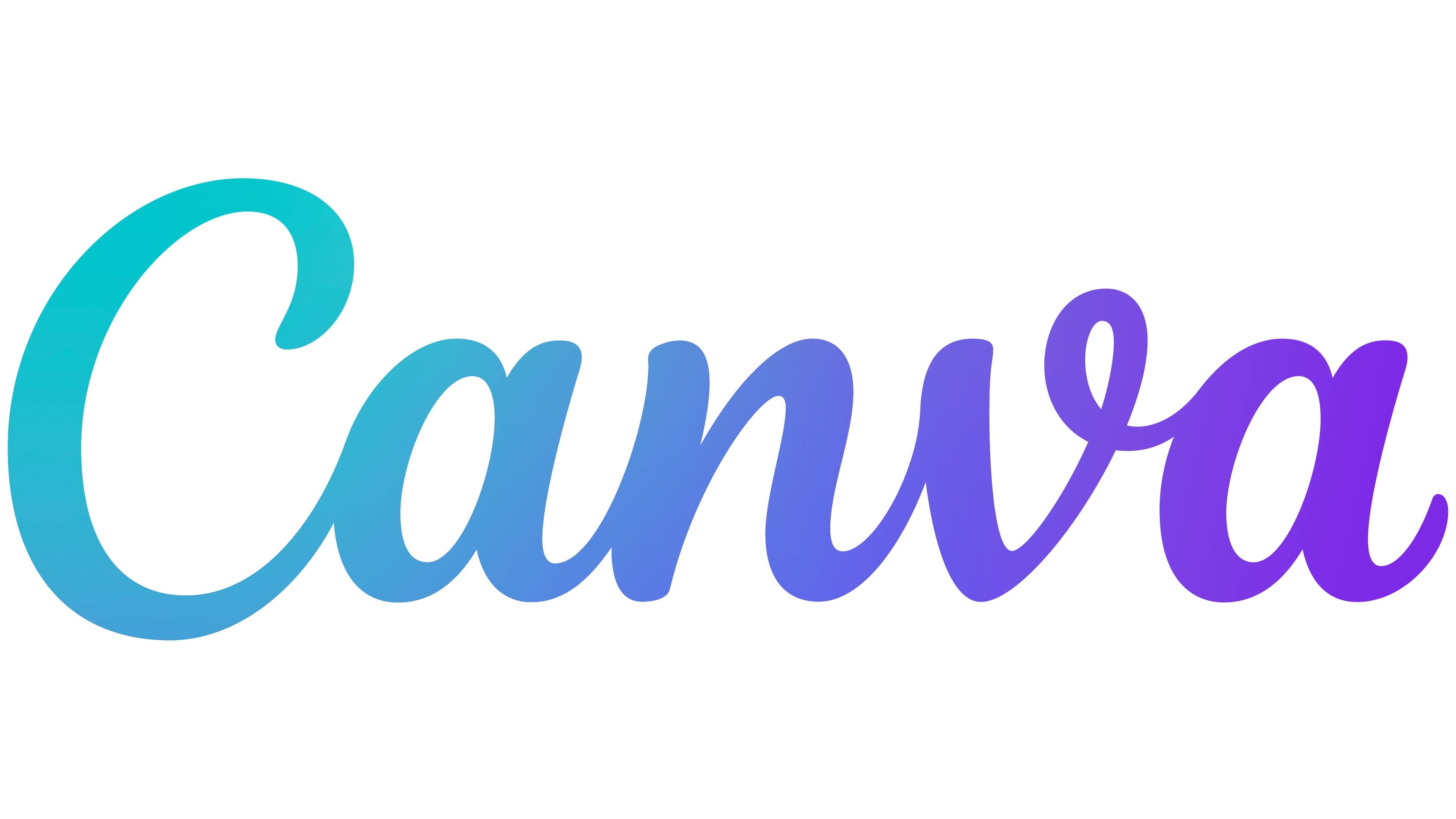
In 2021, Canva updated its logo with the help of its team of specialists. It also hired lettering artist Rob Clarke to speed up production. As a result, the logo became more dynamic, with designers using a gradient that transitions from light blue in the top left corner to bright purple on the right.
The font was also changed, although the handwriting was preserved. Letters became cleaner. Both “a”s look the same: classic glyphs without the previous swirls and open lines. The capital letter “C” has shrunk, though it is still larger than the lowercase letters.
Font and Colors
Smooth, intricate handwritten lines symbolize the service’s artistic direction, but the main emphasis is on the attractive color. Turquoise symbolizes life-affirming energy and renewal, while white speaks to purity and the ability to create everything necessary from scratch.
FAQ
Does Canva own your logo?
Yes, Canva owns your logo; the products we create are not our users’ property. Primarily because it’s a free-access system, your logo may look like someone else’s due to common layouts and templates.
How to make a cool logo?
To quickly create a cool logo, use graphic design services. One of them is called Canva. It will help you create a great icon, personal emblem, or logo for free, with ready-made templates, fonts, and layouts.
How to create a logo in Canva?
Go to the Canva website. Then select a layout or design it from scratch. Adjust shapes, symbols, and colors. Add and edit text (name, slogan). Save the result of the work.
Is the Canva logo free?
Yes, it’s a free service. The logo maker lets you use built-in templates for graphics, images, shapes, and fonts for free. Users can create any logo based on them at no cost.