


 Microsoft Word Logo PNG
The Microsoft Word logo symbolizes the text editor’s enhancements and versatility, reflected in the four blue stripes. The simplified design improved the emblem’s perception, adding elegance while maintaining recognizability.
Microsoft Word began in the early 1980s, when Microsoft entered a market dominated by WordPerfect. In 1981, the company hired Charles Simonyi and Richard Brodie, who started developing a new text editor based on ideas from Xerox PARC.
In October 1983, Microsoft released Multi-Tool Word for MS-DOS. Despite an unusual launch through PC World distribution, the program struggled against WordPerfect, which had an established user base.
A key feature was WYSIWYG, which let users see formatted text before printing. This advantage mattered more in graphical systems than in text-based environments.
In 1985, Word was released for Apple Macintosh, where it gained traction thanks to the graphical interface. This experience showed that the product could succeed on the right platform.
The turning point came in 1990 with Windows 3.0. Word adapted quickly, while WordPerfect lagged. In 1989, Microsoft bundled Word, Excel, and PowerPoint into Microsoft Office, strengthening its position against rivals like Lotus.
During the 1990s, Word expanded its features. Word 6.0 unified interfaces across platforms, and Word 97 introduced grammar tools and automation, along with the Clippy assistant, which was later removed.
In 2007, Microsoft replaced traditional menus with the Ribbon interface, which changed user interaction despite initial resistance.
In 2011, Office 365 introduced a subscription model, moving Word to the cloud and expanding it across web and mobile platforms, reshaping its distribution and usage.
Meaning and History
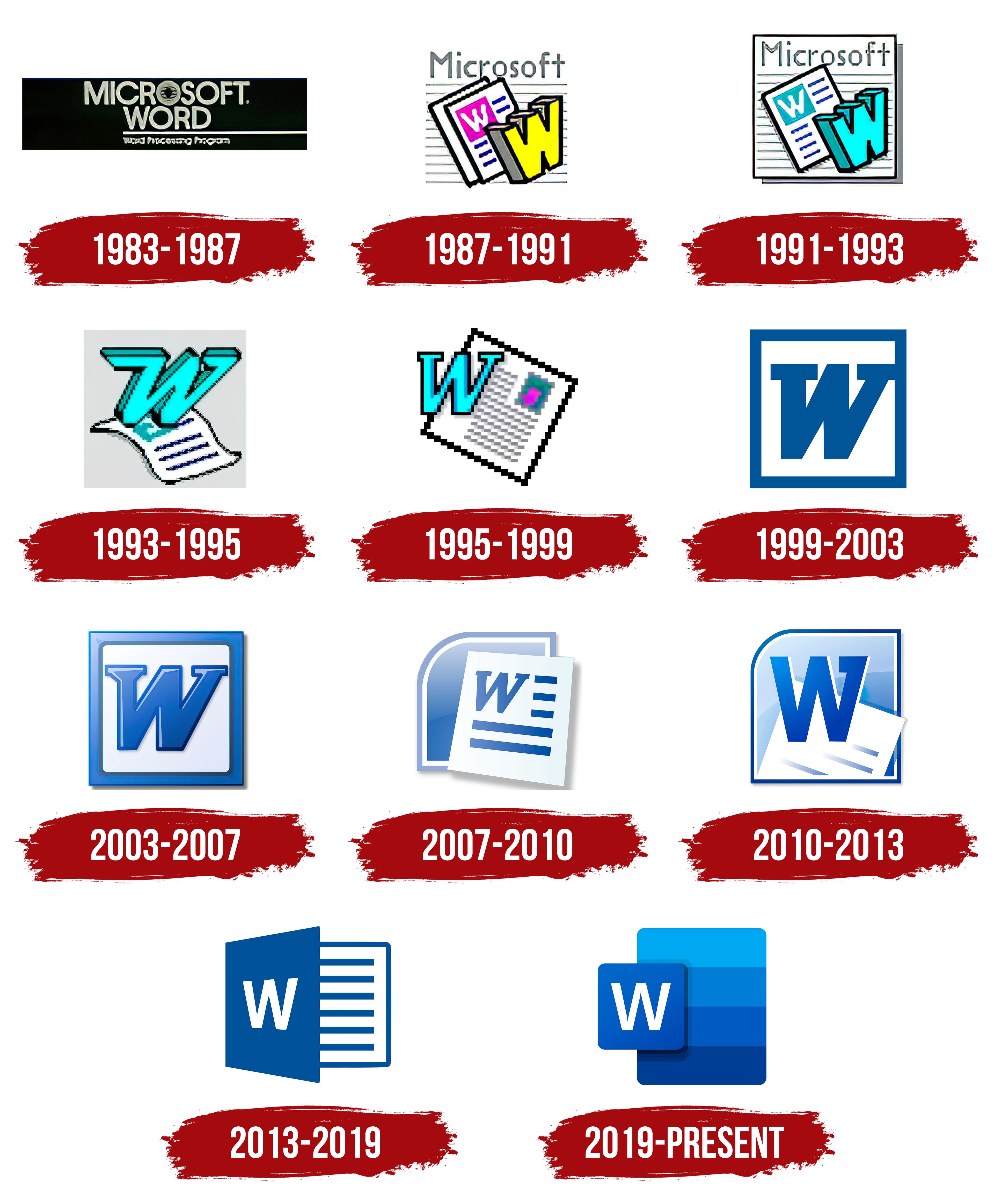
Programmer Richard Brodie created the first version of Microsoft Word in 1983 based on the Bravo editor. At that time, another editor, WordPerfect, was very popular in the U.S. However, Brodie quickly adapted, eliminated all shortcomings, and, two years later, released Word 3.01 for Macintosh, followed by an updated version for Windows 3.0 a year later. WordPerfect became obsolete and incompatible with Windows, and Word became the leading editor in the U.S. and worldwide. In addition to the text editor, new versions of Microsoft Word introduced graphic tools, the ability to embed various objects, and multilingual support.
Microsoft created the Word logo in 1983 and has updated it every 3-5 years. Experts consider the current version to be the most successful and representative of the latest version’s capabilities.
What is Microsoft Word?
It is a program specifically designed for working with text. Alternative names include WinWord and MS Word. This software is part of the Microsoft Office suite, but appeared much earlier in 1983.
1983 – 1987

The first logo was simple: the editor’s name, MICROSOFT WORD, written on a black plaque in white capital letters, with the central letter depicted as concentric circles. A thin white stripe underlines the word Word, and below it, in small print, is the slogan Word Processing Program.
1987 – 1991
Microsoft created a full-fledged logo for Word 3.0 and Word 3.01. The emblem depicted a sheet of paper with small, illegible font text. Above it, in large letters, is Microsoft, and two small sheets are positioned at an angle. The upper sheet shows a purple emblem with the letter W. In the foreground is another large letter W with a bright yellow facade. The editor introduced several fonts, including 3D effects and the ability to color the background and text.
1991 – 1993

The emblem changed slightly; it became twice as large. A thin black frame was added to the background square, and the shadow on the right depicted a stack of printed sheets. The name did not change; of the two small sheets, only one remained, with a blue-green square, and the voluminous letter W became bright azure.
1993 – 1995

The logo changed radically and became softer. The sheet of paper was depicted horizontally with a wave, and the letter W moved up, becoming vertical, slanted, and with large serifs.
1995 – 1999

In 1995, as part of the Office 95 package, Microsoft released Word 7.0. Along with it, the logo changed: the sheet was rotated, the large letter W was highlighted in color on the left, and the square with the fill moved to the right. Notably, all lines represent an “image element,” now called pixels. This version was considered the least successful in its depiction.
1999 – 2003

The next radical transformation in design and color. A white-and-blue gradient color scheme was chosen. A white square is enclosed in a blue frame, with a large blue letter W at its center.
2003 – 2007
Minor changes reduced the emblem’s size, and the plain blue was replaced with a toned-down version that transitioned from blue to light blue.
2007 – 2010

Word 2007 switched to the international Open XML standard, and the emblem changed significantly. We returned to the white sheet with stylized text and the letter W. In the background is a blue square with rounded corners.
2010 – 2013

The design changed slightly by moving individual logo elements, though its visual perception remained the same.
2013 – 2019
In 2013, Word changed its functionality and interface, becoming softer and more intuitive, and added many new features. The logo also changed to an open book with text and the letter W on the cover. The color scheme is blue and white.
2019 – today

Users were presented with a new, improved version of Microsoft Word 2019 and a new editor logo. The plaque background features 4 wide stripes in different shades of blue, symbolizing the program’s versatility. In front of the left is a small blue square plaque with the brand’s white letter W.
As you can see, the designers went in reverse: they simplified and made the Microsoft Word logo more elegant, while the editor itself became more complex.
Font and Colors
Since 2019, WinWord has had a stylish two-part icon. A rounded rectangle with four stripes in different shades sits in the background. A square without corners sits in front, casting a triple shadow. The light seems to come from the left outside the image. Inside the square is a large letter “W”, an abbreviation for “Word”. It can also be interpreted as an inverted capital letter “M” from “Microsoft.”
The only white element on the emblem is the capital letter “W.” It has no serifs and consists of four diagonal stripes of equal length and width. All other parts of the emblem are blue, with several shades present in the palette from light blue at the top of the rectangle to dark blue at the bottom. The square casts gray shadows.
FAQ
What is the Microsoft Word logo?
The modern Word logo consists of two quadrilaterals. A blue rectangle in the background is divided into four horizontal stripes. The shade changes from light (at the top) to dark (at the bottom). In front of it is a blue square with a white letter W.
How to create a design in Microsoft Word?
Go to the “Insert” section, click “Shapes,” and choose the appropriate option. After you create the shape, a “Drawing Tools” tab appears, where you can change the fill and outline to create a design and add more objects.
How to create a logo in Word?
To create a logo in the “Word” program, it is recommended to use standard shapes and experiment with color and outline thickness. The WordArt function is suitable for decorating text. You can also insert any images saved on your computer.
Where are the icons in Word 2019?
In Word 2019, icons are in the same place as in earlier versions: on the “Insert” tab.