 Adobe Photoshop Logo PNG
“Open me! Real treasures are collected inside the program,” the Photoshop logo intrigues. Its tools let you transform a photo, creating a powerful image workflow.
Adobe Photoshop began in 1987, when Thomas Knoll created a program called Display to show grayscale images on a Macintosh Plus. His brother John Knoll, working at Industrial Light & Magic, saw its potential and pushed for further development. By 1988, the project was renamed Photoshop.
Early distribution was limited. A licensing deal with BarneyScan bundled the software with scanners, and about 200 copies were sold. Later in 1988, Adobe Systems noticed the product at MacWorld Expo and licensed it, while the Knoll brothers retained authorship.
On February 19, 1990, Adobe released Photoshop 1.0 for Macintosh at $895. It supported only grayscale but already included core tools such as the brush, eraser, and selection tools. The software quickly entered publishing and advertising workflows.
In 1991, version 2.0 introduced layers, enabling non-destructive editing. In 1993, Photoshop launched on Windows, expanding beyond Apple and competing with Corel Photo-Paint.
Version 3.0, released in 1994, added advanced layers with blending modes. Photoshop 4.0, released in 1996, added actions for automation, and version 5.0, released in 1998, added the History panel. Photoshop LE, a simplified version, was bundled with cameras and scanners.
As the internet grew, version 5.5, released in 1999, included ImageReady for web graphics. Photoshop 6.0, released in 2000, added vector shapes and improved text tools. In 2002, Camera Raw reshaped digital photography workflows.
In 2003, Adobe launched Creative Suite, integrating Photoshop, Illustrator, and InDesign. Free alternatives like GIMP appeared but remained secondary in professional use.
In 2013, Adobe moved to the Creative Cloud subscription model. In 2018, Photoshop expanded to iPad, adapting its tools for touch-based work.
Meaning and History
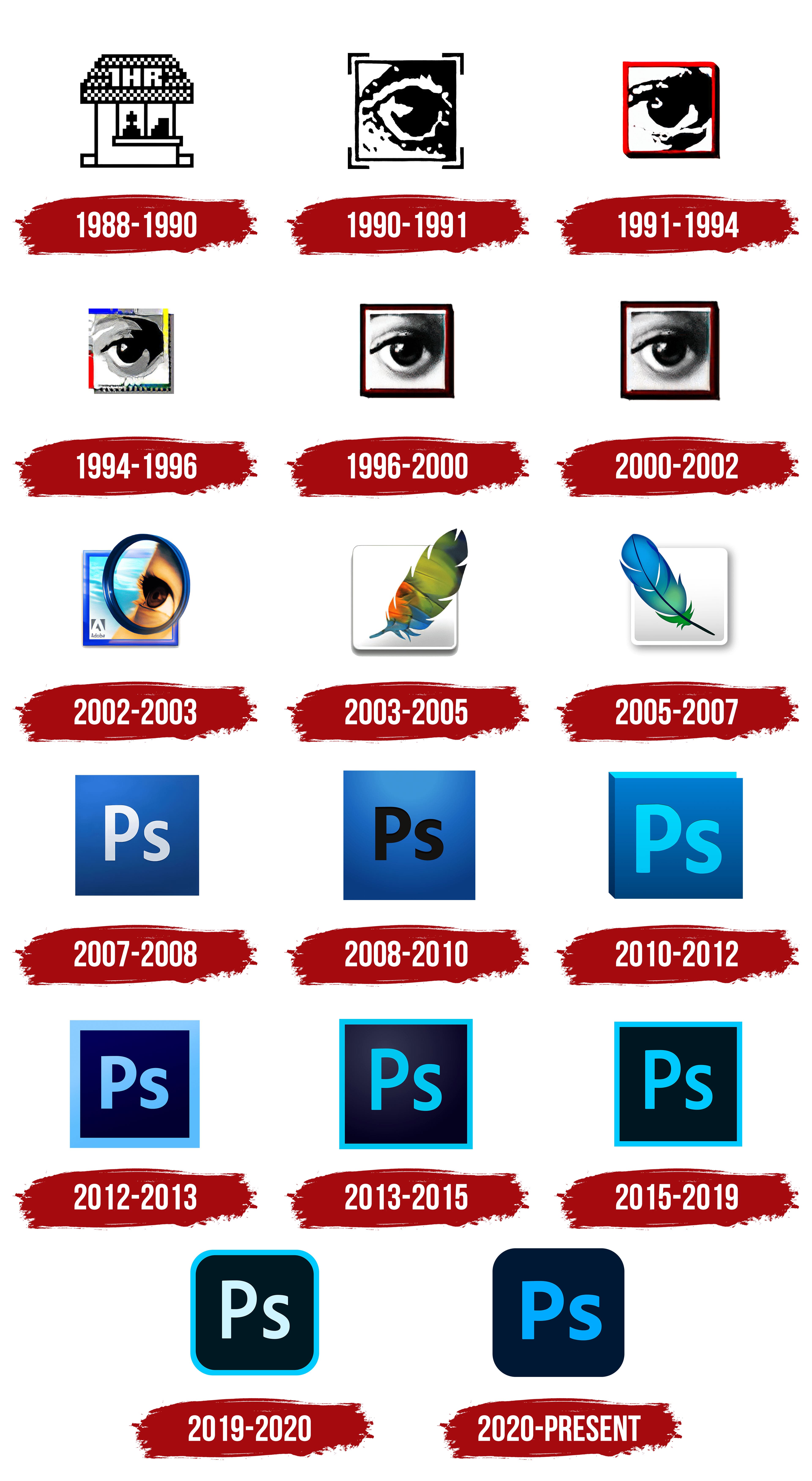
Over its 30-year history, the program has used 14 logos, the first appearing at the software’s launch. The brand name redesign usually coincided with the next update to the graphics editor.
The same icon type represents opening variants, with an eye looking forward. The simplest of the six is the basic one. It looks like a monochrome pixel-art image, framed with double trim at the corners. The latest version of the eye icon is colored. The eye is turned sideways and looks up through the circular opening. The square has a dark blue border and the Adobe sign in the bottom-left corner. In the future, the emblem’s style is based on brevity. Indeed, nothing is superfluous; only the capital letters of the compound word “Photo + shop.” The “Ps” signs are centered in the blue square. Over time, the design varied slightly: the first three options were frameless, while later versions had a blue edge.
What is Photoshop?
Photoshop, or more precisely Adobe Photoshop, is a computer program that allows users to create and edit digital images. Thomas Knoll and John Knoll originally developed it, and Adobe Corporation publishes and owns it. The term “Photoshop” also refers to the process of artistically editing images or photographs on a computer or laptop.
1988 – 1990

Initially, while the 0.07-0.87 beta version of the photo editor was in operation, a miniature icon depicting a simple house was used. It was composed entirely of pixelated elements. The roof featured alternating black and white squares and the inscription “1HR”. The lower part consisted of two porches and a panoramic window. The drawing was monochrome.
1990 – 1991

After testing, version 1 of the program was launched with a logo in the form of a large drawn eye. Only the square shape and pixel style remained from the previous version. The developers designed the geometric figure’s corners with miniature strokes, like a camera viewfinder, hinting that Adobe Photoshop is designed for working with photographic materials.
1991 – 1994

After updating the program to version 2, the developers added another official icon. It also depicts an eye, but a different one, with fewer shadows and a more realistic look. The developers removed the corners, changed the border color to red, and added a 3D effect by duplicating the lines (bottom right).
1994 – 1996
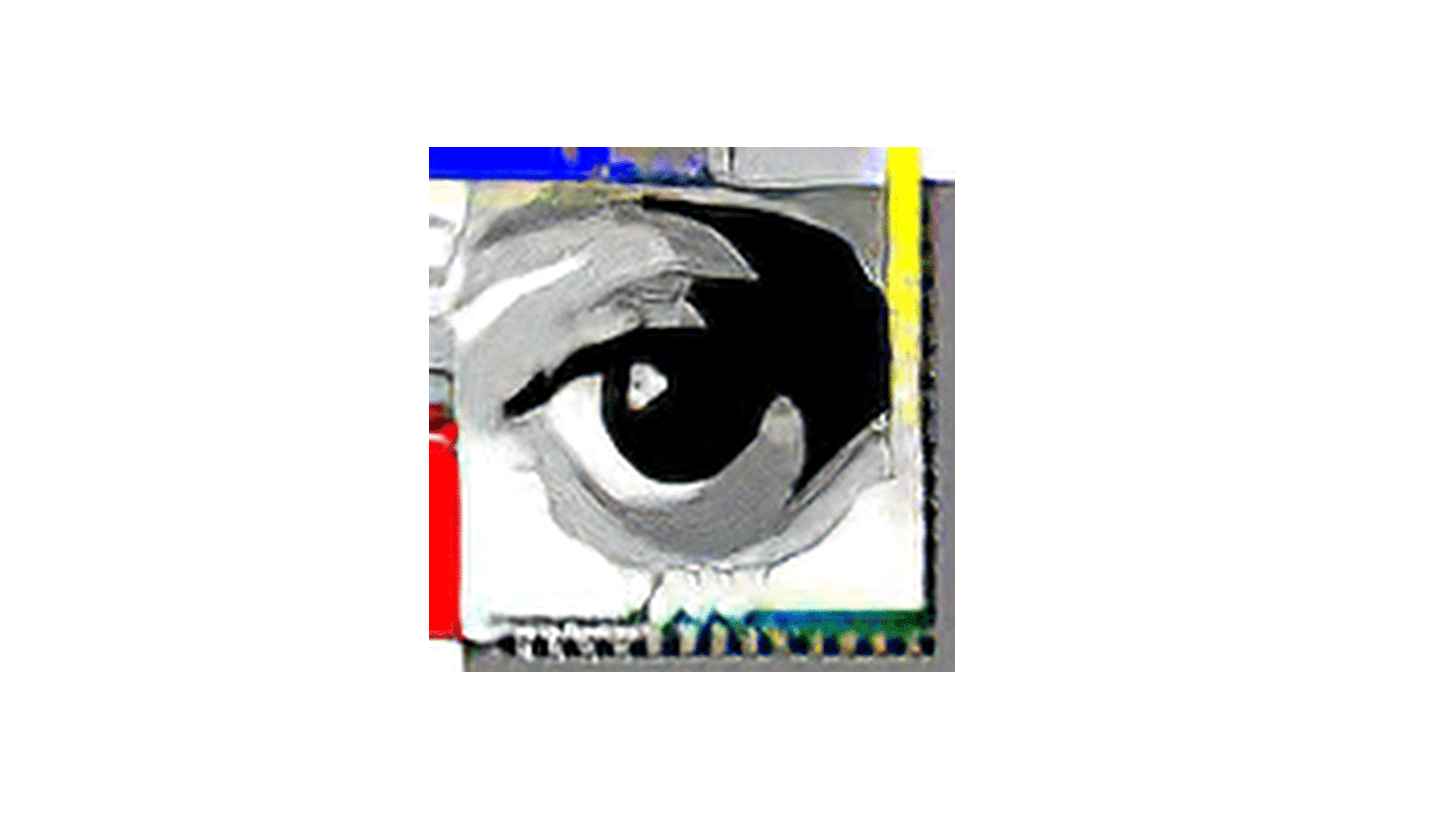
With the release of Adobe Photoshop version 3, the logo was redesigned. It now has a clear, smaller eye. The colors have become more diverse. The internal image has been rendered in multiple shades of gray to make the upper eyelid and eyeball even more distinct. The frame has become more colorful: in addition to red, it now includes blue, yellow, and green. The three-dimensional effect is preserved, but in addition to the shadows on the lower and right stripes, dark pixel points are also clearly visible. They extend up and left from the bottom corner.
1996 – 2000
In versions 4 and 5 of the digital photo editor, the emblem featured a realistic eye. The pixelation effect disappeared, replaced by a realistic style. As a result, the eye looks like a fragment of a real photograph. The developers highlighted the square with a dark color and outlined it with duplicate lines, giving the frame a triple structure. The outer border is black; the inner border is white and red.
2000 – 2002
After version 6 of the program was approved, the logo changed only slightly. The designers only lightened the upper shadow to make the eye look more realistic.
2002 – 2003

This period marked a turning point in the history of the Adobe Photoshop logo, as monochrome gave way to color. The icon has become much brighter. Moreover, the authors turned it to the side. They also added a face snippet, a background, a circle, and a brand badge. The frame was repainted in blue with a purple shade. In version 7 of the photo editor, the eye is depicted within a circle that extends beyond the square on both sides.
2003 – 2005

Over the next few years, developers used a feather-based emblem. The pen is positioned diagonally from right to left. The colors are also different. The logo’s color varies across the visible spectrum, with shading transitions.
The designers made the square white, with a small shadow at the bottom, treating it like a blank sheet of paper you can draw on in this program. The main ideas of corporate images are ease of work in Photoshop, creative focus, artistry, and art.
2005 – 2007

In this new version of the logo, the feather is already positioned from left to right. The emblem has only two basic tones: green and blue, with a gradient between them.
2007 – 2008
With the approval of version 10 (CS3), a completely redesigned emblem was introduced, ushering in the era of text symbology. It shows two letters from the application name “Ps.” It abbreviates “Photo” and “shop.” White letters sit on a blue background with a dark-to-light gradient. A small highlight appears in the upper-left corner.
2008 – 2010
That year, the developers created a special logo for the iOS program. It became Photoshop’s most colorful logo: a multicolored square containing the characters “Ps” in embossed type. Such symbolism looks elegant, voluminous, modern, and dynamic.
2010 – 2012
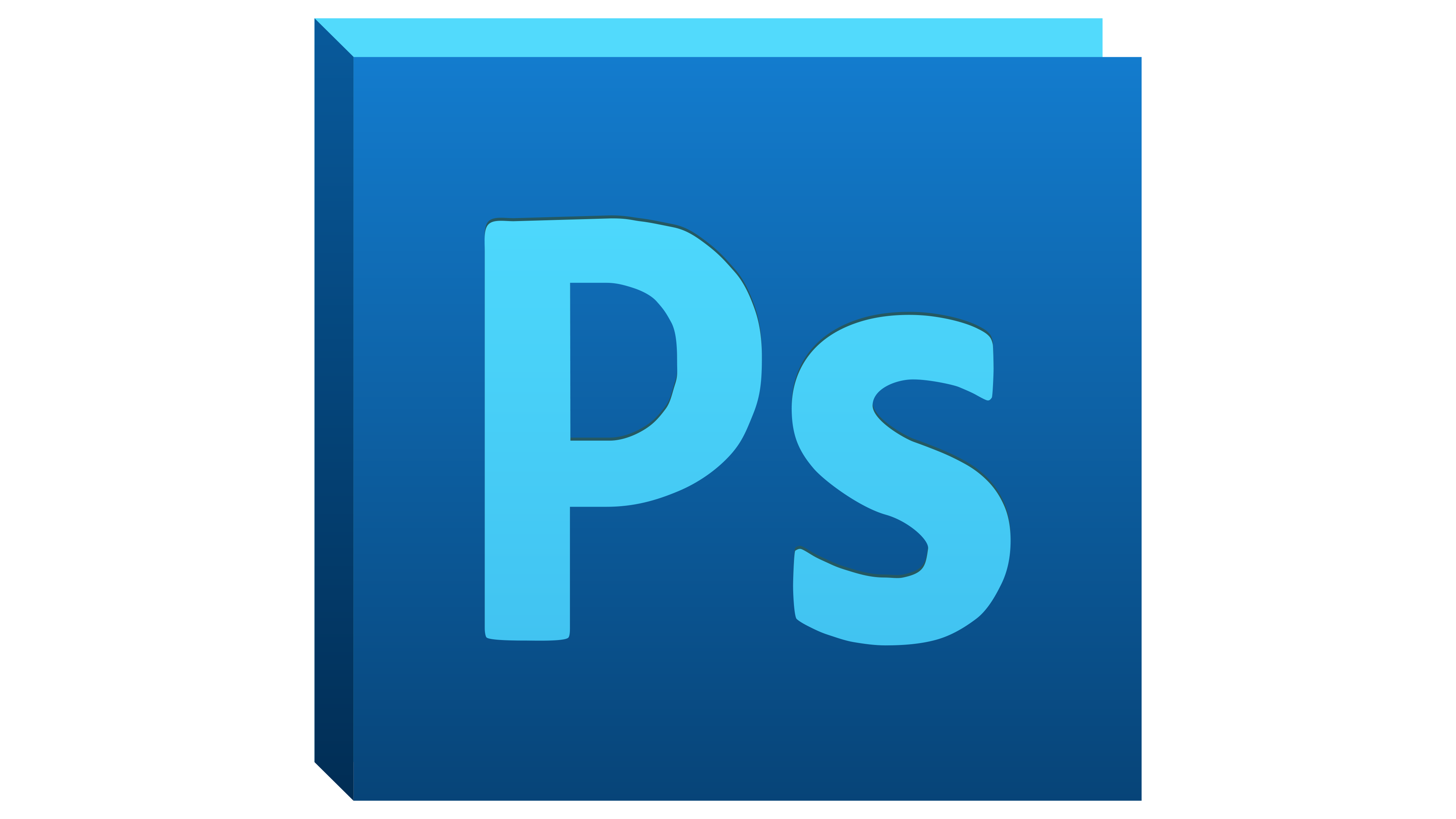
For version 12 of the program (CS5), the developers chose a square box logo from the front. This is evidenced by the diagonally displaced diagonals, a dark sidewall, and a light fragment representing the opposite side of the improvised “box.” The letters “Ps” appear in blue at the center. They have a classic spelling.
2012 – 2013
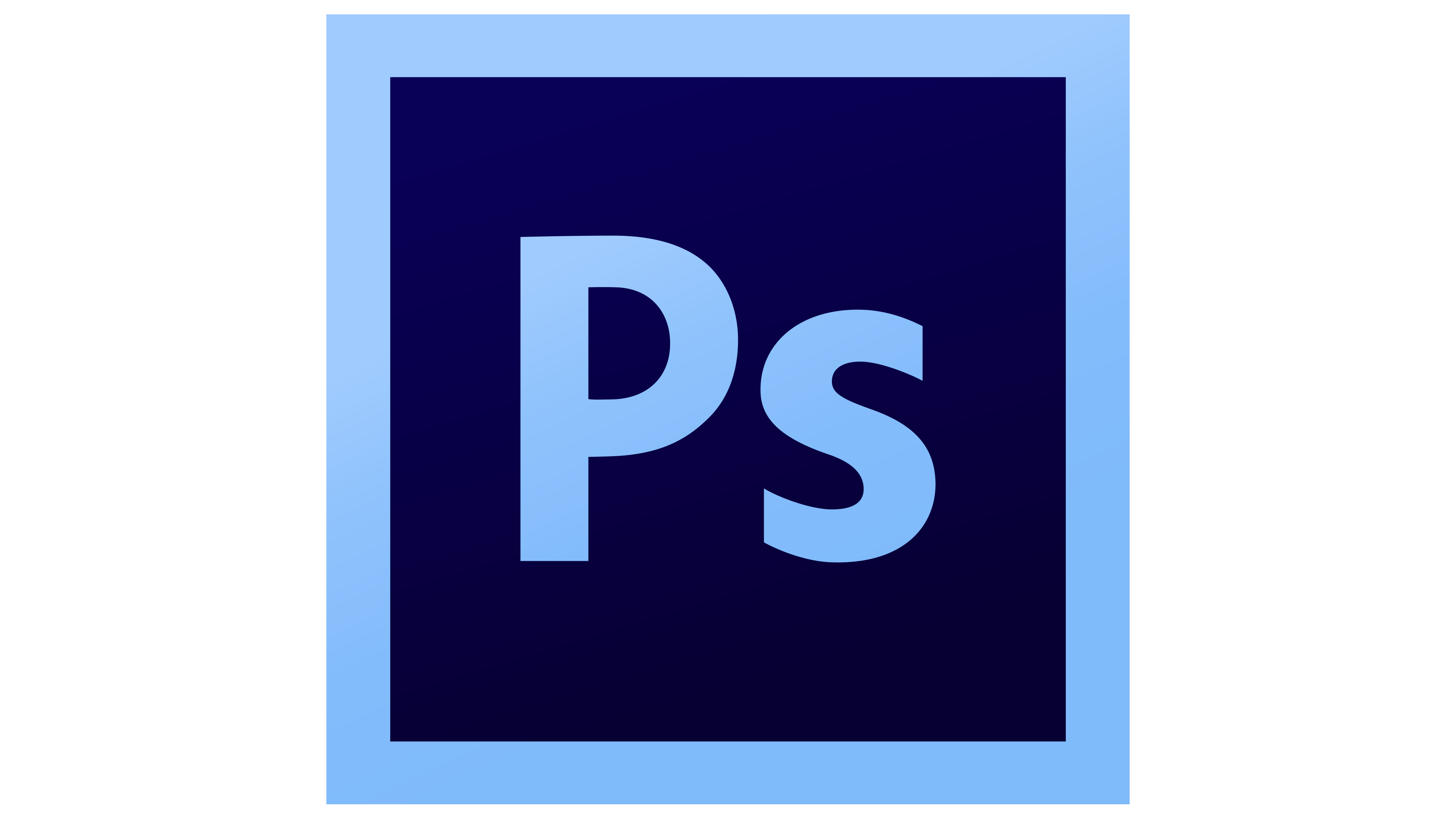
After releasing version 13 (CS5), the designers removed the box shape, eliminating the 3D effect. But they complicated the design by adding a wide azure border to the emblem. Letters were made to match it. They painted the rest of the geometrically precise square dark blue.
2013 – 2015
In 2013, the photo editor received version 13-15 CC-CC2015, along with a minimally updated design. The logo line is slightly narrower, and the background color is more intense.
2015 – 2019
The 16-20 apps icon (CC2015- CC2016) looked almost the same as the previous one. The difference was the darkened background, with adjusted framing and letters (several tones enhanced them).
2019 – 2020
In 2019, Adobe Photoshop was updated to versions 21-21.1.3 (CC2020). Before the product launch, the logo was revised. The square now has rounded corners, and the Ps lettering has turned white.
2020 – today
For software version 21.2 (CC2020), the authors revised the logo again. They removed the edging line (blue border), changed the background from black to dark blue, and increased the letter width and color.
Font and Colors
As the logo evolves, detail is crucial for graphic designers. This idea is emphasized across all logo versions because the changes were minor and focused mainly on small elements.