


 Power BI Logo PNG
The Power BI logo shows how clients’ businesses grow and strengthen, and the software lets you observe and record this process. No fluctuations will go unnoticed. The emblem hints that analytics and prosperity are inseparable.
Power BI grew out of Microsoft’s internal data tools rather than a single launch. By 2011, key ideas had reached Excel through PowerPivot, a free add-in that expanded data modeling inside spreadsheets. In July 2011, Microsoft introduced “Crescent” with SQL Server “Denali,” an early step toward interactive reporting.
In 2013, the company released “Data Explorer” for Excel, later renamed Power Query. It allowed users to connect to many sources, clean data, and repeat transformations without code. In September 2013, Microsoft grouped these tools under the name Power BI for Office 365. Still, the first version depended on SharePoint Online, Office 365, and Excel add-ins, making it difficult for many users.
Microsoft rebuilt the product and launched Power BI as a standalone platform on July 24, 2015. Power BI Desktop became a free application for report building, while Power BI Service handled publishing and collaboration. Against Tableau and Qlik, Microsoft offered a lower entry cost and a simpler path for nontechnical users to create dashboards.
In March 2016, Power BI Embedded enabled embedding reports in third-party apps via Azure. Power BI Premium followed in 2017 for larger enterprise workloads. In 2019, Microsoft added AI features, including Key Influencers. Since 2015, Power BI Desktop has received monthly updates, expanded to hundreds of data sources, and gained thousands of custom visuals. In 2023, Microsoft announced Copilot integration, allowing users to ask questions and generate reports in natural language.
Meaning and History
Two employees from the SQL Server Reporting Services Team, Amir Netz and Thierry D’Hers, developed the analytical software. Ron George later took it over and brought a digital product called Project Crescent to market. Microsoft first released it to the public in summer 2011, alongside SQL Server Codenamed Denali. Later, Microsoft renamed the program Power BI and introduced it as a functional tool in Office 365. This happened in 2013.
Initially, the utility relied on Microsoft Excel add-ins, but the developer company later expanded its capabilities by introducing several additional options. The circle of potential users also expanded, as it was previously designed for individual analysts and small enterprises without their own IT infrastructure. In this version, the product was offered to the public in 2015.
In 2017, Power BI introduced a separate Report Server edition and a specialized version of Desktop RS. These are cloud-based business intelligence (BI) services and a desktop interface. Interactive information panels, search, discovery, preparation, and information storage complement them. The key difference between the service and its analogs is the ability to load custom visual data. The essence of digital technologies is reflected in a simple logo that has undergone two revisions.
2013 – 2016

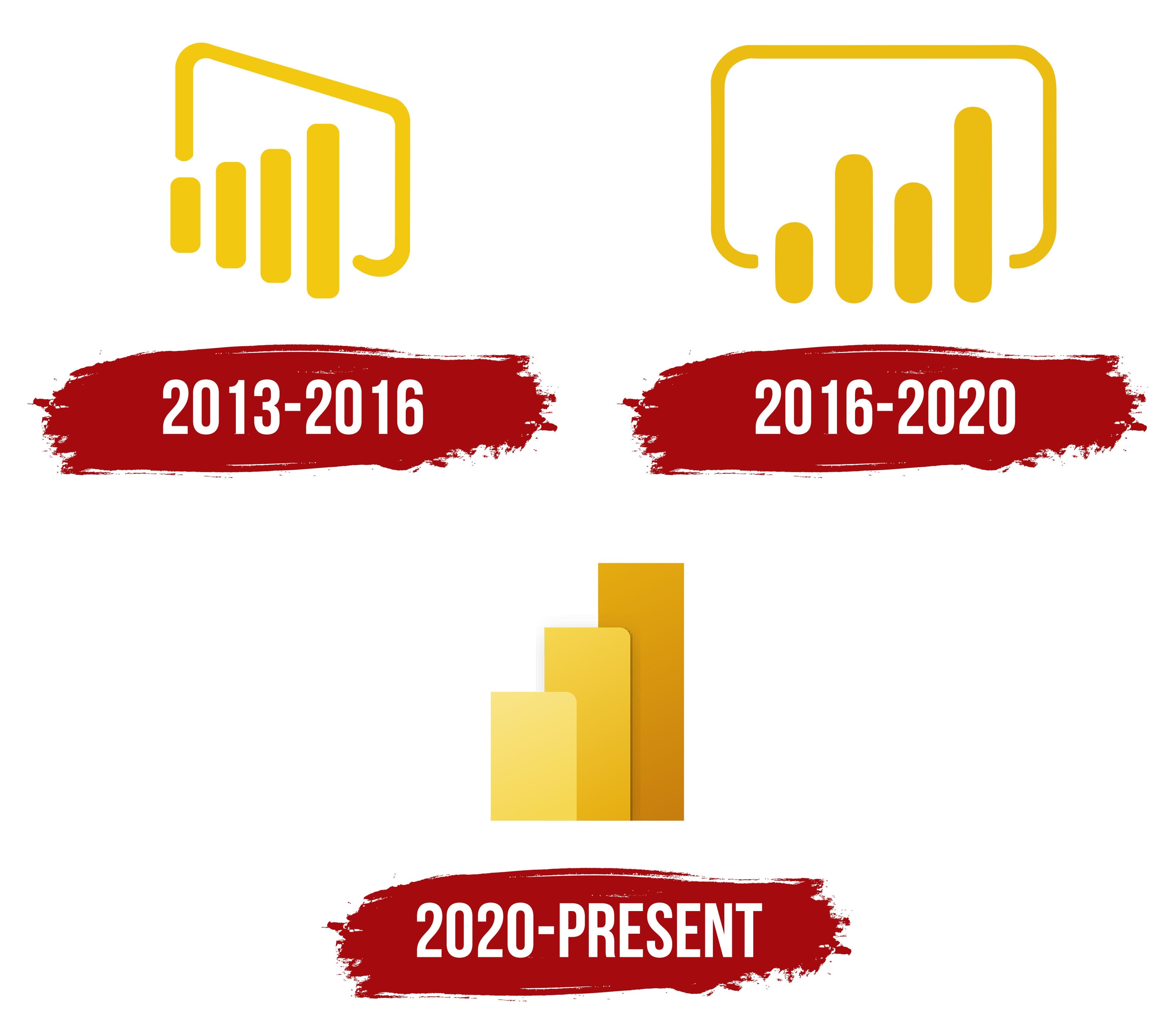
The corporate logo never included text, emphasizing the service’s seriousness and independence from conventional programs. At first, it consisted of a contoured screen and a comparison graph. The display was an open line that formed a rectangle, with a PC or laptop monitor clearly visible. At the bottom were four wide columns of different heights: the shortest was on the left, the tallest on the right. All corners were rounded, and the line had smooth transitions, giving users a feeling of absolute security.
2016 – 2020

The designers straightened the screen (previously angled) and reduced the bezel thickness. Moreover, the display formed from the negative space was much wider than before. Even though the designers left the corners smooth, the ends of the line were cut off and had a smooth edge. But the authors rounded the columns even more. At the same time, their heights differed, and they stood in no clear sequence. The logo’s color has lightened a bit; instead of dark yellow, it now appears as pale gold.
2020 – today

The current emblem no longer resembles the debut emblem, as it has been reduced to a minimum. It no longer includes a display frame; its designers have finally removed it. Only a bar chart remained from the previous version, consisting of three large elements. They look like vertical rectangles with rounded corners. Each is painted a different color, from pale yellow to dark sand.
Font and Colors

The logo was constantly modernized, evolving from a complex configuration to a simple one. This added modernity and clarity, so that users’ attention was immediately riveted to the diagram. The number of columns also changed: it was reduced from four to three.

The emblem consists only of graphic symbols, so it contains nothing but the icon. The color palette has always remained in the spectrum of pastel-gold hues. It uses pale yellow, gold, and dark sand.