


 AZ Alkmaar Logo PNG
The AZ Alkmaar logo is full of dynamism, which no sports game can do without. Using such a symbol, a football club in the Netherlands aims to emphasize its uniqueness, originality, and right to lead. A stylish emblem, like a talisman, leads athletes to victory.
AZ Alkmaar’s roots go back to 1910, when Kooger Football Club, or KFC, was founded in the Netherlands. It turned professional in 1955, and in 1964, its professional section became FC Zaanstreek. Former players and coaches Cees and Klaas Molenaar, who had built an electronics retail business, wanted to create a stronger regional football club.
After a failed merger attempt with ZFC in 1964, the brothers found a working deal three years later. On May 10, 1967, FC Zaanstreek merged with Alkmaar ’54 to form AZ ’67. The club settled in Alkmaar and finished second in Eerste Divisie in the 1967-68 season, earning promotion to Eredivisie. Early spending on foreign players pushed AZ into debt. Still, in 1972, the Molenaars covered the losses through Wastora and took control.
The club’s strongest early period began in 1977, when Georg Kessler became head coach. AZ regularly played in European competitions, won the Dutch Cup three times, and built a team around Kees Kist, Jan Peters, John Metgod, and Hugo Hovenkamp. In 1981, AZ won the league title with 27 wins in 34 matches, 101 goals scored, and one defeat. That season it reached the UEFA Cup final, losing 5-4 on aggregate to Ipswich Town.
After Cees Molenaar died in 1979 and Klaas Molenaar left in 1985, AZ declined and was relegated. Dirk Scheringa of DSB Bank revived the club after arriving in 1993. AZ returned to the Eredivisie in 1998, opened DSB Stadion in 2006, and won the league again in 2009 under Louis van Gaal. When DSB Bank collapsed, AFAS Software took over stadium sponsorship. In 2018-19, AZ reached the Europa League semifinal, and in August 2019, part of the stadium roof collapsed during a storm.
Meaning and History
What is AZ Alkmaar?
One of the 18 Eredivisie clubs in the Netherlands. Founded in 1967. Twice Eredivisie winner, twice Dutch champion, and four times KNVB Beker Cup winner.
1967 – 1980
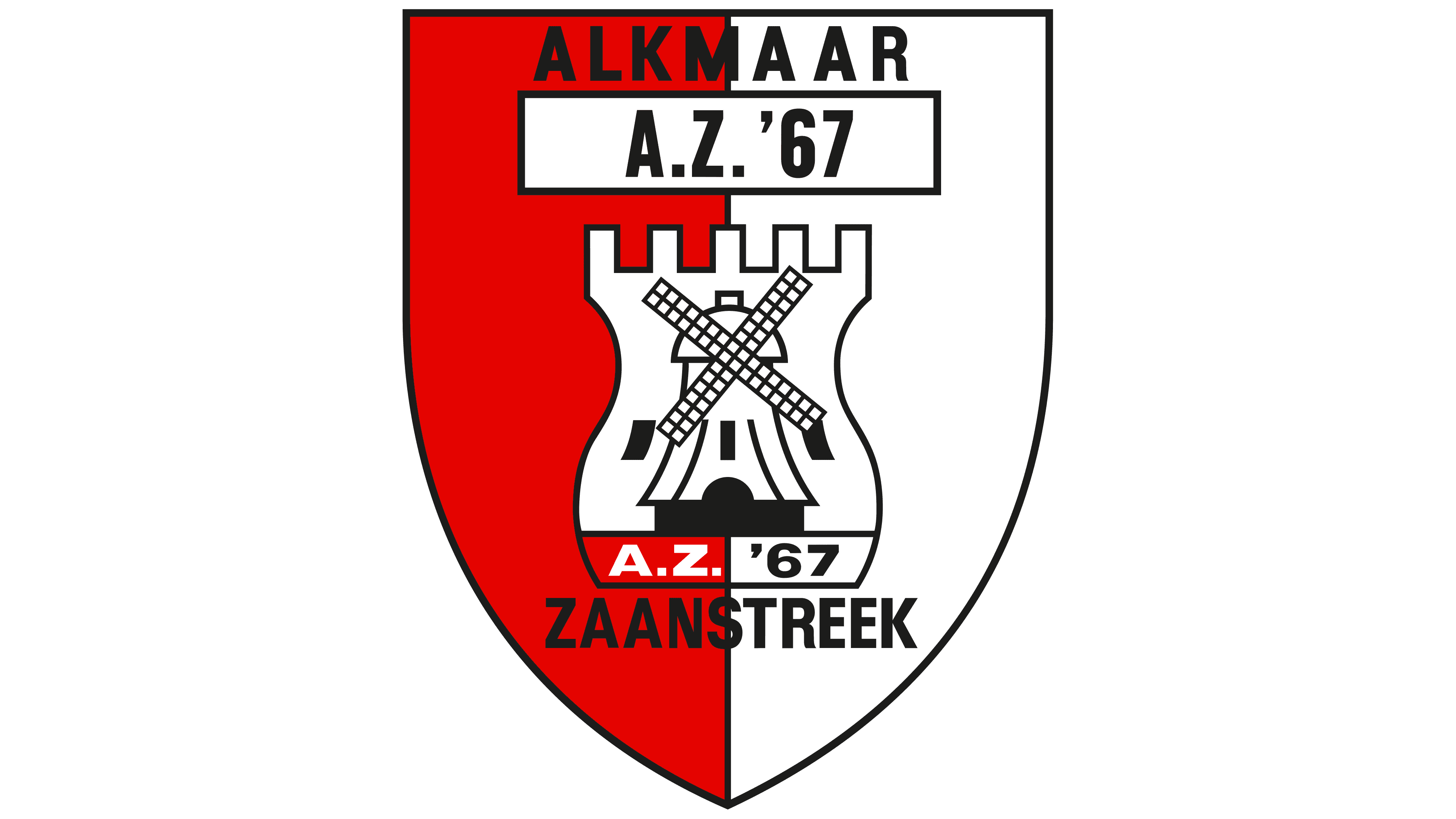
The first logo traces the club’s history. It is shaped like a heraldic shield. Its shape corresponds to the defining feature of Alkmaar, the Dutch city where AZ was founded. Inside the shield, the visual elements of two clubs are combined: Alkmaar ’54 and FC Zaanstreek, which became the progenitors of AZ Alkmaar.
The tower was taken from Alkmaar ’54. It is also the symbol of the city where the club is located (originally, Alkmaar was built as a fortress). Therefore, the figure in the logo occupies a dominant position. Mill taken from FC Zaanstreek. Its image is connected to the city’s past, when barley was grown, and flour was made from it. There were more than 1000 windmills in the region.
The windmill in the logo is smaller and inscribed inside the tower. This shows the clubs’ association and indicates that Alkmaar ’54 came before Zaanstreek.
The shield is divided into two parts, red and white, which pay tribute to the club’s homeland, as they correspond to Alkmaar’s striped flag. The form players received the same shades.
The name of one club is written on top of the shield, and the name of the second is written on the bottom. The inscription A.Z.’67 is in a white rectangle in the middle of the emblem and at the bottom of the turret. It is an abbreviation of the full name of the combined team Alkmaar Zaanstreek, plus the year of formation, 1967.
1980 – 1986
In 1979, major changes took place. Cees Molenaar, who owned the club with his brother, died, and at the end of the year, the club’s team qualified for the championship.
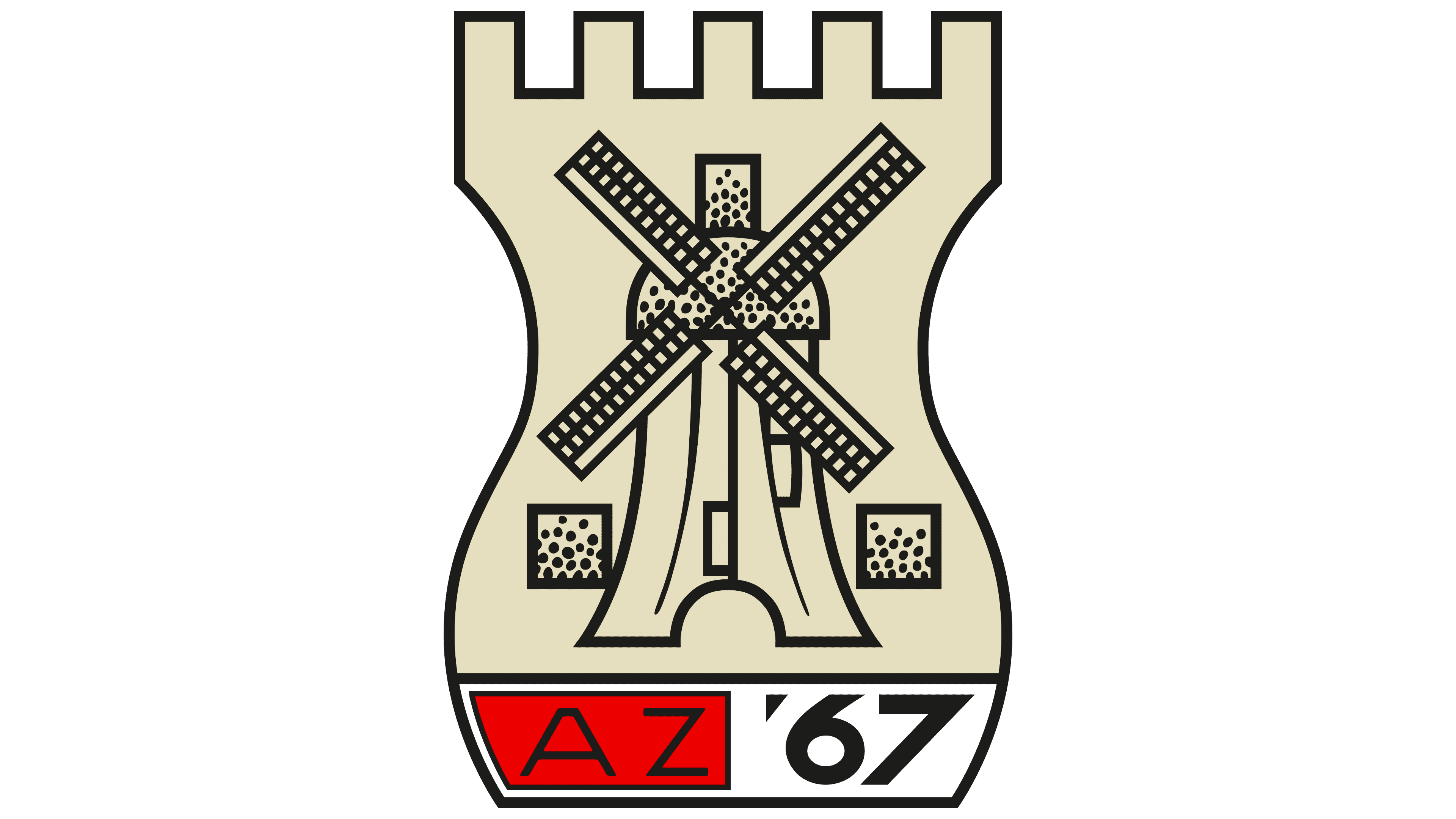
The visual sign for home matches removed all unnecessary details, such as a shield and repeated inscriptions, leaving only a tower, a windmill, and an abbreviated team name.
In this version, the details of the city symbols are drawn more carefully. Grain is loaded into the mill’s dome to the top. Two windows on the tower’s facade also show grain filling the structure. This symbolizes abundance, fruitful work, and victories that have accompanied the club in recent years. The grains allude to the many goals scored.
The logo was discontinued in 1986, when the last Molenaar brothers left the club. Historical details from the distant past are no longer relevant in modern contexts, making a simpler, more understandable visual sign preferable.
1980 – today
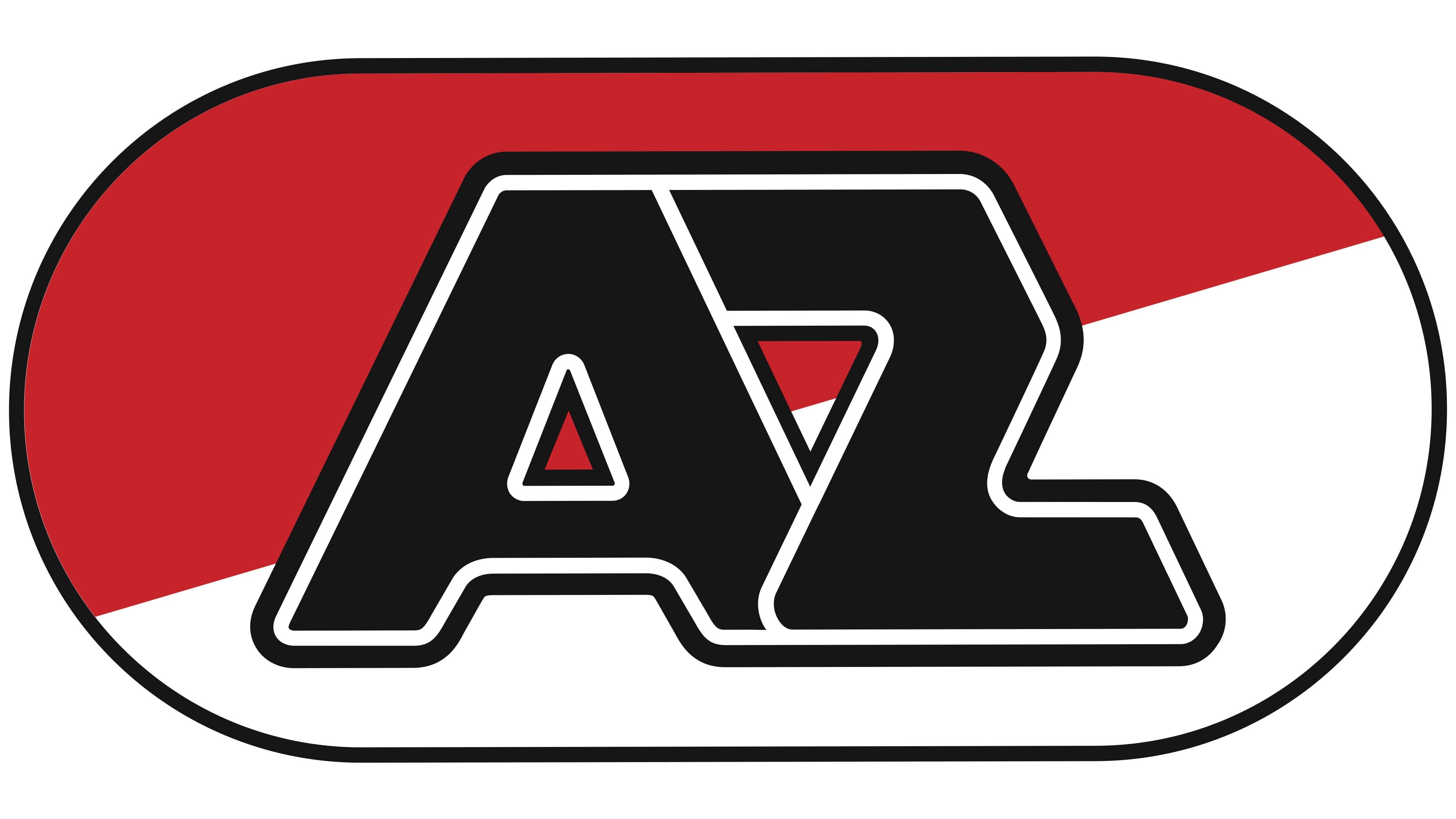
The modern logo is concise and easily recognizable. It includes the most basic details needed to identify the club: the country and the name.
The inner space of the logo is divided obliquely into white and red parts, pointing to Alkmaar, the city where the club is located. Its flag and rowing are red and white. There are also colors in the Netherlands’ flag and coat of arms.
The emblem’s center features large black letters A and Z with a white border. The abbreviation stands out and is visible from afar. The interlocking letters allude to the unification that began the club’s history. White outlines symbolize fair play.
The emblem’s oval shape echoes the ball’s flow and looks perfect on football jerseys.
Font and Colors
The club’s permanent colors are red and white. They demonstrate the team’s patriotic spirit. In addition, red indicates energy, drive, and dynamic play throughout the match. White symbolizes faith in the best, compliance with the rules, and the ability to revive after failures. It shows the ability to start every year with a clean slate.
The AZ font is streamlined, with rounded ends and a nod to a round ball. The inscription features an unusual Z-style letter with a cropped top corner.