


 Baja Fresh Logo PNG
At Baja Fresh, the logo reflects the chain’s specialization. After all, the tortilla pictured above is an important part of Tex-Mex cuisine, which combines Texan and Mexican culinary traditions. At the same time, the emblem’s juicy green color whets the appetite.
Baja Fresh began with Jim Magglos, who had never worked in the restaurant business. In 1978, he opened an auto cleaning and tinting shop in Westlake Village, California, but his real interest was Mexican food. In August 1990, Jim and Linda Magglos mortgaged their home for the third time and rented a low-cost space in Newbury Park, where several food spots had already failed.
Under the name Baja Fresh Mexican Grill, they served burritos, tacos, and quesadillas made with fresh meat, daily-cut vegetables, and salsa prepared in the dining area. The promise above the counter became the chain’s core message: “No can-openers, no freezers, no lard.” In 1994, the first franchise opened, and by 1997, Baja Fresh had 31 restaurants.
In 1998, Greg Dollarhyde and Pete Siracusa invested in Fresh Enterprises, the company behind Baja Fresh. Dollarhyde became CEO, Siracusa became chairman, and Magglos stayed as president. The chain had 45 restaurants at the time. It grew to 249 locations within four years, competing with Chipotle Mexican Grill in the fast-casual Mexican segment.
In 2002, Wendy’s International bought Baja Fresh for $275 million, partly in response to McDonald’s investment in Chipotle and its partnership with Boston Market. Wendy’s planned to open 600 to 700 locations, but sales weakened. In 2006, it sold the chain to BF Acquisition Holdings for $31 million. Baja Fresh bought La Salsa Fresh Mexican Grill in 2007, opened in Dubai in 2010, and was acquired by MTY Food Group in 2016 for about $27 million, with 162 restaurants in the U.S., Dubai, and Singapore.
Meaning and History
The name Baja Fresh comes from the Mexican region of Baja California. This is probably how the brand’s creators wanted to show the connection between their dishes and the authentic cuisine of the state that occupies the upper half of the Baja California Peninsula. There, great attention is paid to fresh seafood and vegetables, facilitated by the mild Mediterranean climate and the peninsula’s advantageous location between two reservoirs. The food service chain has adopted these traditions and added the word “Fresh” to its name to emphasize the consistently high quality of the ingredients.
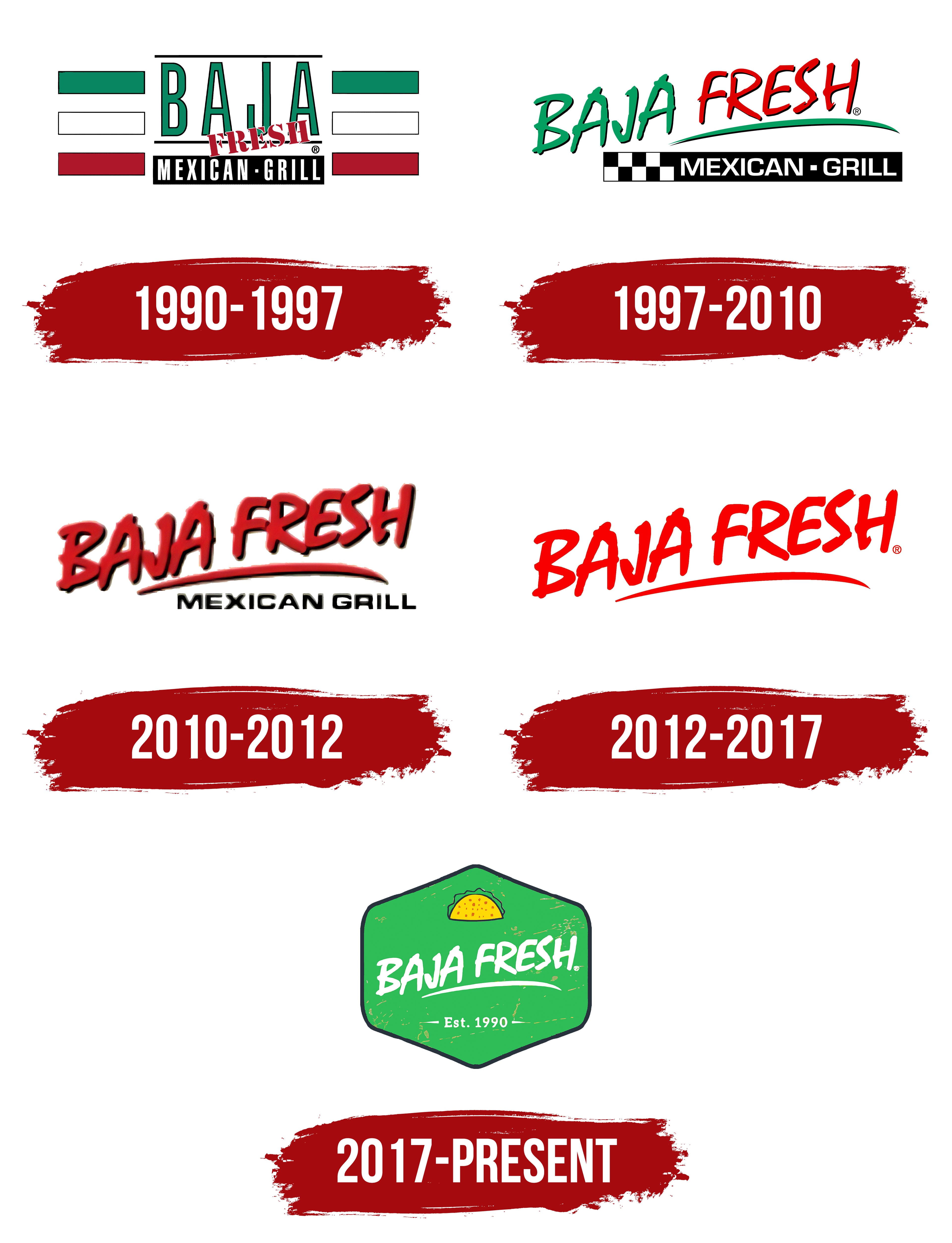
The brand’s logo also reflects Baja Fresh’s Tex-Mex heritage. A thin flour cake with filling is the main feature of this cuisine. It is depicted at the top of the green hexagon above the inscription. But this symbol was used only recently, in 2017. Until then, the restaurant chain had a word mark, supplemented by various elements unrelated to cooking.
What is Baja Fresh?
Baja Fresh is a chain of restaurants serving American cuisine with a predominance of ingredients and culinary techniques of the Texas Techno people. The first establishment opened in 1990, and over time, more than 160 have opened. The trademark is owned by Kahala Brands, which, in turn, is owned by MTY Food Group Inc.
1990 – 1997
Baja Fresh’s debut logo featured the brand name. The first word consisted of large green letters stretched vertically, while the second was written in stencil type and arranged diagonally like a seal. At the bottom, against the backdrop of a black rectangle, was the white phrase “MEXICAN GRILL,” separated by a dot. To the right and left of the inscriptions were green, white, and red rectangles, three on each side. It is easy to guess that they correspond to the colors of Mexico’s flag.
1997 – 2010
In 1997, a centralized network was formed from all the Baja Fresh franchise restaurants. She received a logo with a sloppy handwritten inscription, in which the first word (“BAJA”) was green and the second (“FRESH”) was red with a green underline. The line went up, which was supposed to show the relaxed atmosphere of the establishments. At the bottom, as before, was the phrase “MEXICAN GRILL” in a black rectangle; the letters were balanced in proportion only in this version. On the left, a pattern of alternating squares, the so-called “checkers,” adjoined the dark base.
2010 – 2012
To make the brand name stand out, the designers made it completely red. They also repainted the underline in the same color and moved it slightly to the left, closer to the word “BAJA.” At the same time, the phrase “MEXICAN GRILL” went from white to black, losing its dividing point, and its base and all other rectangles disappeared.
2012 – 2017

In 2012, the developers of the Baja Fresh logo made it more concise, retaining only the restaurant chain’s name. The font, as before, was stylized as handwritten. Both words and the line below them remained red. But at the same time, they lost thin black shadows, which is why the emblem became visually flat.
2017 – today

In 2017, the company carried out a global rebranding, which was reflected in its logo. The iconic wordmark is all white and sits in the middle of a green hexagon with rounded edges. Under the name Baja Fresh, the year the first restaurant opened is written as 1990. Above it is a traditional Tex-Mex dish: a flour tortilla with fresh filling. The emblem is outlined in a thin dark gray stripe.
Font and Colors
A tortilla wrapped in what appears to be a lettuce leaf is the main graphic symbol of Baja Fresh. The restaurant chain wanted to show its connection to Tex-Mex cuisine with this visual sign. As a result, the logo turned out to be bright and appetizing.
The brand name has always used a unique set of glyphs, stylized as a cursive font. All letters in the inscription are capitalized. The text below (“Est. 1990”) is in a serif typeface.
The color scheme is chosen to be both calm and appetizing. The tortilla’s pleasant yellow hue attracts attention, while the green base, with its uneven texture, is associated with freshness. A dark gray border completes the emblem. The inscription is painted in white, making it more visible.