


 Subway Logo PNG
The Subway logo is an ode to youth, freshness, and goodness. The emblem invites you to visit the restaurant and order some sandwiches, promising it won’t take long. The sign’s smooth lines guarantee maximum comfort.
Subway began in the summer of 1965 in Bridgeport, Connecticut. Seventeen-year-old Fred DeLuca wanted to study medicine but lacked tuition money. At a family barbecue, Peter Buck, a family friend and nuclear physicist, suggested opening a sandwich shop. Buck invested $1,000, while DeLuca took charge of daily operations.
On August 28, 1965, Pete’s Super Submarines opened at 3851 Main Street in Bridgeport. On its first day, the shop sold 312 sandwiches for 49 to 69 cents. DeLuca’s mother, Carmela, helped buy bread, meat, cheese, and vegetables. The first year was difficult because the location was weak. In 1966, a second shop opened in a busier area, and Doctor’s Associates Inc. was registered to manage the business.
In 1968, the name changed after radio ads made “Pete’s Submarines” sound like “Pizza Marines.” Subway became the new brand name. By 1974, DeLuca and Buck had 16 shops in Connecticut, short of their plan for 32. They turned to franchising, opening the first franchised location in Wallingford that year. A West Coast shop followed in Fresno in 1978, and international expansion began in Bahrain in 1984.
By the mid-1990s, Subway had more than 10,000 restaurants worldwide and had become a major rival to McDonald’s. Jared Fogle entered national advertising in 2000 after a student newspaper story about his weight loss, helping U.S. sales rise from $3 billion in 1998 to $12.3 billion in 2014. Subway cut ties with him after his 2015 criminal case. Fred DeLuca died in September 2015, and in 2023-2024, the family agreed to sell Subway to Roark Capital for $9.55 billion. Jimmy John’s remained one of its main sandwich-chain competitors.
Meaning and History
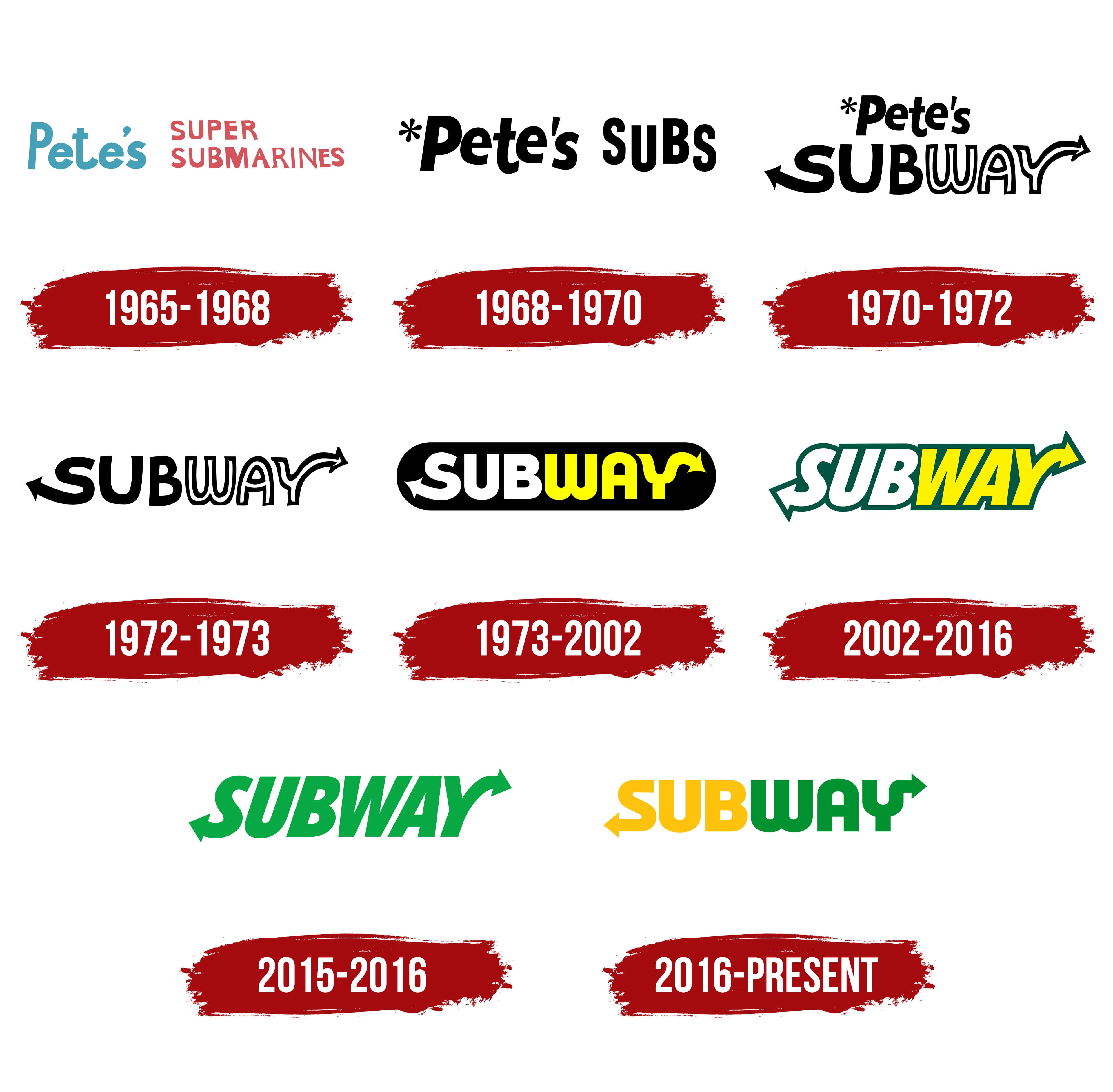
In 1965, Pete’s Super Submarines was opened. This name, derived from Peter Buck, became the star of the red-and-blue text logo. However, it was used for only three years: in 1968, the company changed its name to Subway, and the logo had to be updated. Here, you can see an obvious pun:
- On the one hand, that’s the name of the subway in New York City;
- On the other hand, the prefix “sub” refers to the restaurant’s signature sandwich, the Submarine Sandwich.
The designers added two arrows to the logo to emphasize the subway’s semantic connection. One arrow comes out of the letter “S” and points left, and the second extends from “Y” to the right. These elements symbolize quick service and forward movement. The arrows continue to be used in the restaurant chain’s brand identity. Only the design of the inscription changes the font, background, color, and shape.
For example, in 2002, as part of the “Eat Fresh” campaign, the emblem adopted a refreshing green outline evoking nature. In 2016, the sign became more minimalist, divided into two parts: an orange “SUB” and a green “WAY.” This simplification reflects the modern, versatile design trend and underscores the company’s reliability and professionalism.
What is Subway?
Fast food restaurants opened in America in 1965 and were owned by the DeLuca family. The main difference is specialization in healthy products (fresh salads, gluten-free bread, and sandwiches made with natural ingredients). The franchise generates more than $10 billion in revenue annually.
1965 – 1968
The logo reflects the first sandwich shop, Pete’s Super Submarines. The name was given in honor of Reteg Vzska, without whose money the business would not have started. The word “submarine” refers to the shape of sandwiches placed in buns that resemble submarines.
The emblem had two parts. The first part of the inscription was in blue, in a large font, showing deep respect for the sponsor, with Super Submarines in thin red letters across two lines. The variant represented the young enterprise. The red hue spoke of cooking with love and great speed.
The symbols featured elements of varying thicknesses, indicating different slicing and filling options for sandwiches.
1968 – 1970
In 1968, the diner’s name was changed to Pete’s Subs. This shortened the long second part, reducing it to a phrase that later became iconic for the restaurant’s products. The emblem looks whole now that the font and color differences have been removed. The black letters of the visual sign showed the startup’s growth and confident position in the market.
1970 – 1972
Companions began to consider expanding the business and opening additional outlets. Since the diner mentioned fast-food places, the name was changed to Subway. An arrow pointing in different directions was added to the first and last letters. The composition had several meanings.
- The opening of outlets in crowded places, perhaps near subways.
- Speed of service. Walked in, got your order quickly, and walked out.
- Distribution. Increase in the number of restaurants.
- Customers’ pace of life. Because the restaurant served natural, wholesome food, active, athletic customers and employees rushed to patronize it.
The word “way” was stripped of its coloring, leaving it white, in honor of healthy living.
1972 – 1973
Customers often heard the name “pizza” and were confused, so the word “Pete’s” was completely removed from the logo.
1973 – 2002
Companions came up with the idea of franchises. Before the new phase began, they rebranded the company. The updated logo turned out chic and evoked more positive emotions than the previous one.
The oval backing was designed to maximize customer satisfaction and create a sense of harmony. The black color made the lettering stand out, creating a strong contrast.
The uppercase and bold letters were colored to convey the vivid emotions evoked by visiting the restaurants.
- The first part of the word turned white immediately upon delivery, indicating the ingredients used in the preparation.
- The second part, “the way,” has turned yellow. It’s a hue of joy, showing the pleasure the user and their body get from the chain’s food.
The gamma shows that choosing Subway restaurants puts customers on the right path to healthy, delicious food.
The arrows echoed the background’s curves, enhancing perception.
2002 – 2016
The black background that marred the logo was removed. Instead, a green backing was added, repeating the contours of the letters. The color increased the emphasis on naturalness.
The visual sign has long been used and was only changed to the 2016 design when the outlet was renovated. Therefore, even in 2021, you could see the emblem on the signs.
2015 – 2016
In 2015, several important events happened at once: an anniversary, a change in management, and the death of the restaurant’s founder. DeLuca’s sister, Suzanne Greco, took over as general manager. Already under her leadership, the company rebranded to celebrate its 50th anniversary. It was an attempt to celebrate the legacy that the founder left behind.
An interim logo, which lasted only a year, was proposed to add a new flavor and keep up with the competition. The design agency BBDO Worldwide worked on it. The variation was designed for a new slogan communicating cooking “based on fresh” ingredients. The all-green delicate color represented this freshness and youthfulness. He said, “Despite its venerable age, the company is keeping up with the times, making changes in its work and menu. That’s why it stays forever young.”
2016 – today
The company’s sales began to decline. Therefore, it was decided to revise the visual identity to make it more modern and better cater to young customers. To work on the café’s interior, the American design firm FRCH, which has created designs for Hilton Hotels, Tiffany & Co., and Liverpool department stores, was invited. Turner Duckworth agency worked on the logo.
The designers retained the historical identity and brought freshness to the familiar mark. They took the backing off the image, which symbolized openness and simplicity. They made the letters smooth and harmonious in size, showing consistency and loyalty to the company values. The first half of the “Sub” turned yellow, showing the company cared about consumers’ well-being and good humor. The “way” part turned green, serving as a natural symbol of nutrition and growth.
The arrows were given a clear direction and smooth, curved paths. They seem to say that the company, leaving the past behind, chooses the way forward. They are also a symbol of the choices the firm offers its customers.
When the letters were removed and the arrows connected, the letter S appeared, used for the short sign.
Font and Colors
The main colors are yellow, green, and white. All shades emphasize the healthy menu, created for active people who care about their health.

The final sign font was specifically designed for Subway by IB TYPE Inc., with whom the restaurants began partnering in 2015.