


 Waffle House Logo PNG
The Waffle House logo demonstrates the company’s deep commitment to traditions. These traditions are evident not just in visual branding but also in the dishes that form the core of the menu. Designers crafted a succinct emblem, charging it with dual responsibilities: to display the brand name and its field of operation.
Waffle House began with two neighbors in Avondale Estates near Atlanta. Joe Rogers Sr., a former B-24 pilot, had worked at Toddle House and learned the short-order diner business. Tom Forkner, a former counterintelligence officer and real estate man, shared the plan. On September 5, 1955, they opened the first Waffle House on East College Avenue with a 16-item menu.
The concept was split between them. Forkner pushed the waffle as the name because it was the most profitable item. At the same time, Rogers insisted on 24-hour service every day of the year. A second restaurant opened within two years, and by 1960 there were three. Franchising followed, taking the chain to 27 locations by the end of the decade.
Growth accelerated after Joe Rogers Jr. took over in 1973. From the early 1960s to the late 1970s, the network grew from dozens of stores to more than 400. Waffle House placed many restaurants near interstate highways, making the yellow sign familiar to truck drivers and travelers across storm-prone states. In 1975, hash browns with named preparation styles were added to the menu.
The chain later became known for staying open during disasters, a trait noticed after Hurricane Charley in 2004 and Hurricane Katrina in 2005. The “Waffle House Index” was later used by FEMA as a rough indicator of disaster severity. Waffle House also built its own Waffle Records label in 1982, restored its first building as a private museum in 2007, and stood apart from Denny’s and IHOP through its roadside, always-open model. By 2017, after Rogers and Forkner died, the chain had more than 2,100 restaurants in 25 states.
Meaning and History
Few people know, but the modern Waffle House logo evolved from a wavy black script meant to emulate the flow of syrup. Still, it ended up looking more like Halloween decor. The logo had to change when the company started placing it on tall buildings to attract drivers’ attention. The brand name needed to be in bold, clear letters, visible to everyone traveling interstate highways.
Around the early 1960s, Tom Forkner asked a friend to design a straightforward, clear wordmark. This led to a version with yellow squares and a strict sans-serif font. The restaurant chain used this for the next several decades. Mark Miklos justified such conservatism by stating that companies that frequently change their logo cannot find their identity. Waffle House has no problem; they’re fully confident in their brand and how customers perceive them.
What is Waffle House?
Waffle House is a restaurant chain where one can order waffles with various fillings, omelets, pancakes, bacon and eggs, and other classic American breakfasts. Established in 1955, it mainly operates in the southern US. Its founders were neighbors Joe Rogers Sr. and Tom Forkner. The main headquarters is located in Norcross, Georgia.
1955 – today
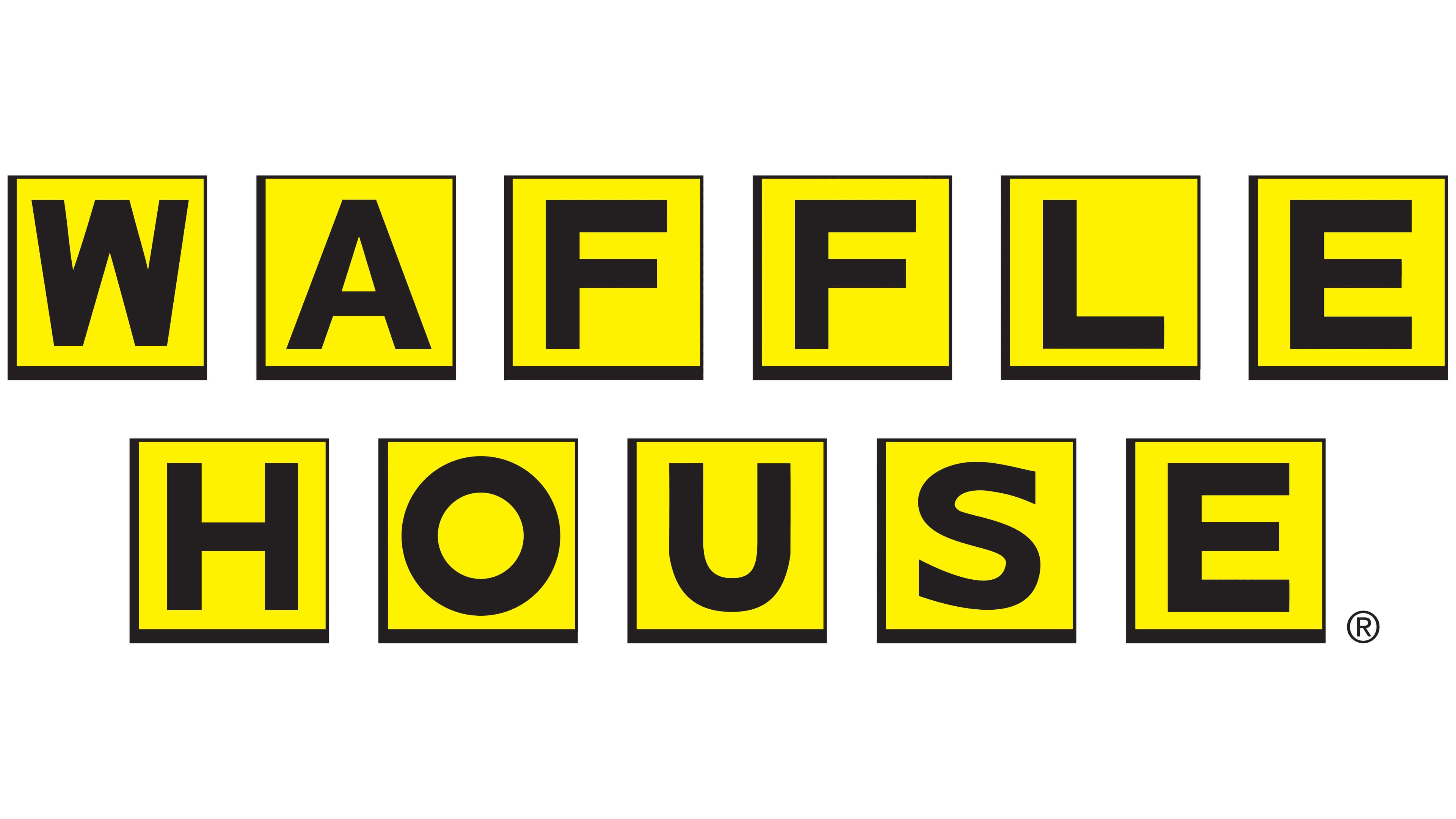
The primary brand emblem features eleven yellow squares with dark outlines, creating a sense of depth. Each rectangle contains a black letter: the first row spells “WAFFLE,” and the second “HOUSE.” Both words are written in capital sans-serif letters and are center-aligned.
Although the logo resembles Scrabble letter tiles, it’s unrelated to the board game. Instead, it’s a stylized representation of a waffle’s surface imprint. This brilliant design not only showcases Waffle House’s primary product but also conveys the restaurant’s friendliness and warmth.

The brand has an additional icon with the initials of its name: “W” and “H.” They are diagonally placed inside a yellow circle with a double black border. The monogram is also colored black. The italicized font with long, slender serifs embodies speed, which is crucial for customer service in fast-food establishments.
Font and Colors
The logo features a bold typeface with geometric contours characterized by smooth, precise lines and simple character endings. It appears modern and confident, resembling well-known fonts such as Wendy’s Waffles or Galaxie Polaris Heavy. Certain letters have unique features that distinguish them from similar styles.
The yellow-and-black color scheme was introduced by the company’s founder, Joe Rogers Sr. His idea was to evoke associations with the familiar colors of a school bus, making the design noticeable and easy to recognize. Another version links the color choice to his son’s university, though this is not factually accurate.

Thanks to the brightness of yellow combined with deep black, the emblem appears friendly yet assertive, clearly conveying the company’s identity without unnecessary elements or complexity.