


 Balenciaga Logo PNG
The emblem demonstrates an unusual approach to creating fashionable looks. The Balenciaga logo breaks all stereotypes about what beauty and style look like. The elements allude to the connection between past and future from which the house’s collections are born.
Balenciaga began with Cristóbal Balenciaga, born in 1895 in Getaria, Spain, to a fisherman and a seamstress. He learned tailoring from his mother and, as a teenager, reproduced a dress for the Marquise de Casa Torres, who later supported his training. In 1919, he opened his first boutique in San Sebastián. The business expanded to Madrid and Barcelona, working under the name Eisa and serving the Spanish aristocracy and the royal family.
The Spanish Civil War forced him to close his stores. In August 1937, he opened a house in Paris on Avenue George V, entering the center of haute couture. After World War II, his influence grew. In 1951, he introduced a looser silhouette, in opposition to Christian Dior’s 1947 “New Look.” Designs such as the tunic dress in 1955, the sack dress in 1957, and the empire line in 1959 reshaped fashion.
Clients included Audrey Hepburn, Grace Kelly, and Jacqueline Kennedy. Coco Chanel described him as a couturier among dressmakers. In May 1968, Balenciaga closed his Paris house. He died in 1972, and WWD marked the moment with the headline “The King is dead.” Jacques Bogart acquired the brand in 1986. In 1997, Nicolas Ghesquière became creative director and repositioned the house.
In 2001, Kering acquired Balenciaga, adding it to a portfolio that included Gucci, Saint Laurent, and Bottega Veneta. Alexander Wang led the brand from 2012 to 2015. Demna took over in October 2015, introduced streetwear references, and later revived couture in 2020. A 2022 campaign controversy affected the brand’s image. In 2025, Demna left, and Pierpaolo Piccioli was appointed.
Meaning and History
Balenciaga was not a high-fashion house, although many call it that. It was not a Parisian organization, Chambre Syndicale de la Couture Parisienne, a member because its owner broke all the rules and firmly refused to comply. Cristobal was outraged by the copying of his original ideas: he believed Christian Dior was stealing his cuts and silhouettes.
The greatest couturier ended his career in 1968 as if anticipating his imminent death, a fact that came as a complete surprise even to the company’s employees. The House of Balenciaga was inactive until 1986. It resumed operations only after it became part of Jacques Bogart S.A. A little later, Kering Holding bought it.
Unlike clothing, Balenciaga’s logo has never changed during Cristóbal’s lifetime or since. The new owners were in no hurry to experiment with the identity: they kept the original wordmark and changed only the font.
What is Balenciaga?
Balenciaga is one of the world’s most prestigious fashion brands. It has helped popularize natural leather and lightweight fabrics, offering many innovative design solutions. The brand dates back to 1919, when couturier Cristóbal Balenciaga opened his first boutique in Spain. Today, the French corporation Kering owns the fashion house, along with Yves Saint Laurent, Alexander McQueen, and Gucci.
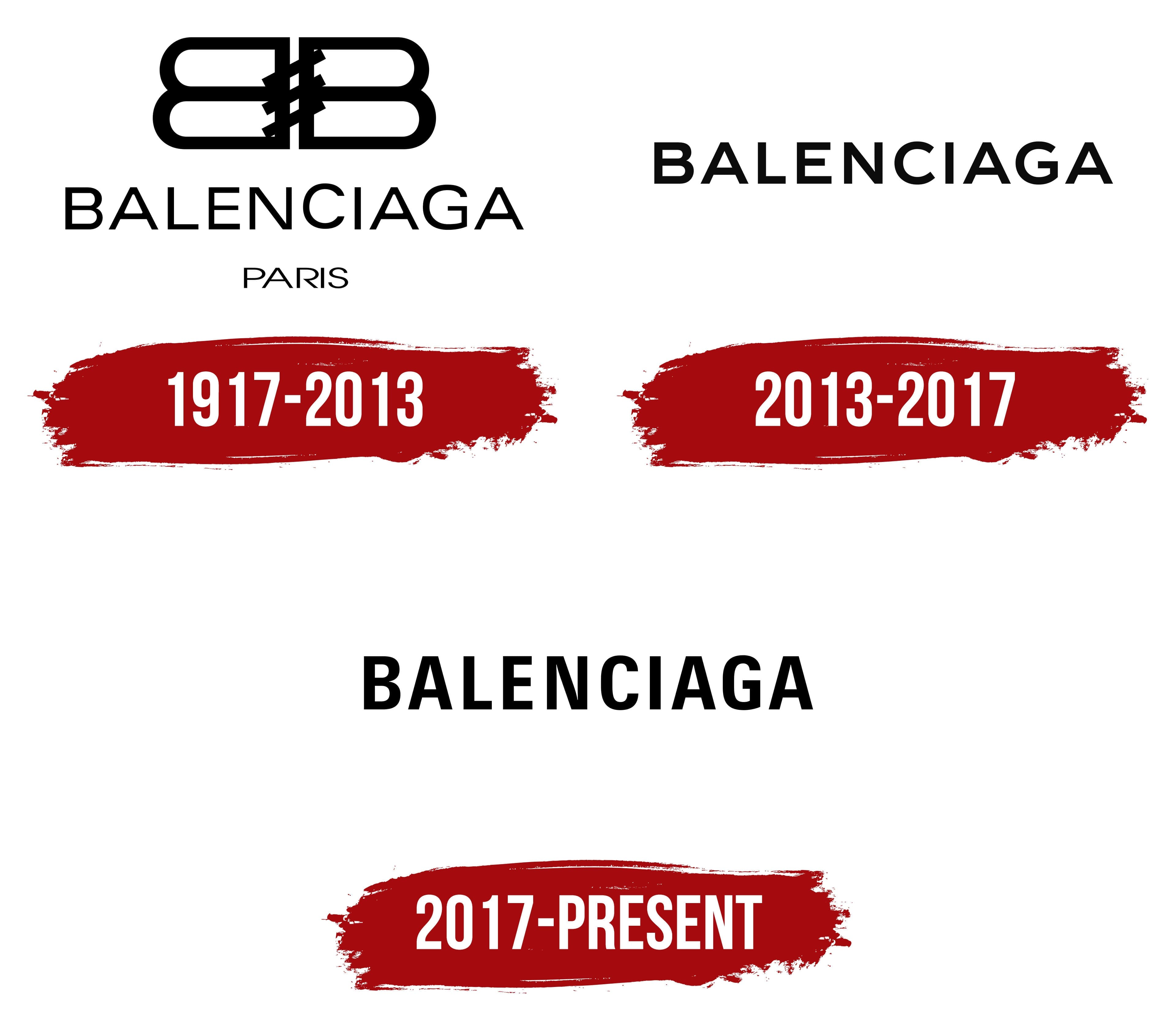
1917 – 2013

One of the first emblems contained two capital letters, “B,” facing each other with flat sides. Three parallel diagonal lines connected them, resembling stitches that held the garment together. At the bottom was the brand name in black sans-serif letters. Below that was the word “PARIS,” indicating the fashion house’s location.
2013 – 2017

The company that bought the Balenciaga trademark ditched the trademark monogram. She used only the wordmark and made the font bolder.
2017 – today

After another update, the letters were squeezed at the edges. Changing the proportions didn’t affect the style, because nothing else changed. The logo’s creators tried to modernize the design while keeping it recognizable.
Previously, Balenciaga used a traditional mark consisting of two letters, “B.” Diagonal lines symbolized the stitches connecting the fabric pieces. Now, the brand no longer uses this monogram. The owners limited themselves to a short inscription without additional graphic elements.
Font and Colors

Balenciaga’s typography comes in a variety of fonts. One of the earliest versions was an analog of Urbano Expanded from FontSite Inc. The typeface resembled Bw Modelica Expanded Bold from Branding With Type and Ultine Normal Demi from Insigne Design. The modern wordmark is set in Utah Condensed Bold, inspired by lettering on public transport. Designer Demna Gvasalia slightly changed it to better fit the fashion house’s logo.
The color scheme, in turn, was not so varied. It always contained black in the foreground and white in the background. A simple combination emphasizes the brand’s aristocracy and good taste.