


 Colorado Rapids Logo PNG
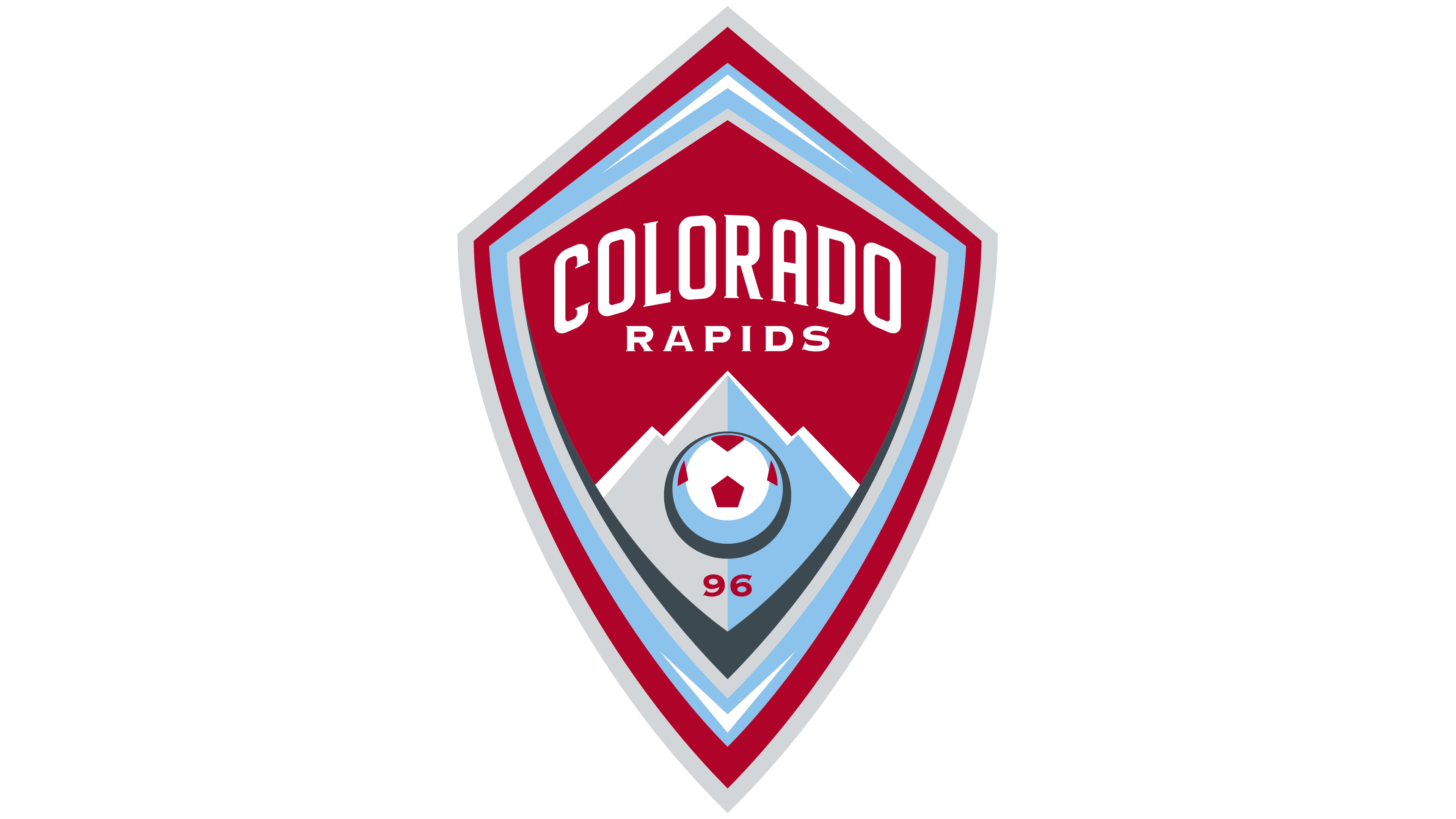
The Colorado Rapids logo features the Rocky Mountains and a heraldic shield, emphasizing the club’s connection to the region’s natural beauty. The mountain silhouette reflects Colorado’s spirit and strength, known for its landscapes and active lifestyle. The symbolism reflects the team’s unity with Denver and its fans, who see football as part of local culture.
The Colorado Rapids were founded on October 17, 1995, as one of the ten original Major League Soccer clubs under Anschutz Corporation, led by Philip Anschutz, part of an effort to build professional soccer in the United States.
Their first match came on April 13, 1996, a 0–3 loss to the “Kansas City Wiz”. The debut season ended last in the Western Conference despite the presence of Marcelo Balboa, Chris Henderson, Roy Wegerle, and Chris Woods. Balboa scored the club’s first goal.
In 1997, head coach Glenn Myernick and GM Dan Counce reshaped the squad. Rapids reached the MLS Cup final after playoff wins, including Henderson’s bicycle kick, but lost 1–2 to D.C. United.
In 1999, the team reached the US Open Cup final and lost 0–2 to Rochester Raging Rhinos, the last non-MLS team to win the US Open Cup. In 2000, Balboa scored a bicycle kick named MLS Goal of the Year.
In 2003, the club was sold to Stan Kroenke, who also owned Kroenke Sports Enterprises, which owned the Denver Nuggets and Colorado Avalanche.
In 2007, the Rapids moved to Dick’s Sporting Goods Park and adopted burgundy as their primary color, even as on-field results declined.
In 2010, under Gary Smith, the Rapids finished fifth in the West but won the MLS Cup on November 21, beating FC Dallas 2–1 in extra time after George John scored an own goal off a cross from Macoumba Kandji.
After 2010, Connor Casey and Omar Cummings left, leading to a rebuild. In 2016, Rapids reached the Western Conference final but lost 1–3 to Seattle Sounders.
In 2024, the club beat Real Salt Lake 3–2 to win the Rocky Mountain Cup. In April 2026, Rapids announced a crest redesign, keeping the name and burgundy color after a fan vote with over 5,000 participants.
Meaning and History
What is Colorado Rapids?
It is a professional soccer team from the USA that competes in the Western Conference. It is one of MLS’s founding teams. The club was established in 1995 and played its first game in 1996. In 2010, the team won the Major League Soccer Cup. Kroenke Sports & Entertainment owns the team.
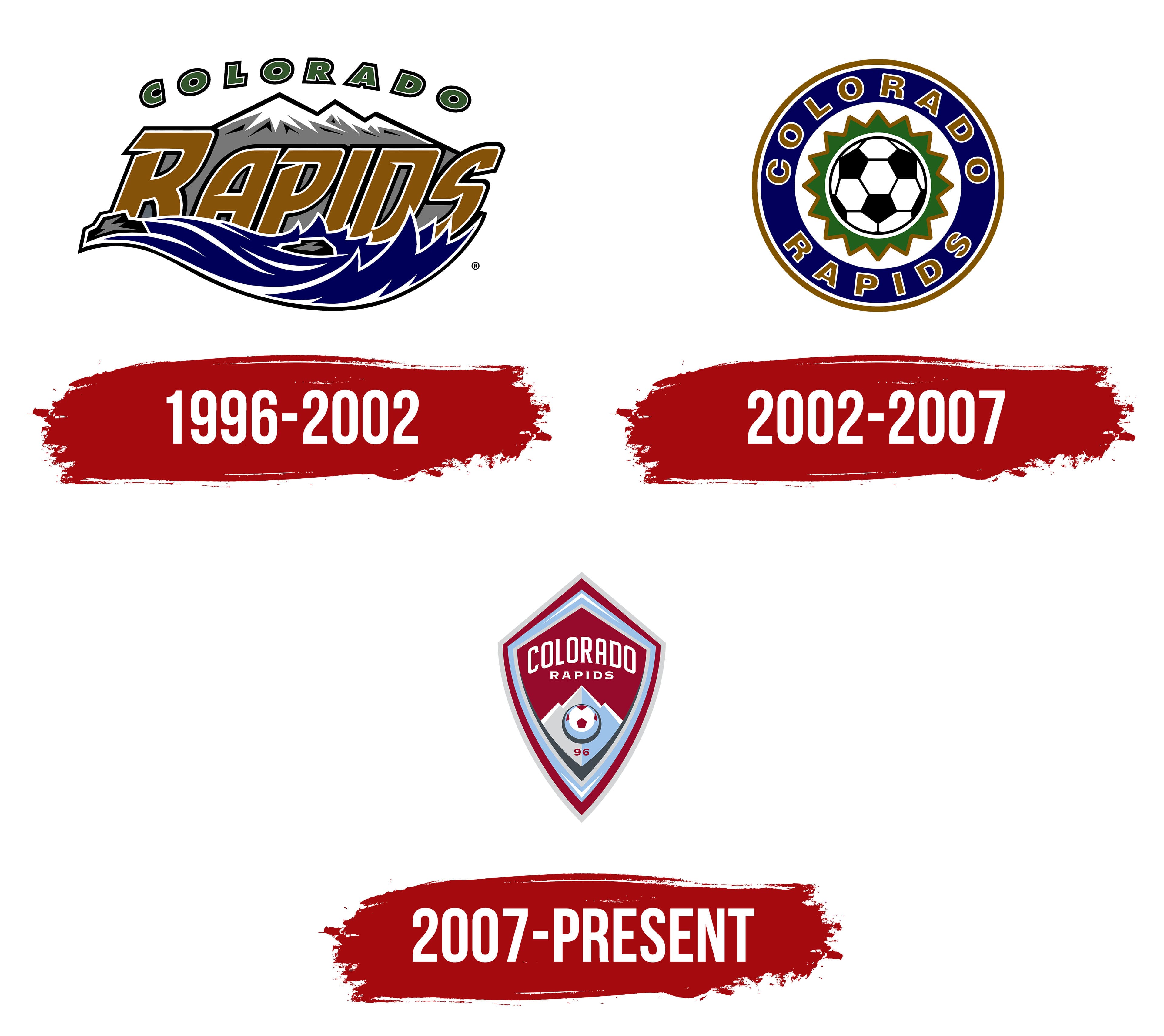
1996 – 2002
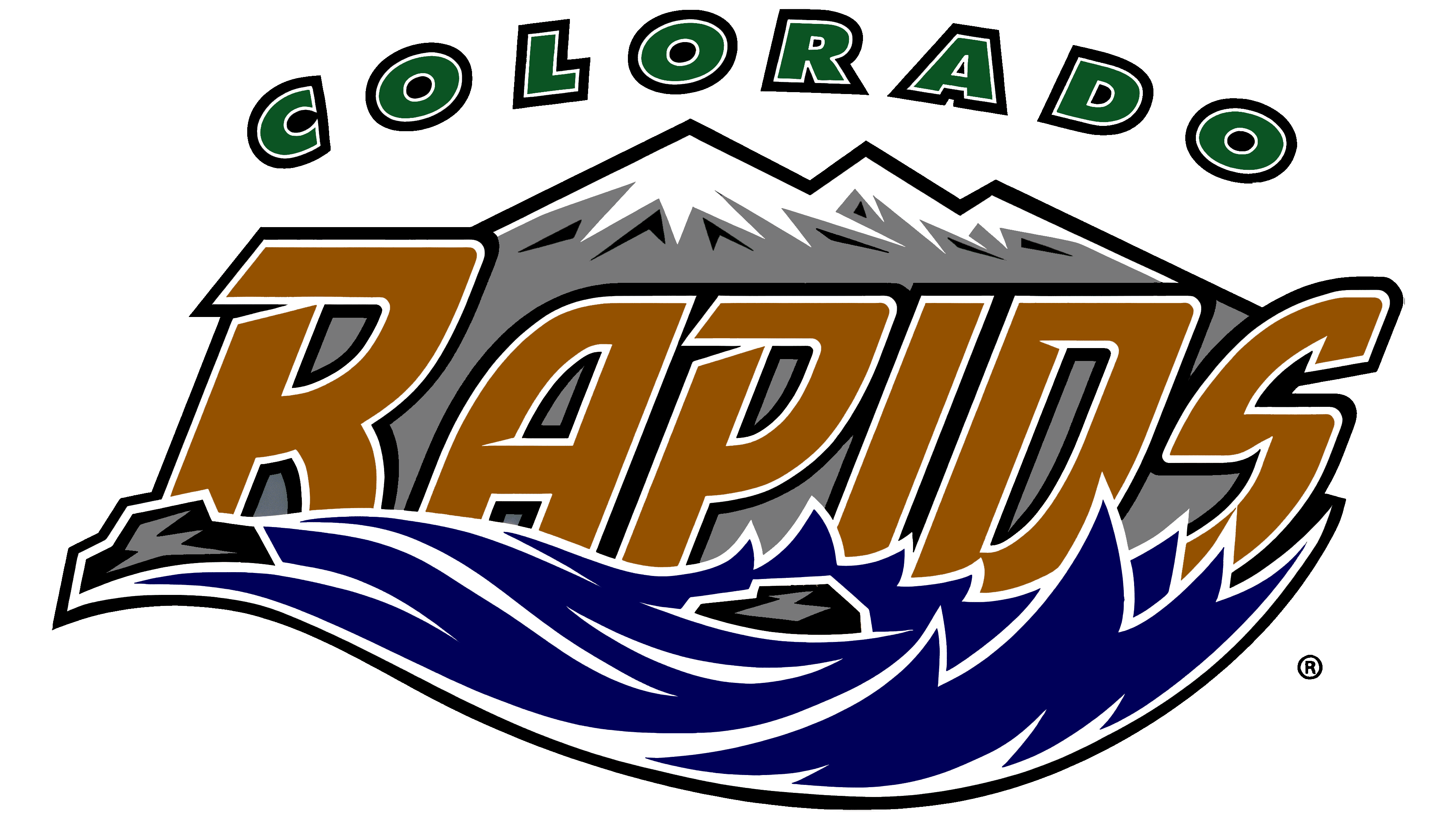
The Colorado Rapids emblem reflects the region’s natural context and draws inspiration from the Rocky Mountains. The symbol’s core is a mountain-range panorama that divides water flows heading toward the Atlantic and Pacific Oceans. In the lower part of this natural system, a turbulent stream forms, which the designers interpret as one of Colorado’s most challenging river rapids, strengthening the club’s connection to the region’s rugged geography.
The composition is layered, combining natural motifs with sports typography. At the top, the word COLORADO is placed along an arc. The green letters are outlined in white and black, forming an arch above the mountain range.
The mountain range is rendered in a generalized way. Thin black lines define three peaks with white snowcaps and gray slopes. The mountains serve a symbolic role, pointing to the club’s geographic origins and its link to the regional landscape.
The name RAPIDS occupies the main part of the image. The brown letters with double outlines feel heavy and convey force and speed. The typography is athletic and slanted, visually echoing Impact and Compacta Bold Italic. The lower portions of the letters are immersed in the water flow.
The lower area of the emblem is filled with a water image. Uneven blue bands with white strokes depict foam and surface highlights on the stream. Two gray-black stones with sharp edges sit among the waves, adding tension and emphasizing the river’s dangerous nature.
2002 – 2007
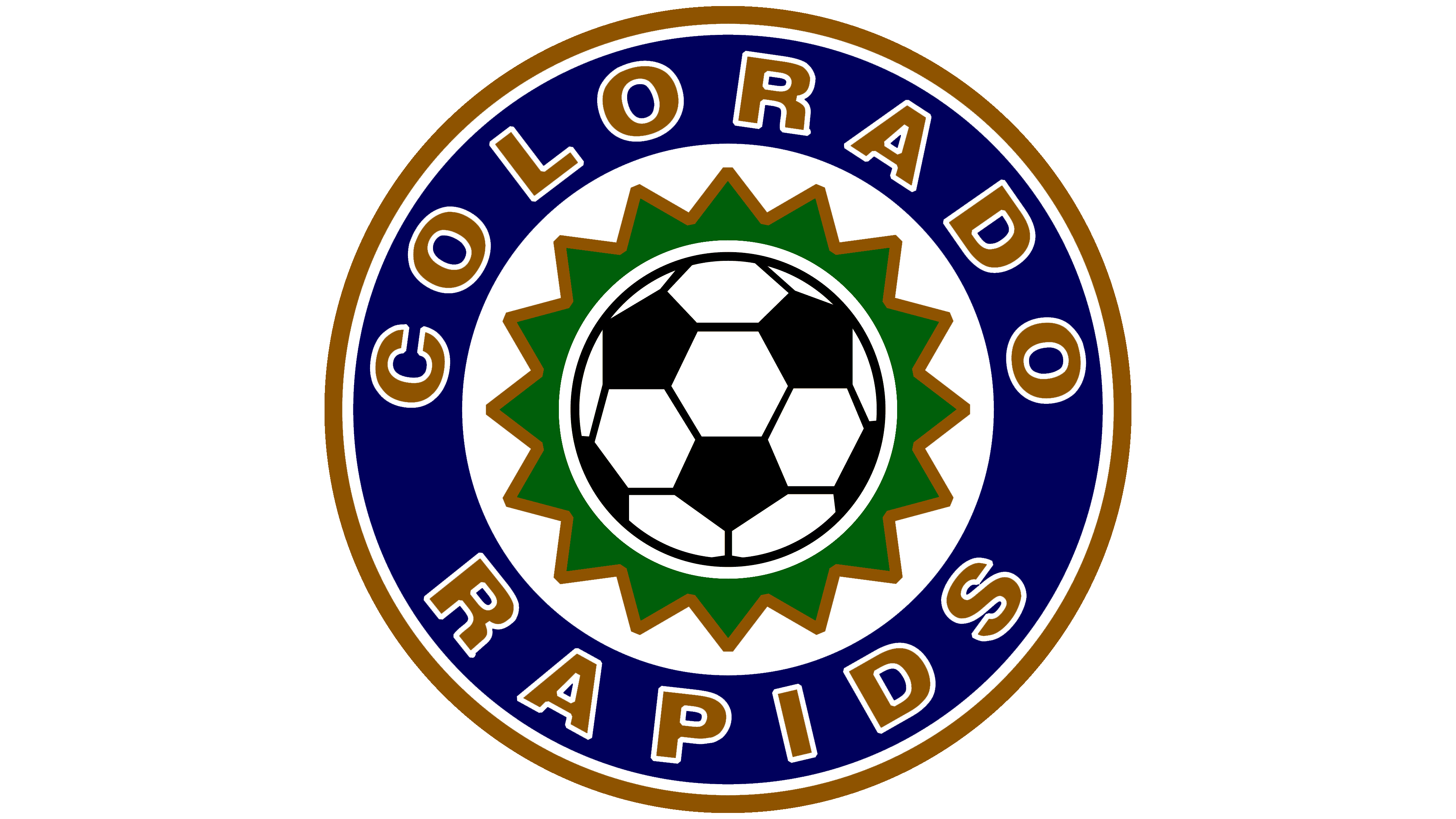
In 2002, the Colorado Rapids introduced a new version of the club logo, moving away from a rushing river image in favor of a more classic soccer symbol. A circular emblem emerged, featuring a ball set within a jagged shape reminiscent of a sun disk.
At the center is a soccer ball with the familiar black-and-white hexagonal pattern, outlined by a thin line. A green star-shaped figure with sharp rays encloses it, resembling a stylized sun.
The mark’s outer level is built on concentric circles. First, a white band serves as a transition layer between the center and the text. Next is a blue ring bearing the team name. The upper section reads COLORADO; the lower reads RAPIDS. The letters are large and geometric, brown with white outlines, arranged along an arc that follows the circle. The lettering references strict sports typefaces, such as Futura Bold and Franklin Gothic. A thin brown line finishes the outer boundary, bringing all elements together into a single contour. This version of the emblem marked a shift in the club’s visual priorities, pushing natural motifs into the background and bringing the soccer theme to the forefront as the identity’s primary foundation.
2007 – today

In 2007, Colorado Rapids entered a new phase. The club moved to Dick’s Sporting Goods Park and introduced an updated visual identity reflecting growing ambitions and a shift in scale. The emblem took the form of a heraldic shield with a diamond-like silhouette tapering downward.
The shield is constructed from several colored inner outlines. Gray, burgundy, and light blue alternate to form a frame, inside which sits the main field in a rich burgundy. At the top is an arched white inscription: COLORADO. Below it, the team name RAPIDS is set on a single line. The letters are compact, restrained in form, and visually balanced with the upper line.
At the center is an image of three mountain peaks, representing the Rocky Mountains. The middle peak is higher than the others, and the upper edges are marked with white areas resembling snowcaps. The mountain masses are vertically divided into color sections. The left side is gray, the right is light blue.
Between the peaks is a classic soccer ball, neatly integrated into the mountain shape. Below the ball is the number 96 rendered in burgundy. The nine sits on the gray half of the mountain mass, and the six on the light-blue half, referring to the year the club began competing in MLS.
The burgundy and light blue colors form an image tied to the Colorado Rapids’ sporting identity and geographic context.
Font and Colors
The core of the Colorado Rapids’ graphic symbol is the Rocky Mountains. They directly relate to the soccer club’s name, as “rapids” refers to the Colorado River’s cliffs, deep canyons, and rapids. That’s why, in the first version of the logo, the snowy mountain peaks were somewhat in the background, with blue water splashing in front of them.
When the team moved to a new stadium, designers removed the waves, and now the river is represented only by a blue diamond-shaped line. It mirrors the shape of the heraldic shield, which brings together all the logo’s elements. There are quite a few: apart from the mountains, the artists depicted a multicolored soccer ball, the number 96 (1996, the year of the Colorado Rapids’ debut), and the club’s full name, split into two lines.
The font of the word “COLORADO” resembles a modified Big Noodle Tilting with small serifs added. At least the letter “A” has a characteristic round shape and a similar position relative to the horizontal stroke. The inscriptions “RAPIDS” and “96” are set in Copperplate Gothic HV with increased letter spacing.
The emblem reflects the professional soccer club’s official colors. Initially, it was a dark shade of green. It was combined with white, gray, blue, black, and light brown. In 2007, the team updated the palette, choosing burgundy and sky blue as the primary colors. However, white and gray did not disappear from the logo; they just took up less space.